
Clean-Clear: Refuge, Bodhicitta and the Nature of the Mind brings together introductory teachings given by Lama Yeshe, who guides students in exploring the foundations of the Buddhist path with his characteristic warmth, clarity and wisdom. The teachings in Chapters 1–10 are from Manjushri Institute, England, in 1976, and those in Chapters 11–16 are from Maitreya Instituut in the Netherlands in 1980.
Compiled and edited by Nicholas Ribush, this is the second volume in a series of Lama Yeshe's collected teachings, following Knowledge-Wisdom: The Peaceful Path to Liberation.
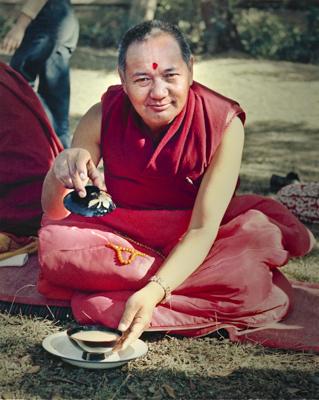
11. Tonight, My Subject Is the Mind
Now, the question is what is the mind, or consciousness?45 The Buddhist point of view is that the nature of the mind is clean clear and that the mind’s function is to discern the different realities of existent phenomena.
First of all, we have to understand the difference between mind and matter. Matter, like form and color, possesses substantial physical energy and can be perceived by the physical senses; mind is formless and colorless and is imperceptible to the physical senses. For example, we can’t describe somebody else’s mind by looking at it with our eyes. Buddhism says that’s impossible.
Another question now arises: if the mind’s energy is clean clear, why are we human beings confused? The answer is that consciousness is like an ocean and confusion is like the waves upon its surface. If we are capable, we can deal with the big waves like a skillful water skier, so no problem. The waves are still part of the ocean and their nature is still water energy. Similarly, the nature of the human mind is fundamentally clean clear, and the confusion and negativities are like waves on its surface. But although the delusions are still mind, they are not inherently one with the fundamental mind and can be separated from it.
Buddhism explains that the difference between the nature of the ego46 and that of the fundamental mind lies in the way they function. Because the mind’s nature is clean clear, it is indiscriminate when reflecting all phenomena, just like a mirror reflects anything before it; the clean-clear mind equally reflects good things and garbage. Another thing is that material phenomena are limited but the mind is not; it is beyond limitation. Of course, the mind has two qualities: relative and absolute. Relatively we discriminate that-this; the absolute nature of the mind is free from the limitations of the that-this reality and way of thinking.
The clean-clear nature of the human mind has existed since we were born. Western psychology says that children have fewer problems than adults but as they grow their ego gets bigger and bigger and their problems increase accordingly. Buddhist thought is similar. As we get older our delusions multiply but the clean-clear nature of our mind remains untainted by them. Its nature has always been clean clear, is clean clear now and will always remain clean clear. That is the fundamental Buddhist philosophy of mind.
What happens is that our basically ignorant ego keeps making wrong judgments and developing mistaken concepts such that we build up escalating fantasies about the way in which the world exists, the way in which we ourselves exist and the way in which others exist, more and more and more, until we live in this tremendous fantasy world and end up in even greater confusion, suffering and dissatisfaction. All because we cannot just let go and leave things as they are. Our ego intelligence works to make everything complicated. That’s its nature.
I’m sure you’ve all heard of the dualistic mind. This is how it works. If you see somebody wearing yellow, your reaction is to look for something red; if you see something red, you start looking for black; on and on like this. This is the nonstop, contrarian nature of the ego and the dualistic mind. As I mentioned, the ego has its own kind of intelligent wisdom, but the result it brings is continued rebirth in samsara, the cycle of existence.
For example, from the time we were born we’ve been doing all these different things, different trips, in our endless quest for satisfaction. But we never find it. We’re never satisfied. Every time we try something we think, “Maybe this new thing will make me happy,” but again, all it brings is more confusion. All these new trips are, in fact, old ones. Still, the ego tries to find happiness in all these different ways.
So you can see, the mind is not only the source of confusion and suffering but also the source of happiness, liberation and enlightenment. Mental energy is the same, but when it goes in a negative direction it produces tremendous dissatisfaction and when it goes in a positive direction it produces liberation and enlightenment. Therefore it is extremely important to understand the reality of the mind. Without that knowledge there’s no way to attain eternal satisfaction.
However, we do have the ability to curb our ego’s tendencies. That is the beauty of being human and why the Dharma teachings emphasize so strongly the preciousness of human life. It is the source of enlightenment, or buddhahood. The profundity of human qualities is why we should respect each other. It is only as human beings that we can cast off the heavy blanket of ego and understand and achieve totality.
Buddhism maintains that totality has always been with us, even when we were children. We don’t need to look for it somewhere up in the sky or out in space. The truth of totality has always been with us. Just as our legs, nose or head were not invented by religion or philosophy, neither was the totality of human consciousness. The totality of the human mind, or, to put it another way, its absolute purity, has always been with us.
Take, for example, the perpetually raining gray skies of Holland. Beyond the clouds is the clear blue sky. The nature of the clouds is not the nature of the sky; the nature of the sky is not the nature of the clouds. Similarly, the gray clouds of ego come and go but the blue sky of totality is always there. It’s always been there, it’s there now and it will always be there. The essential clean-clear nature of the mind is like the sky: always there. The heavy blanket of ego is laid on top of that but it is not inextricably mixed with it. It just gets thicker and thicker and we get more and more confused.
All this is quite simple to understand. You don’t need to be a big philosopher or a great meditator to get it. We’ve all been alive for a while so we’ve all had many life experiences. If you look back and recollect your experiences from childhood up to the present—how you felt about yourself, how you experienced your reality, how you felt about your parents and the world around you and so forth—you can laugh at yourself: at the way you experienced your feelings, the way you discriminated between things and the way you interpreted good and bad.
Here’s a good example. Since we were born our mindstream has unceasingly been with us but the surface waves of age, time, feeling and so forth have also been coming and going throughout the duration, shaking us each time they appeared. Nevertheless, our consciousness, our reality, our continuity has remained beneath it all. If you can understand how this works, you have the basis for becoming a good psychologist. Without examining your own life, your own experiences, your own view, your own feelings, your own discriminations, it doesn’t matter how much Buddhist or Western philosophy or psychology you learn, you’ll still end up miserable.
Consider Western psychologists like Freud and Jung. I’ve read a little about them and how their lives were confused and dissatisfied. One of my students is a Jungian psychologist from Los Angeles who attended a recent Kopan course. She returned to America to find that one of her colleagues had committed suicide and another, both psychologists, had had a nervous breakdown.
So it’s not enough that you have training in philosophy or psychology and spend your time looking at other people’s problems. If you don’t examine and understand your own limited, fantasy-creating ego and know how to treat it, you’re making your life difficult. The whole question is, we all want to be happy, none of us wants to be miserable, and the key to happiness is knowing the mind. That’s what’s important.
We always talk about liberation. Liberation means becoming self-sufficient. You don’t feel as if you are missing something, nor are you looking for something. You’re together within yourself.
One of the things I’ve encountered since coming to the West has been the problem of people taking drugs. Many of them would like to stop but just the intellectual idea that it’s bad isn’t enough for them to quit. It’s very difficult for them to do so if they haven’t recognized the reality of what’s happening in their mind. They, and all of us, would benefit greatly from studying the Buddhist teachings on mind and mental factors [Tib: lorig].
Most of the time we find it difficult to accept even the relative nature of what I am, who I am and how I appear. What our ego wants is a fantasy projection of ourself; it can’t accept the way we are. Right from the start we’re completely mistaken because our ego has projected a heavy blanket of fantasy over our true identity and the world at large, and it doesn’t want to accept the way in which we actually exist. We want to be something else and show ourselves as “this is me.” The heavy blanket of fantasy becomes our world and we take that projection with us wherever we go. In that way we end up in darkness.
According to the Buddhist point of view, the concept of ego begins with “this is me, therefore the world is that.” Also, the ego’s idea of “what I am, who I am” is a permanent conception. Ask yourself how you exist. You always think the way you were last year is the way you are now. You never accept the way you’ve changed. In other words, your intelligent wisdom is too slow. Your past reality has gone but your wisdom has not kept up.
As you can see, Buddhism places great emphasis on examining our own projection of who and what we are. When we do this and get a glimpse of our false view of the ego, we are beginning to touch reality. We do this through meditation, which allows us to abandon our preconceived ideas and stop our garbage thoughts. We have the ability to do all this; that is the beauty of being human. As we develop further we shed the heavy blanket of ego fantasy, and as our mind gets clearer we find more and more satisfaction, the experience of which leads to less dualistic flashing.47
Buddhism also talks a lot about suffering, however, the emphasis is not on physical suffering but mental suffering and conflict, which is the more painful. In the West there may not be so much physical pain and suffering but there’s a great deal of mental conflict. You can see that. Confused philosophies and doctrines abound and as a result there’s a great deal of social disruption. “This is a good idea!” “That is a bad idea!” All this brings pressure, pain and insomnia to the population at large. Meanwhile, the poor people of the East are relaxed during the day and sleep well at night. These are simply my own observations: I’m comparing the minds of people in undeveloped countries with those of the sophisticated people in the developed world. They’re different. Mentally, many Westerners are suffering because they just can’t cope with the stresses of modern life and social change. You can see that. Anyway, there are advantages and disadvantages on both sides.
My point is that the dualistic mind is painful in nature and is the source of dissatisfaction. It’s always engaging in nonsensical conversations with itself: “That-this, that-this, that-this. . . .” We think all this mental cogitation is so important but actually it’s of no value whatsoever: deluded, fantasy-ridden inner dialogues about an illusory world that has nothing to do with reality.
A good example is the way nonreligious Westerners frequently criticize religious people as deluded. “You believers are so misguided. I don’t believe in anything, so I’m much happier than you.” Of course, they are totally wrong. It’s all ego. That belief itself is also a fantasy, as if the person who does not accept religious philosophy is perfect: free from the dualistic mind and ego. From the Buddhist point of view, as long as we’re confused about reality we need religious philosophy, doctrine, ritual and so forth. Once we have gone beyond confusion we can say goodbye to religious rituals, books, symbols and the rest. We no longer need them.
Furthermore, once we discover the totality of human consciousness we don’t even need words. Most words come from the dualistic mind. Even my garbage words come from my dualistic mind.
The way our ego functions is not something we learn from religion and philosophy. Even as little babies, every time we cried we were expressing that we had an ego problem: “I want to be happy, therefore I’m crying.” Seeking pleasure and not desiring suffering is not some kind of philosophy we learned from religion. Simply by being born human we were already confused and possessed that kind of philosophy.
When we understand that our situation under the bondage of ego is merely relative and that our fundamental human qualities are beauty, purity and totality, we will begin to respect ourselves. We will realize that our life is worthwhile rather than thinking, as some people do, “I’m worthless; I ought to kill myself.” That understanding—that others also share our situation—leads to the development of love and compassion. If we don’t understand our ego’s false view, even if we say, “I love you, I have compassion for you,” it’s not really true. It doesn’t work that way. It’s totally transactional, like we’re selling our love and compassion to somebody else. It’s not true love; it’s not true compassion. If, on the other hand, we can come to know the entire evolution of our own psychology, then we will really begin to experience true satisfaction.
So, in conclusion, what I’ve been saying is simply that all of us human beings have to recognize the profound nature of our own consciousness and it’s our own mind that is the source of all happiness, liberation and enlightenment. Conversely, if we continue allowing our mind to go in a negative direction, it will only lead us to further misery and confusion. That’s the main idea. As far as the ego is concerned, it projects an ignorant image of ourselves and others, and all kinds of confused and suffering trips spring from that. That is the main point.
Now, if you have any questions about this or anything else, please ask and I will try to answer.
Q. Can you please say a little more about your thoughts on Western psychology.
Lama. Well, as I said before, I have read a little about Freud and Jung, and when I looked at their lives they appeared to be tremendously dissatisfied and confused. My point is that to become a good psychologist, the most important thing you have to do is to first recognize yourself as a patient and try to solve your own ego problems by understanding how your ego functions in everyday life, how it’s related to your grasping at sense pleasures, how it causes misery and so forth. That’s the way your training should begin. Otherwise you can finish up like those two Los Angeles psychologists I mentioned before.
Q. But even if psychologists can’t completely solve their own problems, can’t they still be of benefit to others?
Lama. Yes, they can be, but I’m saying if you don’t solve your own problems and still try to help others, you’re just projecting your own ego fantasies onto the people you’re trying to help. You can spout intellectual theories, but to really help others you have to manifest what you are. And if you don’t have a healthy mind, instead of becoming a good example you become a bad one; you become an example of a person under the control of their dualistic ego. Like the psychologist who killed himself. What he was presumably telling his patients had nothing to do with what he was. Such a person can maybe help with some problems but can also produce others. I’m not saying that they’re bad and I’m good. My main point is that a good psychologist should first be satisfied with their own life and responsible for their own reality, and if they have that organic satisfaction, then they can really help others.
Q. How can I tell if you are free from problems?
Lama. Me? I’m not free of problems. I know I have problems. That’s why I became a monk!
Q. Are you are saying that because the root of our problems is the failure to recognize the nature of the mind, Western psychologists, with their egos intact, are not really helping others since they haven’t resolved their own issues?
Lama. Well, I’m not quite saying that. They can help some. Every philosophy, every religion has good qualities. In fact, Buddhists are not permitted to criticize other religions. I would say, however, that psychologists can help to a degree but they can’t completely solve all problems. One thing is that their fundamental philosophy—and therefore their psychological practice—is based on the limited idea that people have only one life. So they can’t relate to the fact that people’s symptoms have developed over vast periods of time and many previous lives. What a patient is presenting with may have nothing to do with their present life’s experience. The ego is beginningless and people are already born with deep, profound ego problems. Most psychologists would be too scared to offer that kind of explanation for a particular patient’s symptoms.
Let me tell you a story. One of my nuns at Kopan is a Jewish woman from New York. One day she went back to Brooklyn to visit her family. Her mother thought she was completely psychotic becoming a Buddhist nun and convinced her to go see a psychiatrist. His solution was that she should buy an expensive car. It’s true! I’m not embellishing this story, I’m just reporting what I was told. But before she left America for the East she’d already owned a big car and everything else. She thought the doctor himself was confused and that he should in fact become her patient! I’m not saying that people shouldn’t buy big cars. That’s kind of a normal thing in America. Owning a car is no big deal. It’s so easy. Just pick up the phone and say, “Bring me a big car!” So, that’s Western psychology for you.
Q. You’ve been talking about how to solve the problems of ego. Did I hear you correctly when you said the solution was to become a monk?
Lama. No. That was just my solution.
Q. Then how do we eliminate the ego?
Lama. We eliminate the ego by seeing its false projections, the fantasies it projects. At the moment our ego is bigger than Mt. Everest, but when we see through it it’s like a cloud. Our view completely changes. Here I’m talking about the experience of transcending the ego. At present we have built up our fantasy projections of ourselves and the world such that they’re greater and more solid than a huge mountain, but if we see that that is a false view of reality, it suddenly opens up and some kind of clean-clear space and time appears.
Q. When you became a monk was that the end of your ego?
Lama. No. If it had ended, I wouldn’t be able to communicate with you.
Q. So you still have problems?
Lama. Of course. I’m not saying I’m a buddha, that I have no problems. Don’t misunderstand me. All I can say is that I’m a hardworking monk and that I’m trying my best.
Q. Perhaps, then, one way to overcome our ego is to accept our problems?
Lama. Yes. In one way, you’re right. I’m very happy that you have brought this up. First, we have to recognize our false conceptions and by doing so we begin to touch reality. Most people don’t want to admit they have ego problems. That denial itself is part of the ego’s game. Husbands don’t want to admit to their wives they have an ego problem; wives won’t tell their husbands they have an ego problem either. Ego intelligence is very tricky. Even if we try to solve our problems it can get difficult. We try to talk it out but it devolves into just another ego trip and simply produces more confusion.
Q. Can Westerners get enlightened just as easily as people from the East?
Lama. Sure, of course. It’s absolutely possible. I’m sure it has happened. There’s no doubt. Buddhism believes that all human beings have the potential to attain enlightenment. There’s no distinction. But what I do sometimes talk about is what I find when I compare the two societies. These days I spend about six months in the East and six months in the West, and I find it very interesting to make these comparisons. Of course, there are problems everywhere, but different societal structures make for different problems. For example, physical problems seem to be more prevalent in the East, but I have just spent three months in America and my impression is that mentally, life there is incredibly painful. I feel that American people are really suffering. Everything there is so complex, so complicated, so mixed up. By contrast, Nepalese people don’t have that many problems; there’s much less pressure. They don’t have the anxiety of “What’s going to happen next month? What’s going to happen next year?” They just kind of take it easy and go with the flow.
I’ll be back East in a few days’ time and will catch up with my old friend, the Kopan caretaker, Chowkidar. He’s so laid back and leads a very simple, stress-free life. This is what I’m comparing American life to. I’m not saying that the East is better, the West is worse. But they’re clearly different. In the West we put so much energy into just this life: this life, this life, this life, this life, this life, this life, this life’s pleasure, this life’s pleasure. In the East, this life and its pleasure mean nothing. This life’s pleasure is unimportant, unimportant, unimportant, unimportant, unimportant, unimportant. You get the idea. I’m referring to the lifestyle. So on that basis different philosophies develop. You can see.
Q. But we do have to take care of both body and mind, don’t we?
Lama. Yes, we have to take care of both together. I think it would be greatly advantageous if people in the West were to take more care of their mind than they do. Society has given you a comfortable body, a comfortable life. If you could accept it without confusion and simply enjoy what you have, that would be best.
Q. It seems that psychology is something that happens only in the West and not in the East. Is it because Western society is based on Christian doctrine?
Lama. That’s a great question. However, there is psychology in the East because Eastern religion is psychology. Nevertheless, Western religions can also be psychology, but many of them are too authoritarian and cannot be questioned; you just have to accept what they say. To my mind, Christianity has great psychology within it, but perhaps that aspect of it isn’t really functioning these days and was not developed as it could have been.
For example, when I look at both religious and nonreligious Westerners, I see that many of the religious people have very healthy minds. One of the biggest problems that Westerners experience is the breakdown of their marriage. Religious Western couples seem to understand and accept each other better than nonreligious ones do and tend to stick together. This is just my observation. Nonreligious couples seem to think that marriage is not that big a deal and find it easy to walk out on it. So I feel that Western religion does indeed contain psychology.
Q. How can you say that when it’s based on only one life?
Lama. Well, maybe today Western religions talk about just one life, but in the past they accepted reincarnation and the continuity of lives. At some point such beliefs were banned and their adherents were burned at the stake. I’m sure you’re familiar with European history. If not, you’d better learn it.
Q. Is it possible to gain knowledge about the material world without using our physical sense organs such as eyes and ears?
Lama. Sure. Absolutely. Even though I’m sitting here and haven’t yet had time to go into Amsterdam city, I know what’s going on there right now and what’s going to happen. Himalayan yogis sitting in mountain caves can figure out what’s going on in the entire world better than people who use their sense perception to understand what’s happening. From the Buddhist point of view, sense perception is foolish. It always encounters obstacles no matter how much you use it. For example, we always perceive each other incorrectly. We never get the complete picture.
Some American students took me to Stanford University to see their linear accelerator, with which the physicists examine the movement of a single atom. In their experiments they took thousands of pictures and every time they got different results, which really confused them. Eventually they figured out that the difference was due to the observer, not the phenomenon itself, which sort of aligns with Buddhist theory. So that’s sense perception. It’s extremely limited. Experiences through the sixth sense, the mind, are much more reliable. In order to reach beyond sense perception, Buddhism teaches us to meditate on the five aggregates.48
Q. How do you know that reincarnation is real? Is it because that’s what you’ve been taught or because you feel it? And if you feel it, how do you feel it?
Lama. Well, I’m not going to discuss my personal experiences, but if you can remember when you were in your mother’s womb and understand that your present consciousness is in direct continuity with that, you can come to understand that it’s real. By recollecting that experience you’ll see that your consciousness has not arisen independently; that it is an interdependent phenomenon whose energy is linked to previous moments of mind. If you can see that, you’ll be able to extrapolate that understanding and apply it to previous lives. The way to approach this is to meditate on how your mind of a month ago is related to your mind today. Is there a relationship or are they unconnected? If you do this you will find they are the one continuity. Then go back further and further, and in that way you will discover the reality of past lives.
The problem is modern science. Scientists and people in general accept the limited brain, which has not enough room to contain all of life’s experiences. For Buddhism, there’s no problem. Consciousness is universal; unlike the brain, it has room for the entire universe.
Q. Can you please say something about dance as a human art form in both East and West?
Lama. Well, I can say something but I don’t know that much about it. Still, Buddhism does have religious dancing, which is an artistic way of demonstrating how the mind functions. The dancers wear various kinds of costume—wrathful, peaceful, miserable, satisfied-looking and so forth—reflecting different emotions found in the human consciousness, and we have a lot of respect for those dancers. As regards Western dancing . . . well, what can I say? I suppose it could be good as a means of expressing one’s humanity and balancing blocked energy. But I don’t think it can be explained as extensively as Tibetan religious dancing. Perhaps you can explain it to me.
Q. I think there’s more to it. I mean there can be different levels.
Lama. I’m sure you’re right. I can’t judge. I know classical dancing can be very dignified and some of it can depict realms of fantasy. It can be many things. The important thing is to make it symbolic of the human mind and to assist in its positive development. So I hope you make your dancing useful.
Now I have to stop, thank you so much. Good night.
Maitreya Instituut, The Netherlands 1980
Notes
45. Mind and consciousness are synonyms and are used interchangeably. [Return to text]
46. Simply put, the ego is the wrong conception of the self, the mistaken belief that “I am self-existent.” It is the basic delusion, the root ignorance from which all other delusions arise. [Return to text]
47. Lama uses this term to imply shiny object syndrome, where the dualistic mind is always attracted by new and exciting sense objects. [Return to text]
48. The psycho-physical constituents that make up a sentient being: form, feeling, discriminative awareness, compositional factors and consciousness. [Return to text]