
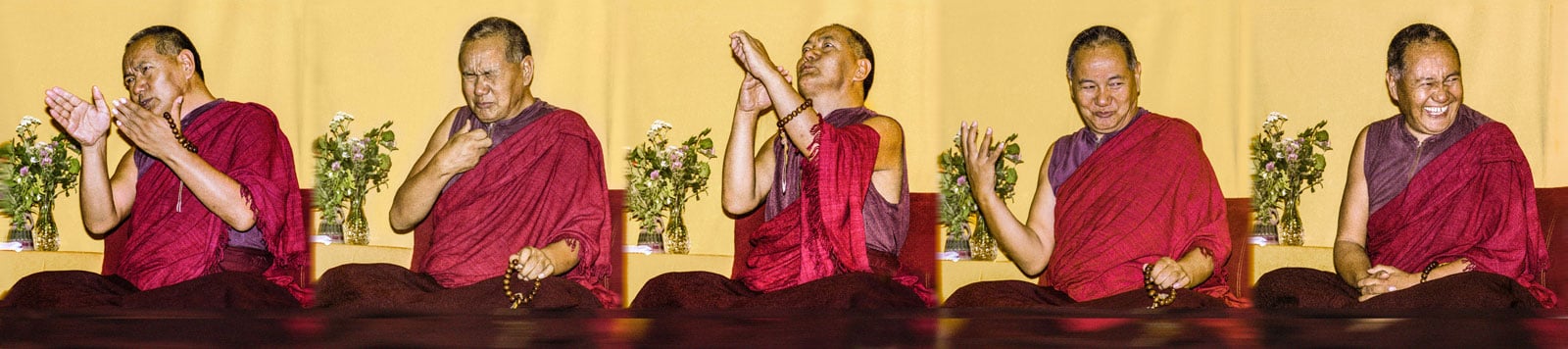
The Dualistic Mind
Lama Yeshe gave this teaching on the unsatisfied mind as part of a commentary on Maitreya’s Discriminating between the Relative and the Ultimate (Skt: Dharmadharmatavibhagakarika, Tib: Chö dang chö nyi nam che). This teaching from Madison, 1977, is published in chapter 15 of Big Love: The Life and Teachings of Lama Yeshe.

The entire subject matter of this work is included within these two terms dharma and dharmata: relative and absolute phenomena. In this work, the term dharma also means samsaric phenomena while dharmata signifies the phenomena of liberation, or nirvana. So in this context, what exactly is “dharma”? It is the dualistic mind. This is the superstitious mind that perceives a dualistic vision. As such, it is the cause of the uncontrolled, agitated life. And from this cause of the agitated life come uncontrollable sickness, uncontrollable death, uncontrollable rebirth and all other forms of uncontrollable confusion. All these samsaric phenomena come from one root: the dualistic mind perceiving the dualistic vision, what we may call namtog, or superstition. This is something we have to understand.
This work by Maitreya explains that the dualistic mind is always involved in some form of competition. This is a major characteristic of modern life, isn’t it? When we consider the Western way of life, and particularly American culture, everywhere we look we see competition; there is always some kind of contest going on. Take a simple example: the man next door buys himself an expensive car and, as soon as we see it, jealousy begins to arise in our mind. “He has such a good car, so big and comfortable. Where does that leave me? I’ll have to do something about that. I’ll get myself an even bigger car ....” As far as material progress is concerned, such a competitive spirit is good, but as far as our mind is concerned, it is not good at all. Why not? Because it only makes us more agitated and conflicted; this is the symptom of the dualistic mind. We call it dualistic because as soon as one thing appears to our mind we look around for something else to compare it with. That shows our dissatisfaction, the way in which we are always searching for something newer, something better, something else. This is the way our dualistic mind is; this is how it works.
This syndrome of the dualistic mind is true for everyone. It doesn’t matter whether you are a religious person or a non-religious person, Buddha’s teaching describes the way things are. This is not a religious trip we are talking about; it is not Buddha’s trip or some lama’s trip. Whether you are religious or non-religious, intelligent or dull, as long as you have a dualistic mind, conflict is always arising. Sometimes it appears on a gross, emotional level; sometimes it works on a subtle, unconscious level. But as long as there is the dualistic mind, there is some form of contradiction and conflict going on.
The dualistic mind is functioning within you right now, and if you just take a look it is easy to understand and experience how this mind is playing games with your life, games that only lead to misery. You can see just how this mind leads to restlessness, frustration and dissatisfaction. And when you release that dualistic mind, you are a buddha, or whatever you want to call that state of complete freedom. At that point you can call yourself a liberated lady or a liberated gentleman if you want to; it doesn’t matter. In short, the cessation of the dualistic mind is liberation, the experience of ultimate reality.