
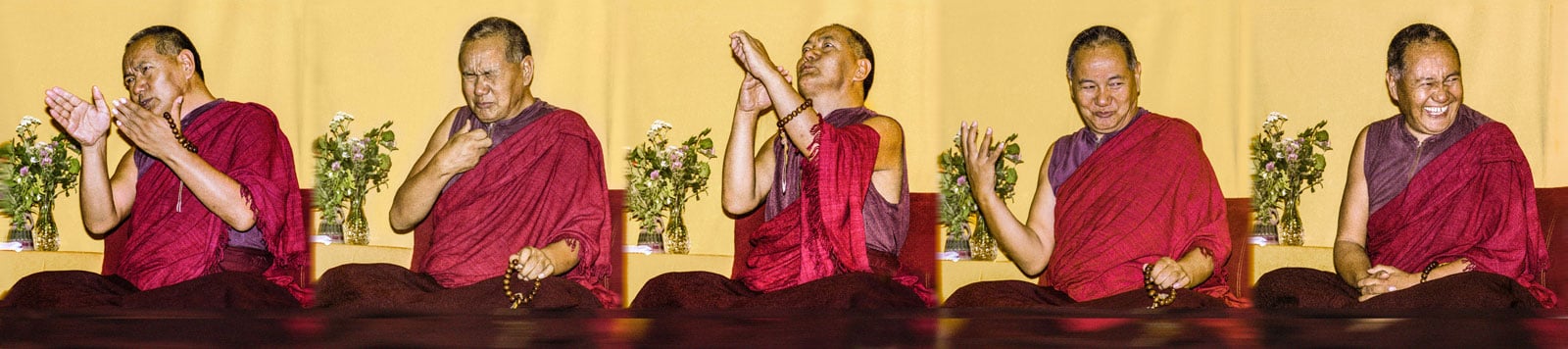
The Dharmakaya Experience
Excerpted from a series of teachings given from September to October 1979 at Chenrezig Institute, Australia. In this teaching, Lama Yeshe explains how tantric yoga uses the death process to meditate on the clear light experience. This teaching is published in chapter 17 of Big Love: The Life and Teachings of Lama Yeshe.

Vajrayogini is from the Highest Yoga Tantra category of tantra, which has two divisions: father tantra and mother tantra. Vajrayogini is from the mother tantra class. Mother tantra has the sensitive aspect of emphasizing great wisdom. In our astrological system daytime is associated with male energy and nighttime with female energy. Vajrayogini is the embodiment of female wisdom, and so to begin our practice of Vajrayogini at night emphasizes this female energy.
The whole subject of tantric yoga is included in two divisions—evolutionary yoga and completion yoga. We have a system: before a commentary is given on how to practice tantric yoga, first a teaching is given on taking refuge, actualizing bodhicitta and the Vajrasattva practice, guru yoga and offering the mandala. Most of you have already learned these practices during the teachings on the lamrim. For those who have not yet received the commentary on Vajrasattva and made that retreat, it would be good to do that in the future. We do have a system.
At this time we are practicing the evolutionary yoga method. The principal aspect of this is taking the three kayas into the present path of enlightenment. I am sure you have heard about the three kayas: the dharmakaya, the sambhogakaya and the nirmanakaya. The reason we do this is to purify ordinary death, intermediate state and rebirth, to make those vanish. This is the unique characteristic of tantric yoga.
Human beings have a gross level body and a subtle level body. We also have a gross mind and a subtle mind. Our gross consciousness is made up of our sense perceptions, but to understand our subtle consciousness is very difficult. There is a subtle, perpetually residing consciousness always existing within us from life to life, whether you are a buddha or a mosquito. That consciousness has a clean, clear character. When this consciousness is functioning you can always experience something similar to nonduality, or shunyata.
For example, when you meditate you almost stop breathing. As your breath becomes smoother you reach the point of being calm, clear and slowed down. In order to discover this subtlest consciousness we need deep penetrative concentration on the clarity of our own consciousness.
At the time of death the four elements [earth, water, fire and air] are absorbed and we experience the clear light nature of the mind. It doesn’t matter whether you are a meditator or not, you have this experience. This is because our sense perceptions have ceased to function and so the gross level of consciousness has disappeared. We gradually reach a point where the last thing functioning is the energy in the central channel. At that time the subtlest consciousness is able to function and the result is the clear light experience. Every ordinary death has that experience. So why do we need to meditate? Because ordinarily we aren’t able to comprehend that experience, we have no awareness of it and so it comes as a shock. In meditation, however, we take that ordinary death experience into the present path, which is the dharmakaya experience. In meditation we train the mind to use that opportunity.