
E-letter No. 273: March 2026

Dear Friends,
We hope you are safe and well. Thank you for subscribing to our eletter and for all your support and generosity during the Fifteen Days of Miracles earlier this month. This is an incredible community and we couldn't do anything without you!
In this issue, we're happy to share an interview with Lama Zopa Rinpoche from the video archive on the benefits of Universal Education. Our monthly podcast features Rinpoche’s commentary on Calling the Guru from Afar. You'll also find new teachings on our website, including teachings by Lama Yeshe excerpted from Big Love, newly added advice in Lama Zopa Rinpoche's Online Advice Book and details about an upcoming LYWA course. And please don’t miss this month’s featured teaching from the forthcoming The Yoga Method of Divine Wisdom Manjushri by Lama Yeshe. Read on to get the full scoop!
From the Video Archive: The Heart of Wisdom
This month from the Video Archive, Lama Zopa Rinpoche gives a talk discussing the great benefits of Universal Education. This talk was prepared for the participants at the Essential Education Conference held in London in 2005. Christina Lundberg filmed Rinpoche's talk in Aptos, California, on June 13, 2005.
Visit and subscribe to the LYWA YouTube channel to explore our complete video collection of teachings by Lama Yeshe and many from Lama Zopa Rinpoche, available from our archive. For many more videos of Lama Zopa Rinpoche's teachings, visit the FPMT YouTube channel.
ON THE LYWA PODCAST: Calling the Guru From Afar
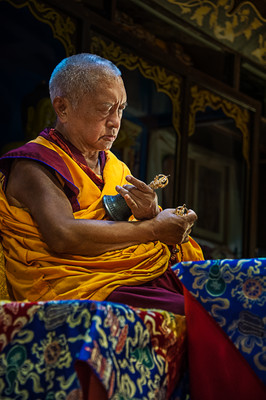
As you listen to the oral transmission, think, "May I be able to reveal each word to every sentient being and may they be able to actualize the path immediately in their mind when they hear it.”
—Lama Zopa Rinpoche
This month on the Lama Yeshe Wisdom Archive podcast, Lama Zopa Rinpoche gives teachings on guru devotion and a brief commentary on Pabongka Rinpoche's Calling the Guru from Afar during an oral transmission of the text in Singapore in April 1992. You can read along with the transcript on the LYWA website.
The LYWA podcast contains hundreds of hours of audio, each with links to the accompanying lightly edited transcripts. See the LYWA podcast page to search or browse the entire collection by topic or date, and for easy instructions on how to subscribe.
WHAT'S NEW ON THE LYWA WEBSITE
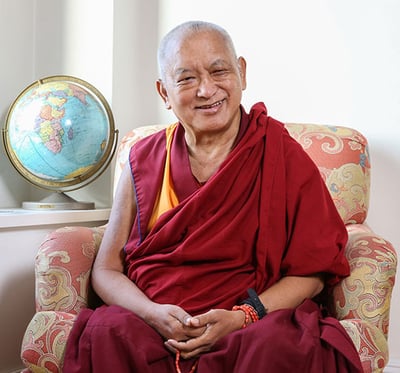
This month we've posted a new teaching on our website, Dharma in the Heart, which features Lama Zopa Rinpoche explaining that real happiness comes from patience and compassion for others, and that educating children in this way is critical for creating peace in the world. This teaching was given in Switzerland during Rinpoche’s tour of Europe in 2018. Visit FPMT's Rinpoche Available Now (RAN) for more teachings from this tour, with videos, audio recordings and transcripts.
We’re also happy to share that we added two new teachings from Lama Yeshe, excerpted from Big Love: The Life and Teachings of Lama Yeshe. In our first excerpt, The Dharmakaya Experience, Lama Yeshe explains how tantric yoga uses the death process to meditate on the clear light experience. In the second teaching, Transference of Consciousness Practices, Lama Yeshe explains the correct motivation required for powa, the practice of transference of consciousness at the time of death, and jangwa, a type of powa practice that can benefit a person or animal who died long ago.
Visit our Big Love Teaching Excerpts webpage, where you’ll find a growing selection of teachings featured in the book. The teachings are organized by chapters, with easy navigation links. Be sure to check back often, as we’re adding new content every month!
Don't miss the new entries we’ve added this month to Lama Zopa Rinpoche’s Online Advice Book. With more than 100 new pieces of advice published each year, the collection has now grown to over 2,600 entries on our website.
- Practices for Insects and Other Animals, Living and Deceased: Advice on various ways to benefit insects and other animals, including specific practices for ants, worms, birds, fish, and so forth.
- Preliminaries and Lamrim Meditation: Guidance on preliminary practices, such as offering water bowls, and on analytical meditation, using the perfect human rebirth as an example.
- Daily Mantras for a Meaningful Life: A student was encouraged to recite the Chenrezig and Medicine Buddha mantras every day, as this purifies negative karma, brings success and makes our life most beneficial for others.
You can always find a list of all the newly posted advices from Lama Zopa Rinpoche on our website. We are very grateful to LYWA’s wonderful editor Sandra Smith for editing Rinpoche’s precious advices and maintaining his Online Advice Book.
A Gateway to Liberation
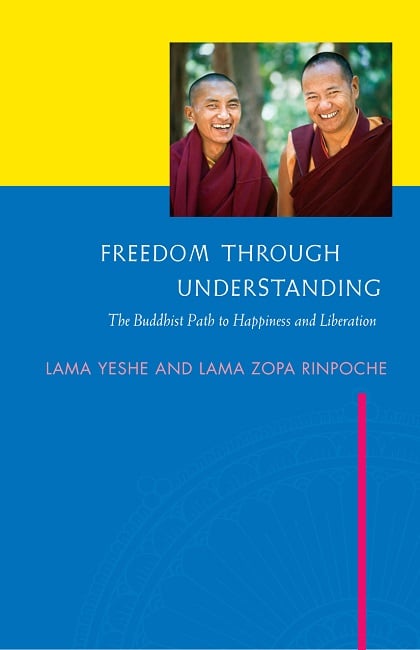
Buddhism isn’t some fanatical religious trip. It’s a philosophical way of living life. And also, to study Buddhism, you don’t need to believe in something extreme. It’s a matter of investigating, examining and experimenting on yourself.
—Lama Yeshe
This month we feature another staff pick, content and communications manager, Stacey Martin, shares: "One of my favorite LYWA titles is Freedom Through Understanding by Lama Yeshe and Lama Zopa Rinpoche. For me, the title says it all: the gateway to liberation is deep understanding. The teachings are clear and accessible, and guided meditations are woven throughout, including a chapter devoted to how to meditate. It’s a great resource for students at any level, as well as anyone curious about Buddhism."
We are also happy to share that later this spring, LYWA will launch the first in a series of easy-to-implement study programs based on LYWA publications. The first program focuses on Freedom Through Understanding and includes supportive materials for students and facilitators, plus archival video of Lama Yeshe and Lama Zopa Rinpoche. This new study program initiative is part of LYWA's strategic plan to support the FPMT community by enabling practical, accessible, and heartfelt engagement with the Lamas' teachings.
We’d love to hear your thoughts on Freedom Through Understanding or any of your favorite LYWA books. You can also help others discover LYWA’s free books by leaving a review on Amazon.
Thank you again for being part of this wonderful community. Your support is vital in helping us freely share the teachings of Lama Yeshe and Lama Zopa Rinpoche with both longtime practitioners and newcomers alike. I invite you to read on for a sneak peek at our upcoming Lama Yeshe title currently in progress.
Big love,

Nick Ribush, Director, and the LYWA team
MONTHLY TEACHING: Developing Omniscient Knowledge-Wisdom
(Note: this comes from Lama’s word commentary on the Manjushri sadhana following an initiation a few weeks earlier. Of course, it can apply to any deity.)
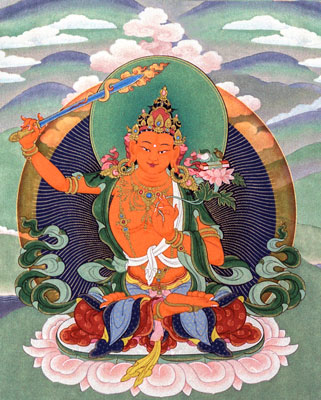
Before taking this teaching, please generate bodhicitta by thinking, “In order to attain blissful enlightenment I must actualize the profound Mahayana yoga method. To be able to do this, I must understand it. Therefore, I am going to listen to this teaching on the yoga method of Divine Wisdom Manjushri.”
Many Westerners seem to think that the responsibility for teaching and realization rests with the lama, as if he’s God. It’s like you can only trust and completely rely on God. You expect everything to come from God. That’s the way you’ve been brought up and educated since you were a child. Everybody’s taught you to be a believer. That’s not the way. That’s a wrong conception.
Actually, whether a teaching is beneficial or not depends on you, not on what the lama says. Therefore, the first thing you have to do when you’re at a teaching session is to check your motivation. Set as pure a motivation as you possibly can. At the beginning, you should be checking your own mind, not the teacher, the book or anything else. Is your mind a fertile, receptive field or a barren, rocky mountain? If you try to plant even the most expensive seeds on a rocky mountain, they won’t grow, even if you fertilize and water them really well. So, the expectation that God or the lama is going to do it all for you is an extreme overestimation; a complete misconception. To grow your own knowledge wisdom you need both the properly prepared field of your mind and the seed of the teaching.
Last time we were talking about the main body of the yoga method of Divine Wisdom Manjushri, the evolutionary yoga method of your becoming Manjushri.
Now, for this to work, you have to understand the process of how you become Manjushri. Otherwise you might think it’s the same as your becoming a concrete pillar. That, then, makes nonsense of the teaching. You should understand clearly the difference between your becoming Manjushri and your becoming a concrete pillar. If you can’t make that distinction, your understanding is completely zero and your ignorance is removing all the taste from this delicious, profound yoga method.
Last night, when I was talking about nang la rang shin me pa, I was trying to get across to you the right understanding of this process. Nang la means view; rang shin me pa means that the characteristic nature of the vision is simultaneously non-self-existent, just like a reflection in a mirror.
Tibetan lamas have many interesting methods to help them develop the right view. One is to set up a mirror to reflect the image of the deity in the thangka. Then they check out the difference between the appearance of the deity in the thangka and that in the mirror. You can see the difference. In the mirror, the form of the deity is there but it doesn’t have the concrete, independent, self-existent look of the original.
Similarly, the characteristic nature of the divine body of Divine Wisdom Manjushri is like the reflection. It’s very important that through experience you learn to recognize Manjushri’s form as a reflection in a mirror. That experience then explains to you the characteristic nature of all phenomena in the universe. This is infinitely more useful than studying, for example, the various life forms in the ocean, as scientists do. They try to discover how many different kinds of fish there are, what species they belong to, what their different colors are, what they eat and so forth. It’s a complete waste of time.
By practicing the yoga method, through understanding one phenomenon within yourself, you can understand the nature of all existent phenomena in the universe. Forget about “Oh, look at this fish; it’s different from that other one.” That way of learning is far too slow. You’ll never develop omniscient knowledge wisdom in that way. If you think the way to learn is to study all phenomena individually, one by one, you’re mistaken. If you try to do it that way, you’ll never even understand everything in this life, let alone develop an omniscient mind. It’s impossible.
When you practice the yoga method, you don’t need to look into the ocean and count the animals. Sitting in meditation, you can know everything about the ocean. The representative of all the ocean’s creatures is within you. One phenomenon within you represents all phenomena in the universe. The scientific way of learning is too slow. You gradually learn one thing; then you move on to the next. From my point of view, it’s impossible to gain omniscient knowledge-wisdom in that way. It’s a waste of time. Life is too short to discover how many fish there are in the ocean and what the body of each one is like. There are even too many human beings to study in that way. They’re almost numberless themselves. It’s like trying to touch everything that exists with the tip of a needle. You can never do it.
The Western way of learning things is like sawing wood with the blunt edge. It takes too long. It’s impossible to learn the characteristic nature of all universal phenomena that way. I’m not saying that learning itself is bad. I mean, just learning something about any existent phenomenon is good. But the Western scientific way is just too slow, that’s all. Through your practice of the yoga method, by discovering one topic—the great joy of blissful shunyata—within you, you gain knowledge of all universal existence.
My conclusion is that searching within yourself is much more important than searching externally: “Does this exist or not?” Spending your whole life in debate over whether or not this table exists is useless. Of course, it’s good to check to see if the table is self-existent or not self-existent but actualizing the yoga method within you is far more important. Once you have realized non-self-existence within you, you don’t need to spend more time in logical debate over whether the table is self-existent or not. You’ve already won the debate in your mind. You don’t ever again have to get hung up over, “Nepal is a small, slow country, it must be non-self-existent, but New York is a big concrete city, it must be self-existent.” That sort of mind can never arise again.
From The Yoga Method of Divine Wisdom Manjushri (forthcoming). Lama Yeshe gave this teaching at Kopan Monastery, Nepal, in February 1975. Compiled and edited by Nicholas Ribush.