
These teachings were given by Lama Zopa Rinpoche at the Third Kopan Meditation Course, October-November 1972, and the Fourth Kopan Meditation Course, March-April, 1973, held at Kopan Monastery, Nepal. Lightly edited by Gordon McDougall.
Visit our Kopan eBook Series page to read more about the Kopan eBook Project and to find links and synopses for all the Kopan ebooks published to date
9. The Delusions
[WFGS pp. 158–63]
THE SIX ROOT DELUSIONS: 1. ATTACHMENT
Attachment or greed1 (do chag) means being attached to a desirable object. Something is seen as intrinsically beautiful based on the mistaken belief in a truly existent self and a truly existent beautiful object. From that, attachment for the object arises.
The being with a subdued mind also sees beauty as we do but is not attached. We, however, are out of control, possessed by attachment. We see the object as beautiful and problems arise from our attachment. If there were no attachment, there would be no problems. In the same way, if there were no hatred, there would be no problems from ugly objects. Therefore, the renunciation of the negative mind brings perfect peace, not depending on external objects. For the fully renounced mind there are no problems with any object.
Although two people may be in one place, the being with the uncontrolled mind sees it as a hot, burning, suffering place whereas the holy being with the well-controlled mind does not, and has no suffering or problems. For the Buddha, objects that appear to the ordinary being as unpleasant, filthy and ugly become delicious, sweet and beautiful. The experience of objects for the ordinary being triggers different degrees of suffering or pleasure, but for the Buddha there is not one tiny suffering; it’s always the same. If we offer him even the most delicious nectar, which gives much pleasure, he experiences its taste and the taste of water as equal. All the experiences of the Buddha are in the nature of transcendental happiness, which are never the experience of our view. For the holy being, any ordinary place is seen as a pure land, a completely purified realm that can also become the mandala without differentiation. The Buddha always experiences the different objects, different foods and different views that we experience in such partial, biased ways as beauty, with transcendental happiness. This is due to having completely purified the mind and gained all the realizations. He always sees things in beauty and there is no attachment.
2. ANGER
Anger is a very powerful mind that exaggerates the negative qualities of an object, brings dislike and a wish to harm the object. Being an intense mind, anger can very easily lead to negative actions.]
3. IGNORANCE
[The third of the three poisons is ignorance. When we are ignorant, we walk about with our eyes closed. Ignorance is like a house without windows or doors, somewhere completely dark. Although there are many forms of ignorance, the two main ones are ignorance of the law of cause and effect—karma—and ignorance of the nature of reality—emptiness.]
4. PRIDE
Pride is the mind that has an inflated image of ourselves. For example, when we are angry, we feel that I am more important than anyone. We also feel that the body and the I are one, and that the five aggregates are “me.” We have a strong view of the self-existent I, that the body and mind are I, one entity.
With the sense of pride, we look down on others, as if from a mountain. Filled with pride, we can’t take anything in. Even when we listen to the teachings, it’s very difficult to benefit the mind. We might understand nothing, but pride stops us asking others to explain.
There is a similar reaction of being separate from others when we feel fear, but it’s hard to remember all this since we are unaware of our own experiences.
5. DOUBT
Doubt is usually based on being between two points of something existing and not existing, not sure which is correct. For example, we may have doubt whether the I exists or not, whether it is permanent or not. Or we may think that maybe the Buddhist path leads to liberation or maybe it doesn’t. Our uncertainty causes us to stumble. We become skeptical, which blocks us from practicing and therefore from attaining realizations. This is the greatest disturbance because it doesn’t allow us to follow the path to liberation. Doubt about whether something is true, such as positive karma being the cause of happiness, stops us from creating good karma.
6. THE FIVE WRONG VIEWS
[The last of the six root delusions is wrong view, which is often divided into five wrong views: the view of the changeable aggregates, the view of extremes, the view of holding wrong views as supreme, the view of holding moral and religious discipline as supreme and wrong views.]
In meditation, we should always check up on our delusions. For example, we should examine what we believe in and see whether it is an incorrect assumption or not. We should try to understand what this sense of I means and see how a belief in a truly existing I creates a duality between us and other and leads to negative actions that cause suffering. Seeing that the I is just a mere name we place on the ever-changing aggregates and that the inherent I, which doesn’t exist at all, is what needs to be eliminated, we can overcome all our obstacles to liberation.
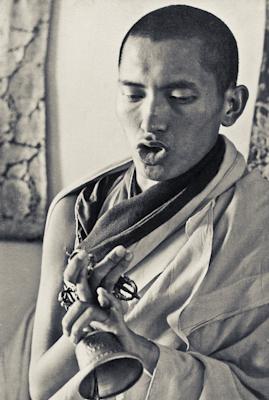
Just as this bell consists of countless atoms and molecules, this life’s physical existence depends on the five aggregates.
At death, when the mind involuntarily separates from body, the I doesn’t cease. We can define life as the conjoining of mind and body, and death as the separation of mind from body, but at death, whereas the body ceases to function, the mind continues. The mind has existed from beginningless time and will continue to exist, even after we have become enlightened and every single negative mind has been eliminated. Some think that the mind won’t continue after death, like a burned-out candle, that the end of the physical body means the end of the mind. This is a wrong concept.
THE TWENTY SECONDARY DELUSIONS
[WFGS pp. 160–62]
These arise from the six root delusions. [The twenty secondary delusions are belligerence, resentment, concealment, spite, jealousy, miserliness, deceit, dissimulation, haughtiness, harmfulness, non-shame, non-embarrassment, lethargy, excitement, non-faith, laziness, non-conscientiousness, forgetfulness, non-introspection and distraction.]
Like the root delusions, these secondary delusions are mental factors. They arise from the main minds, rather than being main minds themselves. We need to recognize these minds when they arise and do whatever we can to overcome them.
For example, there are the delusions of non-embarrassment and non-shame. Non-shame is doing whatever we want without considering the harm we do ourselves, and non-embarrassment is the same kind of mind but without considering the harm we do others. The opposite, shame, is an important mental factor to have; it stops us acting rashly and harming ourselves and others. Without it, we may recklessly create nonvirtuous actions when alone and we think nobody will know, or even when we are aware that others, and certainly the enlightened beings, know of our actions. We are not concerned about creating negative actions and have no fear of the suffering consequences.
Positive shame means we don’t create negativities because we are afraid of the result. Negative shame increases the negative mind because it causes us only to shamelessly care for the eight worldly dharmas. For example, we dress up in our best outfit for a party so we will be noticed and admired. Such an action is done with the negative shame of wanting reputation, feeling ashamed that unless we do this, people will laugh at us.
We should feel shame in performing actions against the wishes of the enlightened beings and be vigilant so that we don’t create any negative karma at all. We must keep the mind conscious all the time because negative actions occur like heavy rainfall unless we are constantly aware of our actions. If we have a negative thought and realize that it’s negative and can cause negative karma with a suffering result, this can decrease the power of the karma according to the strength of the thought and the strength of repentance. The more we are repulsed by having done the negative action, the more likely we are to avoid it in the future. But without a deep understanding of the suffering result, we will keep on doing it even though we might feel it’s a bad thing.
So, positive shame, which works to destroy greed, is completely opposite to samsaric, negative shame, which works only for greed, and cares only for the worldly comfort. The happiness or unhappiness in any situation is only our mental concept. We often feel happy that we have beaten somebody or stolen something because of non-shame, whereas positive shame makes us afraid to create negative actions.
THE FOUR CHANGEABLE MENTAL ACTIONS
[WFGS pp. 162–63]
The four changeable mental factors are sleep, regret, investigation and analysis. Sleep can be virtuous or nonvirtuous. If we sleep having meditated on Guru Shakyamuni Buddha beforehand, with bodhicitta, the rest of the sleep is virtuous, following this motivation. But if we go to sleep with some kind of greed arising, our sleep becomes nonvirtuous. If we have sexual intercourse before sleep or go to sleep feeling angry with someone, it’s nonvirtuous. Such negativities may recur during sleep as dreams and continue upon awakening.
Regret is also changeable. Negative regret is repenting positive actions. For example, after attending the meditation course, we cancel the positive karma of this good act by feeling sorry that we didn’t stay in Kathmandu smoking hashish, eating good food and listening to music.
Investigation and analysis are also positive or negative depending on the object we are examining. If we look at an object, attachment or aversion can arise based on what we see as the good or bad qualities of that object. For example, we see a car and admire its whitewall tires or its beautiful color, or, for a person, we will think of their face, hair, skin color and so forth. Positive investigation of analysis means we check the details of an object, such as a flower, with respect to its impermanence and so on.
Notes
1 In this course, the students transcribing Rinpoche have used greed more often that attachment, presumably because this was Rinpoche’s term at that time (1973). Since then, attachment has become more commonly used, so I have changed it here where it seems this is the intended term. [Return to text]