
Why We Exist
Lama Yeshe teaches that all existence arises through interdependent causes rooted in ignorance, which generates karma and perpetuates the cycle of samsara, making individuals responsible for their own suffering and potential for awakening through understanding this process. This teaching was given at Chenrezig Institute, Australia, in June 1981 and is published in chapter 19 of Big Love: The Life and Teachings of Lama Yeshe.
Today I thought that my subject would be dependent origination—that is, how and why we are existent on this earth. I think that many Western people question why they have come on this earth. It is difficult sometimes to find the answer to this. Buddhism has an answer to why we are existent. That is why I feel that sharing this explanation with you is so important.
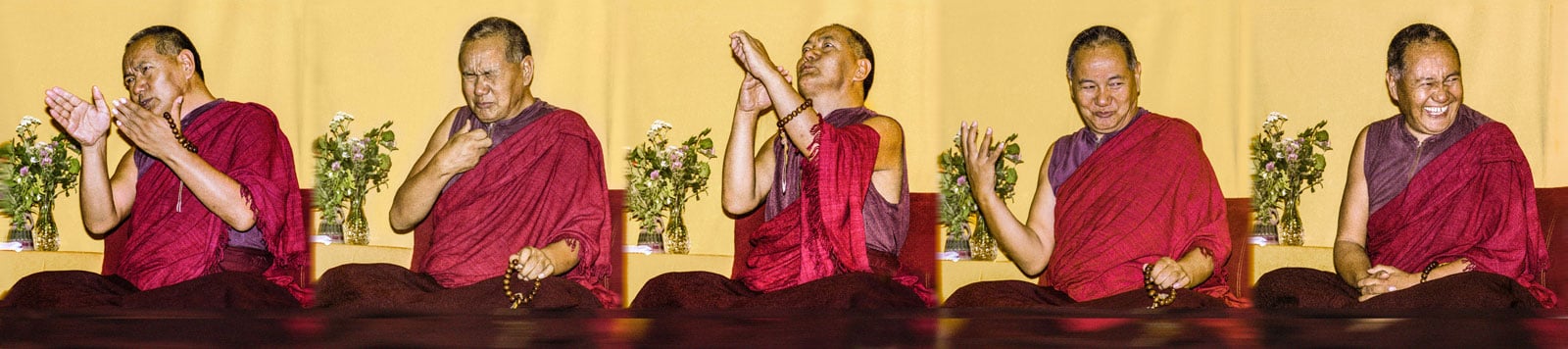
When Shakyamuni Buddha gave this teaching on interdependence, he held up one flower, like this, demonstrating that because this flower is existing, there must be a seed from which it came. Thus, because there was a seed, now there is this flower. Isn’t that true?
This is a very simple way of explaining. We have to understand that all phenomena are existent in this way, that all phenomena arise from causes. Every phenomenon is related to other phenomena; every phenomenon comes from something else. All of us have a father and a mother; we are dependent on our father, our mother, genetics and the energy of the four elements. Thus, it is important to know the interdependent cycle of existence. In this way, according to Buddhism, we can eventually discover the totality of shunyata. If we don’t understand the interdependent relationship of all existence, then shunyata becomes just words and it’s not possible to discover this profound totality.
I’m sure that all of you have studied the science of botany and biology and those things. If you have this kind of knowledge then it is easy for us to understand the Buddhist explanation of dependence. Subjectively, this is an explanation of how we sentient beings are interdependent. Objectively, for example, science clearly explains how trees are interdependent. So simple. So, the Buddhist explanation pertaining to sentient beings is that of the twelve links of dependent origination.
First of all, in Buddhism the primary cause is ignorance. Ignorance is the creative cause of all worldly, or samsaric, beings. Ignorance means the ignorant mind. It is the mind that is unclear, that does not understand reality. This is the meaning of ignorance. Don’t think that ignorance is somewhere in space, somewhere “out there.” In very simple terms, all of our human energy—physical, mental—could not exist without interdependent causation. All our energy came from a previous energy, which in turn came from yet another previous energy, and so on. So we are linked.
So ignorance is the main cause of life existing. It is the cause that produces the seed of life. Now, one can have either a good life or a difficult life. We all know this. A difficult life comes from ignorance, but a good life, a life filled with temporal pleasure, comes from ignorance as well.
We can talk about different types of ignorance and different degrees of ignorance, can’t we? If you eat muesli, then this might indicate that you know how to take care of your body. But you might not know how to do anything more than that to stay healthy. So, beyond that knowledge, you are still ignorant, aren’t you? Thus, you shouldn’t think that ignorance means something totally black. I don’t want you to think that way. It’s not true.
From the Buddhist perspective, we are all considered to be fortunate beings. As human beings, we are of especially profound good quality. But still our source is ignorance. Nevertheless, as good human beings we have potential, great potential. That’s why we can progress, because we can use our energy to develop that potential.
Ignorance is very dangerous because it produces extreme minds: extreme in both overestimating and underestimating reality and in projecting mistaken characteristics on reality. Because of ignorance, we judge and project wrong values, wrong motivations, and then we act mistakenly and again bring ourselves more trouble. So, from ignorance arises motivation, that is, what we call karma. Karma means to make active, active and shaking. It also means to shape and to change. That is karma. So, from the unclear mind comes shaking, perhaps in the form of extreme hatred or extreme attachment. That becomes our motivation. This motivation then leads to another and another, until after an hour that motivation passes and you seem to be OK. But actually, you are still not OK because one hour of extreme negative energy is still left in the ocean of your consciousness. The imprints are left there and you are still carrying them. Month after month, year after year, you continue to carry everything you have done. It is so important to comprehend this, to gain that comprehension. Most of the time we ignore this. We think that it is all gone, but it is not gone. The emotional disturbance has gone but the imprints, the reality imprints, are published in our consciousness. Then, after a thousand years, because of those imprints in the mind, we again react in the same way. Our reaction comes out of this confusion left in the mind.
This is why we understand that ignorance is the first and primary cause, which then creates the reaction of karma, leaving imprints on the consciousness. Thus, the potential for the cycle to continue is there.
Another example of the twelve links of dependent origination is this. I use my senses; I open my eyes to look at you and then I perceive you. I get a picture of your reflection. Then, through my senses, I accumulate concepts of you—you are this, you are that. So these three work together—sense, object and consciousness. Then through the factor of discrimination, I apprehend you as good or bad, and from that I get a feeling, an emotion. From that feeling I act. Thus, I think that all these things, each one leading to the next, are very important. First, I come in contact with the object, with you, through my senses. Then that contact stimulates discrimination and feeling, through which I become deluded.
You can see that our deluded view is not something that exists without a cause. Each deluded view has a cause, a long history. You have to learn all this history, and then you can understand. It is very helpful to recognize our wrong views, our wrong concepts. In that way you come closer to reality. From the Buddhist point of view, more control comes. If you do not recognize the way that you are deluded, then having control is like a joke. Understanding with your own wisdom how you are deluded is a great strength. From that, control comes naturally.
I want you to understand that every movement of the body, of the senses—seeing, hearing, smelling, tasting, touching—every movement is karma. Whether you want this or not, it’s automatic. The force of your mind, your attitude, your body, your energy is karma. Lord Buddha gave it the name samsara, the cycle of existence. You go round, round, round, round. Even though your deluded mind thinks, “I’ve given up my old things; now I’m doing new things,” as a matter of fact we are always on an old trip. Even hippies, they mean well. They think they are revolutionary, but they are on an old trip.
So you carry your own karma, whether you go up a mountain or under the ocean. You carry your world with you, like this. That is why we are, all of us, individually responsible for our own happiness or misery. That is Buddha’s teaching.