
Finding Happiness Without Going Anywhere
Lama Zopa Rinpoche explains that when we shift our motivation from “How can I be happy?” to “My life’s purpose is to benefit others,” our experience changes immediately: life feels more meaningful, we naturally smile, and we feel close to others in a way that isn’t forced or political. We find happiness without going anywhere.
From November 9 to 11, 2018, Lama Zopa Rinpoche taught at the Aryatara Institute in Munich, Germany. Visit FPMT’s Rinpoche Available Now (RAN) for more teachings, transcripts, audio recordings and videos from this event. The video for the teaching excerpt below is available here on the FPMT YouTube Channel.
As I mentioned yesterday, the whole thing—all our happiness, all our suffering—comes from our mind. I think I mentioned the person walking along a road with a mind so squeezed and a facial expression so squeezed, thinking, “I have this problem, I have that problem. When can I be happy? When can I be happy?” With this kind of thinking day and night, we make ourselves so unhappy, exaggerating our problems, seeing our life as having so much suffering. Like that, there’s nothing to smile about. But if we were to suddenly think, “I’m here and the purpose of my life is to benefit others,” our life immediately changes. Instead of only cherishing the I and not caring about the numberless sentient beings, not having any feelings for them, thinking only the I is important, instead of that, if we think, “The purpose of my life is to benefit others,” that immediately changes our attitude to life.
We wish to benefit others, to help free them from suffering and achieve happiness. Because our life is to free others, with this changed attitude, we are to be used by others for their happiness. Just like they use water any way they wish for their happiness, or they use fire or wind or earth any way they wish for their happiness, they can use us any way they wish. And the sky. There are many different ways of using the sky for their happiness.
Even if we can’t think as extensively as that about how others can use us, we can at least feel that we are here for others, to serve them and to help them create the cause of happiness. Then, right there we find happiness in our life. This happens the minute we change from the self-cherishing thought into the thought cherishing others. Right there. We don’t have to go anywhere. Right there, we find our happiness, we achieve happiness.
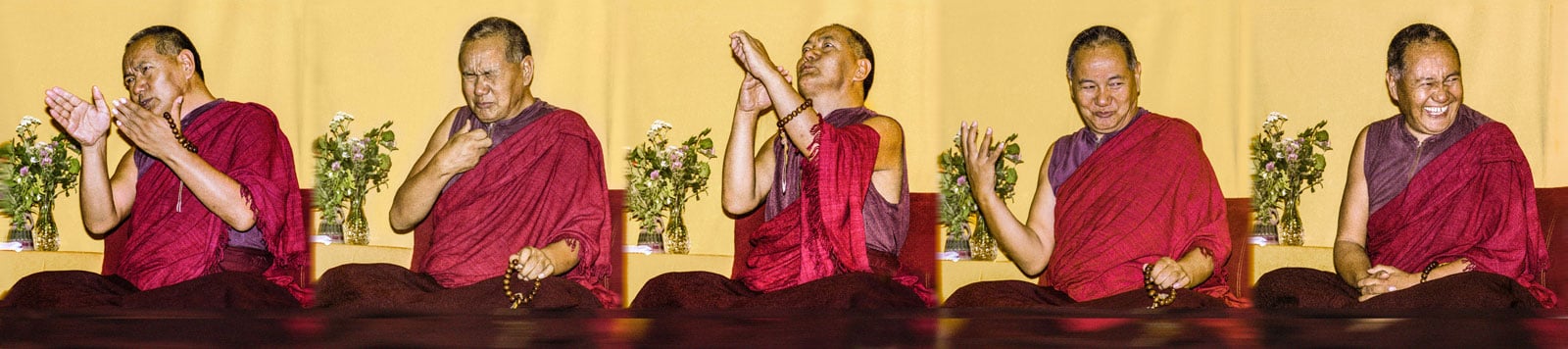
Then, we have a natural smile, not a political smile. Sometimes, we’re forced to give somebody a political smile, a false smile, not a natural one, a heart smile. [Rinpoche smiles a fake smile]. When we cherish others, we are close to all others and they are close to us; they are all like family to us, all close to us. Wherever we go, there is great happiness in our life, in our heart. Wherever we go, we give happiness to others.
Sorry, I don’t think I will have time, but as soon as you wake up, please use the small book they have printed, with the morning motivation to transform your life of iron into gold. I made it kind of a bit funny by saying you turn your kaka life into gold. You transform your life, which has been a kaka life until now, into gold by changing your mind. [How to Make My Lives Wish-Fulfilling: The Method to Transform a Suffering Life into Happiness.]
You can also use the motivation from A Guide to the Bodhisattva’s Way of Life, which is an incredible way to cause sentient beings to have happiness. It tells you how to make your life happy by cherishing others. Cherishing others, working for others is the best life. Cherishing yourself, cherishing the I, that is a suffering life. It’s like that.
It’s mentioned in A Guide to the Bodhisattva’s Way of Life that what we need to do if we wish to quickly guide and save ourselves and others is to exchange ourselves with others. We transform our current attitude, which has been causing so many problems and bringing so much suffering in our life—the attitude of the self-cherishing thought—into one of cherishing others. The great bodhisattva Shantideva said,
Therefore, in order to allay the harms inflicted on me
and in order to pacify the sufferings of others,
I shall give myself up to others
and cherish them as I do my very self.1
We should practice exchanging ourselves with others secretly. Although this is a practice of the higher bodhisattvas—it doesn’t fit the minds of the lower bodhisattvas, who don’t have the courage—this is a practice we do mentally, secretly. We don’t actually exchange our body for the bodies of others but exchange our self-concern for concern for others. This is a very secret practice. We don't advertise it, telling others how we are practicing bodhicitta. We don’t announce it to the world. We don’t tell everybody in our country or in our society; we do it mentally. That is why Shantideva advised us to do this practice secretly.
It’s very true that there are many charities who work [to help others] but if we never transform our mind while helping others, there will be many problems. Even as a Buddhist, working to help others, if we retain our strong selfish attitude, principally working for our own happiness and failing to transform our mind, we may look like we are helping others on the outside, but there will always be problems. Holding on to our self-cherishing thought, we will crash, like being in a car crash, encountering so many problems in our charity work: financial problems, relationship problems, personal problems. Our life becomes just so many problems, such as never getting on with others.
Instead of becoming more peaceful and satisfied, finding more fulfillment in helping others, while we retain our selfish attitude there is only more dissatisfaction, only more problems. Our discontent brings us physical and mental illnesses. Life goes on like that. That is because we don’t take care of our mind, because we don’t do the bodhicitta practice that Shantideva advised us to do. We don’t mentally exchange ourselves with others. We think we are helping others, but our mind remains selfishly thinking of ourselves. We don’t help others with bodhicitta.
Helping others with bodhicitta is the best way. Without that, the selfish mind brings so many problems. As Shantideva said in A Guide to the Bodhisattva’s Way of Life,
Whatever joy there is in this world
All comes from desiring others to be happy.
And whatever suffering there is in this world
All comes from desiring myself to be happy.2
All suffering arises from not letting go of the I and not cherishing others. When we cherish others, that’s where all our happiness comes from, including enlightenment. Therefore, whether it’s one insect, one person—any sentient being—we must cherish others.
NOTES
1 Ch. 8, v. 136. Translated by Stephen Bachelor. Taken from A Guide to the Bodhisattva’s Way of Life, published by Library of Tibetan Works and Archives, 2011. [Return to text]
2 Ch. 8, v. 129.