
Happiness and the Subdued Mind
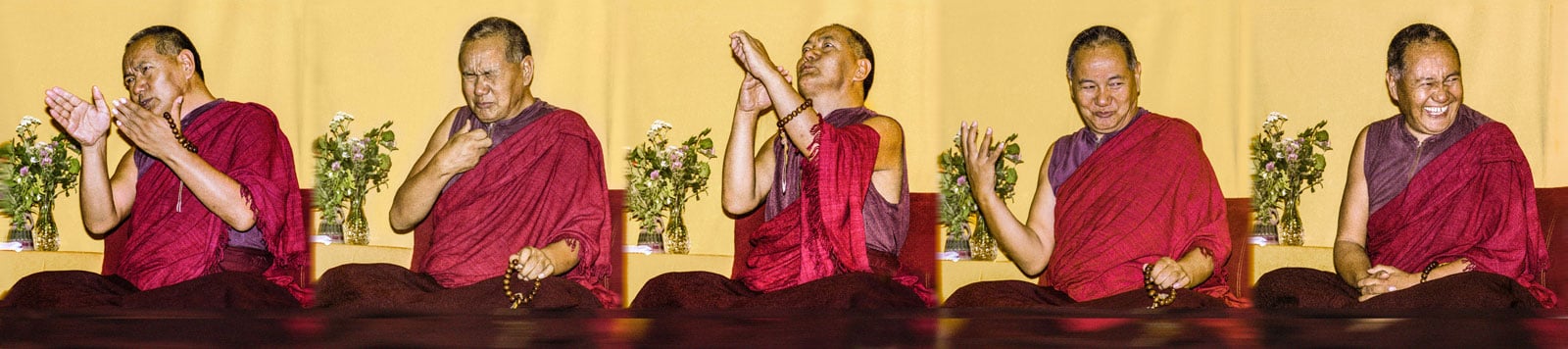
Lama Zopa Rinpoche teaches that the essence of Buddhism is to subdue one’s own mind and that real Dharma is internal, not external. Rinpoche explains that even having a deep understanding of Buddhist philosophy is meaningless unless it is applied to one's own mind; knowledge without practice does not constitute real Buddhism. The teaching excerpt is lightly edited by Gordon McDougall.
From June 28 to 30, 2019, Lama Zopa Rinpoche taught at the Ganden Buddhist Center in Riga, Latvia. Visit FPMT’s Rinpoche Available Now (RAN) for more teachings, transcripts, audio recordings and videos from this event. The video for the teaching excerpt below is available here on the FPMT YouTube Channel.
The essence of what the Buddha taught is found in this verse:
Do not commit any unwholesome actions.
Engage in perfect, wholesome actions.
Subdue one’s own mind.
This is the teaching of the Buddha.
After the first two verses, it says “Subdue one’s own mind. This is the teaching of the Buddha.” This is the most essential advice. In our everyday life, this is the best meditation, the best practice. It explains everything. “Subdue one’s own mind. This is the teaching of the Buddha.”
The mind. When we don’t take care of our mind, we don’t take care of our life. If we never take care of our mind, it is left suffering from the chronic disease. This isn’t a chronic disease from this life but the chronic disease from countless past lives. This chronic disease of the mind refers to the self-cherishing thought and the three poisonous minds, ignorance, anger, attachment, that have afflicted us from beginningless rebirths.
Because we don’t look after our mind, no matter what we do externally, whatever we change, we leave out caring for our mind. Our mind remains untouched. Because we fail to take care of this sick, troubled mind in this life just as we haven’t done in all our countless lives, we fail to take care of our life. Any external changes we do are not real Dharma; they are not real Buddhism. External changes alone are not really spiritual. Even by using the general term “spiritualism,” it’s not spiritual, it’s not holy Dharma. It can become worldly dharma but not holy Dharma. It is not the Buddha’s teaching.
Therefore, “Subdue one’s own mind” has great meaning. Its meaning is unbelievably important. Outside changes—the colors we wear, how we dress, the shape of our hair, whether it’s long or short—these things don’t take care of our life; they don’t care for our mind. Then, there is always confusion and suffering in our life, one problem after the other.
We can become more educated, not just a general education, but even more educated in Buddhism. We can even become an expert. There are more than a hundred volumes of the Buddha’s teachings, the Kangyur, translated into Tibetan by translators were great holy beings, bodhisattvas, having renounced cherishing the I and transformed their minds into bodhicitta. They attained bodhicitta for every single sentient being, for the numberless hell beings, the numberless hungry ghosts, the numberless animals, the numberless human beings, the numberless gods, the numberless demigods and the numberless intermediate state beings. There is not only this world; there are numberless universes with numberless human beings who generated the holy mind of bodhicitta.
These great translators who translated the Buddha’s teachings from Sanskrit or Pali did this for all sentient beings. There are also more than two hundred volumes of commentaries to the Buddha’s teachings by the extremely learned pandits who had actualized the path to enlightenment and attained buddhahood, the state of omniscience. So many great pandits from great monastic university of Nalanda in India made commentaries on the Buddha’s teachings. There are more than two hundred of these commentaries.
But even if we are experts in all these sutras and commentaries, even if we know them all by heart and can explain them perfectly to people, if we never look at our life, never take care of our mind, it doesn’t really become Buddhism. Even if we are experts in explaining sutra and tantra by heart, all the root texts and commentaries, our actions still do not become Buddhism.
On the other hand, somebody with a subdued mind who recites OM MANI PADME HUM with the ultimate holy mind of bodhicitta has generated the remedy to the self-cherishing thought, which is the chronic disease that brings all the problems, all the misfortunes in this life, everything, even black magic. Every single problem such as depression, abuse, diarrhea, headache, toothache, any disease, whether curable or incurable—all this comes from this selfish mind, from the self-cherishing thought. The self-cherishing thought is like the main root of a great tree, and from that main root other roots grow out, first a few, and then hundreds and then thousands, increasing more and more. From self-cherishing comes attachment, clinging to the pleasures of this life, which is in the nature of suffering. And from that, so many problems come, hundreds and thousands of problems.
This is because we never take care of our mind, of our life. Even though we might be an expert in Buddhism, able to explain philosophy, knowing the whole lamrim so well, we never take care of our mind, we never take care of our life. This isn’t Buddhism’s fault. We had attachment well before we met the Dharma. We had anger and pride well before we met the Dharma. Maybe we didn’t have that much before, but by becoming educated, by learning so much about Buddhist subjects, we have really developed our pride, having more arrogance, more anger and so forth, instead of our mind becoming healthier, more peaceful, with less attachment, less anger, less ignorance, less self-cherishing. This is without thinking about to tantra. This is just the foundation. Unless we know how to subdue our mind, we can develop more negative thoughts than before we met the Dharma.
That means that although we are learned, although we have learned the words intellectually, we don’t practice. That is very clear. Because we don’t practice, we don’t achieve any happiness. Without practicing the Dharma, we can’t achieve any happiness.
Happiness comes by subduing our mind. By taking care of our mind, we take care of our life. Subduing the mind means having less self-cherishing, which means having less attachment, less anger, less ignorance, less pride, and so forth, and that means more peace and happiness. When our mind becomes more renounced, we have more contentment, more satisfaction, more inner happiness, more peace.
To just give a simple example, when we are more patient, we naturally have less anger. Therefore, more patience means more inner happiness, more loving kindness and more compassion. Then, of course, there is more peace and inner happiness. Then, our mind becomes healthier and healthier, our life becomes healthier and healthier, more and more positive.
That is the basis of the practice of Buddhism, the Buddha’s teachings. With that basis, we learn to rely on the Omniscient One, not the ignorant one. The Omniscient One, the Buddha, is the one we can rely on, the one who has perfect qualities to guide us, from now on up to buddhahood. He has the perfect qualities to reveal the whole path to enlightenment to us, to guide us there. And we also learn to rely on the Dharma and on the Sangha.
Basically, everything comes from our mind. Our samsara comes from our mind. Our nirvana, our ultimate happiness, the blissful state of peace, comes from our mind. Our enlightenment comes from our mind. Our hell comes from our mind. Our everyday problems come from our mind. Our everyday happiness comes from our mind.
That is why the Buddha said, “Subdue one’s mind. This is the teaching of the Buddha.” That is why there is this strong emphasis on subduing our own mind. The Buddha is telling us we must take care of our mind, and then we take care of our life. That is the huge reason this is emphasized so much. Just as all the suffering comes from our mind, all happiness comes from our mind. Suffering does not come from outside; it comes from our mind. When we don’t examine it, it seems to come from the outside, from other people, but that is our mind hallucinating. Without examining, it looks like suffering and happiness do not come from our mind if we don’t check.