
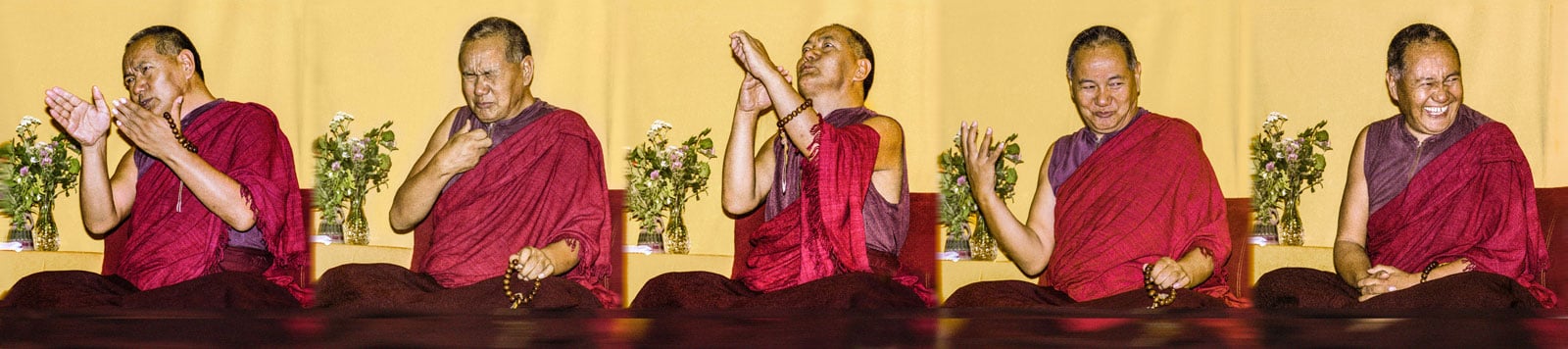
E-letter No. 52: September 2007

Dear Friends and Supporters,
Welcome back to our monthly e-letter after our month off for retreat. I hope you are well.
Our Most Popular Title

Since I was last in touch with you we have received our beautifully re-designed reprint of Lama Yeshe’s Becoming Your Own Therapist / Make Your Mind an Ocean combined edition. We now have well over 100,000 copies of these amazing teachings in print and they’re still very much in demand. Both books have been translated into French, Spanish, German, Chinese, and Italian, and we have links to these on our website. Thank you all for supporting our program of publishing and distributing free books all over the world…please keep it up!
We have also just sent our next book to our designer, Lama’s Maitreya yoga method commentary. We were commissioned to prepare and publish this book by the Maitreya Project to be made available for sale at the Relics Tour, so this one won’t be free but we will, of course, send a complimentary copy to our Members and it will be available at a discount on our Web site. Please find an excerpt below.
Report to Members
By now most of you are aware of our Membership Program which has supported a team of editors who have been working primarily on Lama Zopa Rinpoche's Kopan courses. We are now in our fifth year of the program, so we have prepared a Report to Members summarizing donations received and related program expenses to date. It includes a link to a 3-year financial review for all of the Archive's activities. Please check them out.
The kindness of our supporters has enabled our editors to check, edit and organize thousands of pages of teachings from 15 month-long Kopan courses, which have since been made available in our Members' Area and on Rinpoche's Teachings page. One of our editors also prepared all the advices in Rinpoche's Online Advice book. All of this work has laid the critical foundation for future lamrim publications.
Donations from new and continuing members is presently funding a professional audio editor who is preparing lectures for publication on our online recordings page, and is also assisting in the production of forthcoming Lama Yeshe and Lama Zopa Rinpoche DVDs.
We thank all our members for their generous support, and encourage others to join.

Additions to Our Online Recordings Page
This month we have posted the 6th chapter from Lama Yeshe's book Ego, Attachment and Liberation which is titled "Every Problem on Earth Comes from Attachment." You can read along with the unedited transcript.
Last month's podcast was the first part of the recording of the animal blessing that Rinpoche gave at Kurukulla Center in Boston, MA. Listen here to the entire animal blessing event, as well as the recording of Rinpoche's lecture at a book signing for Dear Lama Zopa that was held the night before.
New Teachings
We've just posted a teaching of Lama Yeshe's from September 1983 titled How to Let Go: Integrating Emptiness in Everyday Life. It appeared in the FPMT's Wisdom magazine in 1984, shortly after Lama Yeshe's death, in the issue which celebrated Lama's life. Excerpts from this issue are also on our website.
We've also posted Geshe Soepa's book on animal rights: Protecting the Life of Helpless Beings: The Udamwara Lotus Flower. The ebook is available in the LYWA Store, and the book can also be read online on our companion website TeachingsFromTibet.com.
Our Photo Archive is Growing
We are also very busy digitizing every photo of Lama Yeshe we can get our hands on, as well as early photos of Lama Zopa Rinpoche and historic FPMT shots, including Kopan courses, so it’s always exciting to get a new batch of photos from our photographer friends all over the world and be transported back through the wonderful years of FPMT history.
One of the photos we received recently accompanies Lama’s teaching below and shows him with some of his dogs at Tushita Retreat Centre, Dharamsala, 1982. A year or two before that was taken, Lama got a Pekinese from Holland. He called her Yeshe. Then he got a Chihuahua, which he called Lama. He wanted them to mate but somehow they couldn’t get it together, so he finished up crossing Yeshe with a Lhasa Apso in Dharamsala, and some of the first litter of five are shown in the photo. Lama had a special pen built at Tushita; he called it “my dog farm.” The puppies were totally cute and Lama Zopa Rinpoche gave them Dharma names, like Dzog-chen, Jang-sem and Tong-nyid. So…that’s an example of the reminiscing that happens as these great photos come in!
Eventually, most of these photos will be posted to our Photo Gallery.
Thank you again for your kind interest and support. Please pass this e-letter on to anybody who might be interested. We’re always trying to build our list.
Much love,
Nick Ribush
Director

The Fundamentals of Tantra
Tantra comes from the Buddha
The first thing I want to say is that Buddhist tantra definitely comes from Shakyamuni Buddha. Before his enlightenment, when he was a tenth-level bodhisattva, the buddhas of the ten directions stirred him from his deep meditative absorption and said, “You’ve attained the highest bodhisattva level, which is completely free from ego conflict, emotional problems and anxiety, but to discover the omniscient wisdom and eternal bliss of buddhahood, you have to receive tantric initiation.” So they initiated him and he was then able to attain enlightenment.
One of the main tantric techniques enables us to handle pleasure in a positive way, to take pleasure as the path to enlightenment. A powerful king once said to Lord Buddha, “I’m confused as to how best to lead my life. I’m responsible for all the people in my kingdom and surrounded by worldly pleasure—what I need is a teaching to transform what’s left of my life into the path to enlightenment.” In response, Lord Buddha taught him tantra.1
For similar reasons I think that tantra is the right practice for Westerners and of the utmost need in this twentieth century. After all, the Buddha wanted us to have as much perfect pleasure as possible; he certainly didn’t want us to be miserable, confused or dissatisfied. Therefore we should understand that we meditate in order to gain profound pleasure, not to beat ourselves up or to experience pain. If entering the Buddhist path brings you nothing but fear and guilt then it’s certainly not worth the effort.
The human problem
Our problem, our human situation, is that whenever we experience pleasure we get more confused; we react to pleasure by developing emotional confusion, hatred, anxiety and so forth. In other words, whenever we experience pleasure we lose control. Therefore Lord Buddha’s teachings always emphasize gaining control of the mind.
So look within to see what happens when you experience pleasure: do you get more ignorant or less? Check that out—that’s the main question. If whenever you experience worldly pleasure you become more mindful, concentrated, aware and in touch with reality, that’s fine. However, it’s more likely that you get further out of touch with reality, more spaced out, and enter an illusory, fantasy world of your own creation.
The two Mahayana vehicles
To help us deal with these issues, Lord Buddha taught two Mahayana vehicles—Paramitayana, or Sutrayana; and Vajrayana, or Tantrayana or Mantrayana.
So what’s the difference between these vehicles? We already practice Paramitayana and the six perfections; we’ve all heard lamrim teachings and are trying our best to actualize them—why do we need tantra?
The difference is that Paramitayana does not contain the skillful means for taking sense pleasure as the path to enlightenment, for transforming worldly pleasure into the path to enlightenment. This is the unique quality of tantra.
The difference is not that tantra offers us better or deeper explanations of shunyata, bodhicitta or renunciation. Those are the same in Paramitayana and Tantrayana. In fact, those three principal aspects of the path—renunciation, bodhicitta and the wisdom realizing emptiness—are the fundamental prerequisites for entering the tantric vehicle.
Renunciation
Renunciation doesn’t mean changing the color of our skin, putting on robes or wearing make-up. Everybody, each human being, needs renunciation. Does that mean giving something up? Yes, it does—we all have to give up something—but what it is that we have to abandon is an individual decision; each of us has to check up for ourselves what extreme thoughts come into our mind and once we have determined what they are we should deal with them in an easy-going way. That’s the way to renounce…deal with extreme emotions in an easy-going way.
I don’t need to tell you the characteristics of your own emotional disturbances—you know from experience, “When I don’t get this or that I get irritated.” Thus you can figure out what you need to do in the way of self-correction to be happy. That’s what I mean by easy-going with respect to renunciation. Anyway, I’m not going to tell you the details of renunciation, just its nuclear essence.2 Each of us has to understand our own hypersensitivity and gross emotions, the problems they bring and the way to correct them. That’s renunciation.
When Lama Je Tsongkhapa explained renunciation in his lamrim teachings he went into great detail about ego conflict, its results and how and why people become dissatisfied, so you can research his extensive explanations for yourself.3
If you do, you will see that actually, renunciation is not that simple. From the Buddhist point of view it means learning about yourself by understanding how your ego works within your mind and how it manifests externally in your life situations and friendships. Therefore it takes a lot of wisdom. You don’t just say, “Oh, I must renounce,” and squeeze yourself. It doesn’t work that way. Renunciation and meditation go together.
Bodhicitta
Bodhicitta means opening your heart to others as much as you can. Normally we do open our heart to others to some extent—everybody does—but here we’re talking about doing it with the highest destination in mind: the transcendent, universal aim of complete enlightenment. That’s the way we create space in our heart. So it’s very important.
We can see from our normal human relationships that when we’re uptight and closed to each other it’s extremely difficult to get along but when we open up and aim to achieve something more profound it’s much easier. If I’m in a relationship with you only for chocolate, when I don’t get my chocolate, I’m going to get upset, aren’t I? From the Buddhist point of view, human beings are much more profound than that; we can achieve tremendous things. So bodhicitta is very important.
We think it’s important to become a great meditator but that’s very difficult to accomplish in this revolutionary modern world. These days it’s much more practical to open our heart to each other and make that our Dharma path.
Still, it’s a lot easier to say the words than to actually practice bodhicitta. Realizing bodhicitta is a process that requires continuous action and steady application rather than the occasional sporadic effort. The mind of bodhicitta no longer sees any objects of hatred or neurotic desire anywhere in the world and it obviously takes time to achieve the kind of equilibrium with all universal living beings that forms the basis of such a view. However, Buddhism is extremely practical and far-reaching and teaches an organic, gradual approach by which anybody can become truly healthy, completely free from any problem, by developing the universal thought of enlightenment.
Sometimes I ask my Western friends, “Do you have any enemies?” and they often reply that they do not; not one object of hatred. I say, “Really?” I don’t believe them; I’m very skeptical. So then I ask, “Do you have any objects of desire; anything with which you’re emotionally obsessed?” To that they usually reply, “Yes,” to which I go, “Ah-ha!”
I respond like that because my studies of Buddhist psychology have taught me that if you have an object of grasping, emotional obsession you instinctively have objects of hatred; the mind of hatred is automatically there, waiting to react.
What do you think about that? Is my understanding polluted, wrong? What’s the Western point of view? The Western mind is kind of radical…you’re easy going; you think you don’t have any enemies, but in fact you do. It’s simply a matter of being aware. But we’re usually not aware of what’s in our mind.
From the Buddhist point of view, the healthy mind is one that is free of all objects of irritation—organic, inorganic, philosophy, ideology…anything. As long as your mind contains even one idea that makes you uneasy, you’re neither free nor healthy.
Look at any big Western city these days. How many religious or psychotherapeutic groups are there? Do they all get along with each other or not? What about your own mind? Are you able to accept the trips that other people around you are on as necessary according to their individual need and simply let them be? Does something as simple as the noise of an airplane flying overhead upset you? Why? It comes; it goes. Don’t get irritated; just let go. Airplanes are also individuals’ need. If small things like that bother you, again, from the Buddhist point of view you’re not mentally healthy.
Well, we can find many good examples of annoyance in twentieth century life. What about uranium enrichment, nuclear power stations or the recently announced neutron bomb?4 Does your ego hurt when you hear the government announce such things? Do you react? Do you cry? There’s no reason to react like that. It doesn’t help. You’re just making yourself emotionally sick, needlessly tiring yourself out. It’s useless; we all know that.
Who knows? Perhaps President Reagan is a manifestation of Shakyamuni Buddha or Jesus Christ. I’m not lying. Intuitively, I can’t say he’s evil, so I can’t say he’s not buddha. It’s not my business, either. You never know. I heard him explain the reality of the neutron bomb, how it destroys organic life and leaves all the precious inorganic resources intact. That’s fantastic. Maybe it’s a good thing. Perhaps this is another way of explaining the reality of Dharma, his way of explaining love. Perhaps human beings can learn love through this.
Sometimes the only way people can learn is through being shocked; if we don’t get shocked we don’t learn but remain comfortably in the dark shadow of ignorance. I believe that when we get a shock we learn; that that’s the way to bring comprehension. Perhaps when people hear about the neutron bomb they’ll develop detachment from their worldly possessions, thinking, “This bomb makes the entire future completely insecure. I might as well enjoy my wealth as much as possible because in a couple of months all my friends and I might have completely disappeared.” Thus many people might develop detachment—how fantastic!
I often think that people don’t pay attention when we explain the Buddhadharma because they’re not shocked. They’re kind of, “Oh, yeah…maybe yes, maybe no….” But when they hear about the bomb they think, “That’s true. I’d better go to Hawaii for a holiday and have at least one week’s good time. After that, whatever happens happens.”
Since entering the monastery as a six-year-old I’ve heard about impermanence—how things are constantly changing, changing, changing—hundreds of times. But now, looking at this twentieth century world and seeing how quickly things change and react, I see impermanence more clean clear that I ever did and it really comes home to me how the Buddha was right. So that’s unbelievably great. It’s so clear.
Goodness! It seems that my teaching today has been mainly about the neutron bomb…you probably think I’m a complete disaster!
Well, this twentieth century life has advantages and disadvantages. One of the advantages is that we can get together and talk. If it weren’t the twentieth century we wouldn’t be here like this.
The wisdom of emptiness
The third principal aspect of the path is the wisdom of shunyata. In order to completely obliterate the root of human suffering we need to understand non-duality. Love, compassion, bodhicitta and other positive attitudes serve as temporary solutions to problems such as anxiety and the uncontrolled mind but they don’t completely eradicate them; only the shunyata experience can do that.
Anyway, I’ll explain these things in more detail as these teachings progress, so don’t worry if you don’t understand them right now.
Vajrayana
Tantrayana, or Mantrayana, means to elevate the consciousness, or liberate the mind, from ordinary thought. That’s the connotation of mantra. The way we do this transformation is through the profound practice of deity yoga. Also, when we practice tantric meditations there’s much emphasis on how to gain the experience of bliss, or pleasure.
Now, because Shakyamuni Buddha had complete realization—the fully omniscient wisdom that clearly knows the minds of all living beings, past, present and future—he was able to give a complete range of teachings, from the simplest up to the most profound, according to the level of mind of those in attendance. Therefore, within his teachings, we can find explanations of reality and methods for mental development suitable for us twentieth century seekers. Even 2,600 years ago the Buddha already knew us well and was able to leave us an appropriate, quick path to enlightenment.
As time passes, everything changes—culture, people’s mentality and behavior, the environment and so forth—so the way that the teachings are presented also has to change. Today, when everything moves so fast, we can’t necessarily use methods that in earlier times took a long time to accomplish. Lord Buddha himself said that when the culture changes, delusion, mentality and behavior also change, so even the vinaya rules have to be adjusted, because in their original form they may no longer benefit. We should therefore understand that Lord Buddha taught in order to help beings according to their individual need, so naturally, as time passes, the way his teachings are presented and practiced might also have to change. Even in times of nuclear war there’d still be a skillful way to practice Dharma.
If the teachings are not suited to the times and way of life, they’re very difficult to practice. I mean, if the only way to reach enlightenment was to ride a snow lion around Amsterdam we’d really be in trouble.
However, the practice of tantra is very well suited to twentieth century life. Life today is full of pleasure but we also have a tendency to be easily confused and dissatisfied. Therefore we need a method whereby we can transform the energy of all our everyday life experiences into the path to enlightenment; we desperately need that kind of skill. So that’s what tantra offers us.
Tantra doesn’t emphasize renunciation and a negative view of life. In fact, in tantra we vow not to look at life negatively or to criticize our body. Tantra also doesn’t allow us to place a higher value on men than women. Both men and women have an equal right to practice tantra in order to reach enlightenment and both men and women can reach the enlightenment of Shakyamuni Buddha in a single lifetime. Nevertheless, in some of his sutra teachings Lord Buddha did say that a male rebirth could be more advantageous than a female one and in certain times and environments I think that could be true.
Therefore I think Lord Buddha’s tantra and sutra views are both correct; they both have reality because we’re just talking about the superficial conventional view, not the absolute. For example, look at what ten-year-old children can do these days; things that even twenty-five year olds could not do in the past. It’s amazing. The other day I saw a twelve-year-old girl on television doing things with a computer that most adults wouldn’t have a clue about let alone be able to do.
Similarly, women can also do most things that men can do, too. I saw a female body-builder the other day…actually, she looked kind of grotesque! But I’m not saying it’s bad. Human beings can do anything. Through Lord Buddha’s teachings I’ve gained great confidence in people’s potential and capabilities.
On the down side, however, I think people are more dangerous than any neutron bomb; one dissatisfied person can blow up the entire world. Anyway, the neutron bomb came from the human mind.
Still, the sophisticated modern energy people produce is very interesting. It’s symbolic of the human mind, of modern culture. From the Buddhist point of view all those things are part of the human consciousness. It’s amazing. We’re part of the neutron bomb. The non-duality of the neutron bomb is ours; our non-duality is that of the neutron bomb.
Anyway, the tantric viewpoint is that we should not criticize twentieth century life. Normally we complain about big-city life: “It’s so crowded; it’s so difficult; people are so angry and aggressive.” That’s our interpretation, but from the tantric point of view big cities are beautiful; tantra sees all the men and women of the city as Maitreya. Tantra leaves things as they are; city life as it is. Tantra says that everything, even worldly life, can be beautiful because it can all be experienced transcendentally by the human consciousness, unified by great universal love and non-duality.
After all, it’s through the relative world that we discover absolute, ultimate reality, in the way that clouds are the source of good weather. If there are no clouds there’s no good weather because good weather is what we get when the clouds disappear. In the way that the space of the sky allows the clouds to come and go, the space of non-duality allows the materiality of worldly life to function.
In a way, tantra reflects life in modern society because it emphasizes the enjoyment of as much pleasure as possible and discourages neglect of the body and living an ascetic life. In line with this, tantric meditations contain methods of exploding the pleasure centers in our nadis.
For example, many tantric meditators practice techniques where they concentrate at the heart. You might think, “I don’t think so! My heart hurts enough already.” You have the preconception that meditating at your heart will increase the pain you already feel. But that’s not the way that yogis meditate. The purpose of meditating at the heart center is to generate an explosion of blissful pleasure there that satisfies the nervous system and eliminates craving for the outside world.
Then you might ask, “Why do we need physical transformation? Isn’t it enough that we meditate with our mind?” From the tantric point of view the answer is no; we need physical transformation because we are physically dissatisfied, physically ignorant, physically angry. We are not only mentally disturbed but physically disturbed as well, and this kind of meditation is very powerful in knocking out our physical as well as our mental negativity.
When Western doctors test your reflexes they hit you just below the knee and your foot springs forward. They know something. Tibetan Buddhist tantra also knows something. If you build up energy in one part of your body, something happens in your head, something happens in your heart. So the practice of tantra also has the function of healing you physically as well as mentally.
Lama Yeshe gave this teaching at Maitreya Institute, Holland, September 1981. Excerpted from Universal Love: The Yoga Method of Buddha Maitreya, edited by Nicholas Ribush, forthcoming from the Lama Yeshe Wisdom Archive, November 2007.
Notes
1. See Introduction to Tantra, p. 13. [Return to text]
2. See Introduction to Tantra, Chapter 5, for a more detailed discussion. [Return to text]
3. See The Great Treatise on the Stages of the Path to Enlightenment. [Return to text]
4. The neutron bomb, which no longer exists, was a small thermonuclear weapon designed to harm mainly biological tissue. President Carter cancelled its development but President Reagan restarted it in 1981, around the time of this teaching. [Return to text]