
The Arya Sanghata Sutra

Introduction to the Sanghata Sutra
The Sanghata Sutra is a direct record of a teaching that was given by Buddha Shakyamuni on Vulture's Peak in Rajagriha. This discourse of the Buddha, like all Mahayana sutras, was memorized by his disciples and later written down in Sanskrit. However, the Sanghata Sutra is unique in that it is a teaching that the Buddha himself had heard from a previous Buddha, and it is also unique in the scope of the effects it has on those who recite it.
The Sanghata Sutra is one of a special set of sutras called dharma-paryayas, or 'transformative teachings' that function to transform those who hear or recite them in particular ways. One very powerful benefit is that at the time of death, any person who has recited the Sanghata Sutra will have visions of Buddhas who will come to comfort them during the death process. A further benefit is that wherever the Sanghata Sutra is established, the Buddhas are always present, as explained in the text itself. As such, the recitation can bestow a powerful blessing on the place where it is recited.
In general, the recitation of Mahayana sutras is one of the six virtuous practices specifically recommended for purification, and the recitation of this sutra in particular has far-reaching karmic consequences that last for many lifetimes, as the Sanghata Sutra itself explains in detail. Within the sutra, the Buddha provides numerous descriptions of the ways in which the sutra works on those who recite it to clear away their seeds of suffering, and to assure their future happiness all the way up enlightenment. The sutra also includes some forceful teachings on death and impermanence, including a teaching on the physical and mental processes that occur at the time of death.
For many centuries, the Sanghata Sutra was among the most widely read and copied of all Mahayana sutras. In the 1930s, an archeological excavation conducted in northern Pakistan under British colonial rule unearthed a library of Buddhist texts. This archeological dig was extremely important for historians, in that it yielded a large cache of manuscripts written in the fifth century AD, a much earlier period than can be found anywhere in India itself. Among these many important manuscripts, the text of which we find the largest number of copies was the Sanghata Sutra, more even than the Lotus Sutra, the Diamond Cutter Sutra or the Perfection of Wisdom sutras that nowadays are more familiar to us. Although the Sanghata had been translated into many languages of early Mahayana Buddhism, including Chinese, Khotanese and Tibetan, until that excavation in the 1930s, the original Sanskrit had been lost.
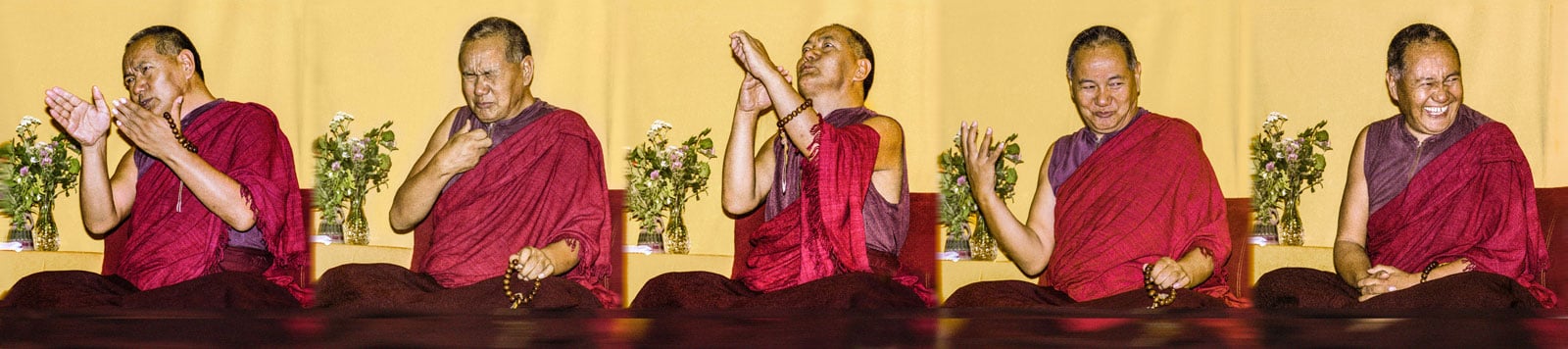
In more recent times, after first encountering the Sanghata Sutra while staying at Geshe Sopa la's monastery in Madison, Lama Zopa Rinpoche decided to copy the sutra by hand in gold, and has asked his students to recite the text on numerous occasions. On the anniversary of September 11, Rinpoche requested that all his students worldwide recite the sutra as many times as possible in order to prevent further attacks.
While reading such a powerfully transformative sutra, which Buddha Shakyamuni taught in order to make the path to enlightenment as easy as possible, we can feel very palpably the Buddha's incredible kindness for us. At the same time, because this sutra contains the actual words spoken by the Buddha, by reproducing that speech ourselves during the recitation, we are offering our voices to serve as conduits for the presence of his teachings in the world. Thus in reciting the Sanghata Sutra, along with all the benefits we ourselves receive, we are acting in a very direct and powerful way to keep active the teachings of the Buddha, which are so urgently needed in order to alleviate the sufferings of all beings.
To access the Sanghata Sutra in English and many other languages, visit the FPMT website.
To learn more about the Sanghata Sutra, visit www.sanghatasutra.net.