
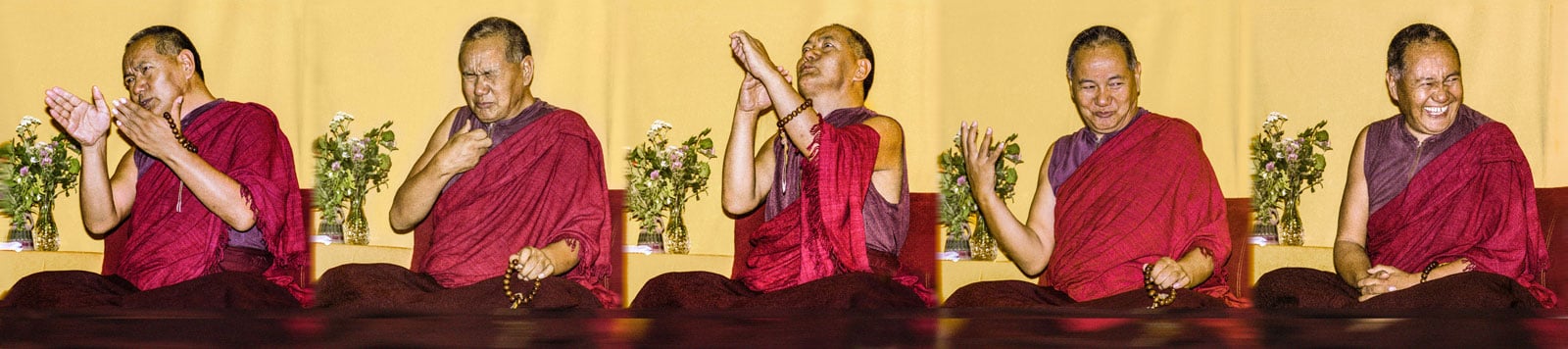
The Diamond Cutter Sutra Dedication |
|
|
The following is a dedication translated and annotated
by Lama Thubten Zopa Rinpoche for the Diamond
Cutter Sutra, to be read at the end of a Diamond
Cutter recitation. Given at Kachoe Dechen Ling on January
24, 2005. Scribe/transcriber Thubten Labdron. Lightly
edited by Thubten Labdron. |
Dedication Prayer
after Reading the Diamond Cutter Sutra
In this world, with its devas, to the founder who, with
the roaring sound of a snow lion, proclaimed the talk of dependently
connected arising,1 I respectfully
prostrate.
The son of the king, abiding majestically in the temple
in the midst of an assembly of virtue beggars (bhikshu,
ge.long) and those intending virtue (ge.dun),2
handed over this Dharma to the holy holder of Dharma, Kungawo
(attendant Ananda) with great emphasis (great care) proclaiming
the definite meaning with the defining words, “Even
if all the Dharma is forgotten, don’t forget this one.”
It is said by Buddha that writing or
reading one word of the Prajnaparamita has greater benefit
than making offerings to all the buddhas for 1000 ten million
eons.3
Why is it like that? The only remedy extremely powerful
in (directly) cutting the root of all the mistakes of the
world (samsara), ignorance, is this holy Dharma, the Dharma
supreme of all the teachings, the ultimate heart of Prajnaparamita
(Wisdom Gone Beyond.)4
Having written, read and made offerings to the supreme Dharma
of all the (Buddha’s) teachings, the heart of Prajnaparamita
(Wisdom Gone Beyond), the ultimate one, the sutra called Diamond
Cutter, may it cut the continuity of the sickness and
harms of black magic, evil si (possession by an evil
spirit)5, obstacles (astrological) and so forth, and increase
the life and wealth; may whatever wishes spontaneously be
accomplished according to holy Dharma.6
Due to the merits and imprint of having
listened to this Sutra and having read it at this time, in
all future lifetimes may I and all sentient beings who have
connection with me be able to hear, reflect and meditate on
this profound Sutra.7
May I become exactly like the life-stories of Sharipu and
Muadiglyana: the minute one hears the words and meaning (of
the Prajnaparamita Diamond Cutter Sutra) able to
have the words and meaning within one’s understanding
and achieve the result. 8
By the virtue of having read this
profound Sutra, may I directly perceive the truth and liberate
in that second all transmigratory beings, equaling the sky,
from the great ocean of samsaric suffering.9
Not grasping at just mere emptiness10 by seeing that the
meaning of emptiness is dependent arising—while the
mind is in that emptiness, free from creativity (mental fabrication
projecting true existence), enjoy the view of emptiness-only.11
Ascertain that the various appearances,12 the dual dharma,13
are mere appearance.14 May I realize emptiness while there
is appearance, with the thought, “even though there
is appearance it is not true (truly existent.)”
By the eminent heart wisdom,15 without abiding in the extremes
of samsara and peace, quickly proceeding on the five paths,
may I become the guide (leader) of all the transmigratory
beings.16
By this particular virtue, and all (other) virtues, may
the gurus’ holy lives be stable and all the deeds and
actions of the victorious ones be accomplished by myself,
alone.
May this holy Dharma, for which the founder
(Guru Shakyamuni Buddha), while training in the path, gave
up the holy body and all enjoyments and possessions, and accomplished
the work only for sentient beings, last a long time.
The victorious one gave up lying for numberless eons even
at the cost of the life and spoke truthfully; by that blessing
may all the prayers be accomplished.17
These prayer words, related to Diamond Cutter Sutra,
were composed by Mipham Dawa. I am not familiar with this
author but the words are extremely profound.
After this one can recite the Diamond Cutter Sutra
mantra.
NAMO BHAGAWATI/ PRAGYA PARAMITAYE/ OM NA TA TATITHA/ ILISHI
ILISHI MILISHI MILISHI BINAYAN BINAYAN / NAMO BHAGAWATI
PRATAYANG PRATI/ IRIDHI/ IRIDHI/ MIRIDHI/ MIRIDHI/ SHIRIDHI/
SHIRIDHI/ USHIRI/ USHIRI/ BUIYE/ BUIYE SWAHA
“The benefit of reciting the heart of the Diamond
Cutter Sutra equals having recited the Diamond Cutter
Sutra 9x3000 times.”
Then recite the mantra of dependent arising and Vajrasattva
mantra. Also, after reciting the Diamond Cutter Sutra
it is good to do the mantras for increasing merits.
May the merit of having translated this work bring the most
benefit to and be used by all sentient beings, causing them
to quickly realize emptiness and then with direct perception,
bodhicitta, achieve full enlightenment as quickly as possible.
May it cause all sentient beings in this world to be able
to read the Diamond Cutter Sutra, realize emptiness
and actualize bodhicitta, realizing other sentient beings’
suffering and how they are so precious. May nobody experience
war, famine, disease or danger from fire, water, wind and
earthquakes.
Whoever reads this dedication, may all their negative karma
get purified and may they never get reborn in the lower realms.
May they immediately realize emptiness, actualize bodhicitta,
complete the two stages of tantra in this very life and achieve
enlightenment as quickly as possible. May each person who
reads this dedication become the source of peace and happiness
for all sentient beings, like Chenrezig, like Guru Shakyamuni
Buddha, like Maitreya Buddha, Vajrapani and Manjushri.
May the wishes of whoever recites the Diamond Cutter
Sutra succeed immediately, may they have a long life
and receive all the benefits, whatever they wish.
Notes
1. Tib: ten.ching del.wai jung.wa.
Ten – depending; del – connecting;
jung – arising. Things arise and come into
existence by depending on the base, the mind. [Return
to text]
2. The virtue they are begging (Tib. ge.long)
is liberation or nirvana, and because they are seeking that,
they are living in the vow. The other one is intending virtue
(Tib. ge.dun; ge - virtue, dun
- intending.) For that reason they have the wish to live in
virtue. [Return to text]
3. 10x100,000 = 1 sa.ya. 10
sa.ya = 1 che.wa (10,000,000.) The result of
making one offering to a picture or statue of Buddha includes
all the happiness of samsara we have had since beginningless
time and all the samsaric pleasures we will experience in
the future. Not only that, the benefit continues as one achieves
liberation from samsara, all the realizations, and doesn’t
finish until one achieves great liberation, enlightenment.
That includes the complete Mahayana path from guru devotion,
renunciation of this and future lives, then bodhicitta, right
view, the five paths and ten bhumis, and the tantric path.
It includes the limitless qualities of Buddha’s holy
body, holy speech and holy mind. Everything is the result
of having made a tiny offering of one grain, a stick of incense
or a tiny flower to Buddha or an image of Buddha, a stupa
or scripture.
The text mentions liberation, which means great liberation,
but my view is that even after you achieve enlightenment still
you experience the benefits of making that tiny offering,
because then you liberate numberless sentient beings by revealing
Dharma. Through suitable means you liberate one sentient being
from the lower realms, from the suffering of samsara, from
lower nirvana and from the subtle defilements; then you bring
that sentient being to enlightenment. Like that you bring
numberless sentient beings from happiness to happiness to
full enlightenment. So even after you achieve great liberation,
there are all these unimaginable benefits of guiding each
of the numberless sentient beings from happiness to happiness
to full enlightenment; still you are experiencing the resultant
merit of offering a tiny flower or grain to a statue, stupa
or scripture. The benefit is the same when we make offering
before we drink or eat.
So the benefit of making offerings to Buddha, even a picture
or statue of Buddha, is limitless, it includes everything,
all the happiness and every single realization on the path
to enlightenment, every single samsaric pleasure that one
has experienced from beginningless rebirth up to now and will
experience in the future; for that long, still the merit doesn’t
finish. Here it says, for however long you make offerings
to Buddha, even 1000 times ten million eons, even to all
the buddhas, writing or reading one word of the Prajnaparamita
has greater benefit. [Return
to text]
4. Neither bodhicitta nor any other realization
of sutra and tantra can directly cut ignorance. [Return
to text]
5. Tib: si, a being who, with
an evil mind harmed others in a previous life. I think maybe
si is somebody who criticized or broke the relationship
with the vajra master; who created very heavy negative karma
and died with hatred, then was reborn as a powerful spirit
that harms holy beings or those sentient beings who preserve
and spread the Dharma. [Return
to text]
6. Only bodhisattvas living in the 8th,
9th and 10th bhumi don’t have delusions, so I added
“according to holy Dharma” to protect from the
danger of someone dedicating for the success of harmful negative
thoughts, like wishing someone to die, etc. [Return
to text]
7. At the beginning this text tells how
much Buddha cherished and emphasized the preciousness of this
sutra and how Buddha handed this teaching precisely to Ananda.
Then it talks about how it collects incredible merit; how
offering to Buddha is incredible, like limitless sky, bringing
benefits beyond our imagination and yet how having written
or read even one word of Prajnaparamita has much greater benefits.
It then explains how the Prajnaparamita benefits by being
the only one powerful enough to cut the root of suffering,
from where delusions and karma come, and other benefits. Then
it tells why it is the only remedy powerful enough to cut
the root of all the suffering, delusions, karma and ignorance.
Then it talks about other benefits like stopping heavy problems
such as black magic, astrological obstacle years and the evil
si spirit, and increasing life and wealth.
So it talked about pacifying, then about increasing life,
wealth and enjoyments, and for all wishes to spontaneously
succeed.
Then the next one is making prayers to be able to hear it
in all future lifetimes. Here, I added, so that you are not
doing the prayer and dedicating the merits only for yourself,
“… I and all sentient beings who have connection
with me, in all future lifetimes be able to hear…”
Then I added “reflect and meditate on” this sutra.
[Return to text]
8. One is able to understand the vast Prajnaparamita;
just as many things can be packed inside a small container
or suitcase, the minute one hears Prajnaparamita Diamond Cutter
Sutra, one is able to have the complete words and meanings
within one’s understanding. [Return
to text]
9. I added this dedication. [Return
to text]
10. This has a very profound meaning.
“Grasping at mere emptiness” refers to ordinary
emptiness, like space. When you meditate, if it didn’t
touch the hallucinated object, the object to be refuted, that
would be ordinary emptiness. Then the whole life you would
be meditating on ordinary emptiness, meditating on the sky,
like looking from an airplane window at space. [Return
to text]
11. In Tibetan “emptiness only”
is tong-nyi. Tong is “emptiness”
nyi is “only.” Why not just tong?
Why is nyi added? Putting the word nyi makes
a huge difference, it gives incredible protection by cutting
the misconception of ordinary emptiness; it gives the meaning
of ultimate truth. [Return
to text]
12. “The various appearances”
means everything, all the billions of things here, in the
department stores or supermarkets. They are all dual appearance
or dual dharma. [Return to
text]
13. One meaning of dual dharma is true
existence; another meaning is appearing as subject and object.
When arya beings are in equipoise meditation on emptiness
there is no duality, there is no subject/object in the view
of that mind. The dual view is not cut at that time but absorbed.
Only when you become enlightened, when the subtle negative
imprint left by the concept of true existence, which projects
the truly existent view, is ceased, is the dualistic view
cut. During the path of the arya being it is not cut but temporarily
absorbed, like having put water into water.
I think what it is saying is that one has to meditate on
“merely labeled,” like the example of a mirage.
You look at the things that happen in everyday life as like
an illusion or a dream, with your meditative awareness that
there is no such thing in reality, everything is empty. Whatever
appears to us here, right now—I appear to you, you appear
to me, whatever appears to our six senses—the way they
appear is not as phenomena merely labeled by mind, but as
existing from their own side. When you are practicing mindfulness
you see how all this is merely labeled by mind or like a dream,
an illusion or a mirage.
When you apply those examples to everyday life, the understanding
that comes in your heart is that all this is not true. There
is no such subject I, there is no such action, object—there
is no such thing. So it’s a totally different
world. The reality, what exists, is completely another
world. When you don’t meditate or practice mindfulness,
the mind believes as true all the hallucinations that appear
truly existent. But the reality is completely opposite:
everything existing from its own side and believed as such,
is completely non-existent. That is the truth, the other one
is false. The way things appear to us—subject, action,
object—and is believed by our own mind to be real, is
all hallucination.
What exists is that non-existence. The reality, that nothing
exists from its own side, is unknown. The non-existent, truly-existent
I, action and object are the reality. For those who have realized
emptiness or see things as illusory, perhaps it is different,
but otherwise the reality is unknown. What is believed according
to our concepts doesn’t exist; what one doesn’t
believe or what is not known is what exists. [Return
to text]
14. All phenomena are merely imputed by
mind on mere appearance. You have to get that idea. First
there is mere appearance and then mind merely imputes on that
and that is how things come into existence. If something is
appearing as truly existent then it is not mere appearance.
After being merely labeled it should appear back as a mere
appearance, but when it appears back to us there is something
additional, existing from its own side. When it appears back
as merely labeled by mind, then it is mere appearance. That
is the correct view, what it should be.
Here it says “ascertain mere appearance.” Another
way you can say it is “ascertain as merely labeled by
mind.” It has the same meaning.
For example, Pabongkha Rinpoche also mentioned in the teachings
when you look at a drum and try to be aware that this drum
is merely imputed by one’s own mind, not just saying
the words but meditating, you see the base, the shape and
the function—beating to make a noise—and by reason
of that that the mind merely imputed “drum.”
At that time if you are watching the mind as it merely imputes
“drum” there is a very subtle moment of mere appearance,
a very short second, then immediately after that it appears
as existing from its own side.
For example, after you conceive a child, you think about
a name. If your mind is aware, at the very first moment when
your mind merely imputed a name, during the very second you
are labeling, there will be a mere appearance, when there
is not a strong clinging to that “Peter” or “Tashi.”
But it’s a very, very subtle moment; if you are not
aware, of course, it looks like immediately truly existent
Tashi or Peter.
I don’t know whether you can say there is an extremely
subtle true existence, but right after your mind merely imputed,
because of habituation, the negative imprint left on the mental
continuum by the past ignorance, the concept holding true
existence, immediately projects “truly existent”
on that. That is the evolution. There might be a second where
it doesn’t have heavy true existence; right after the
parents said “What about ‘Peter’? Let’s
decide on ‘Peter.’ This is Peter,” while
they are aware of labeling, merely imputing; but when you
are not aware, you don’t notice that extremely short
second. You have to analyze.
There may be some cases when you put this name for a few
seconds, then the next minute you change that name—during
that time how does it appear? It’s good to check how
it appears to you. Does it appear as something very heavy
truly existent or not? Pabongkha Rinpoche did express that
there is a very, very short time of mere appearance and then
the usual one, true existence.
When you look through the window at the road, there is,
for example, a horse’s body running and on that particular
appearance, you label “horse running.” Or a cat
jumps—on the sudden mere appearance of that particular
bodily shape the mind labels “cat jumping.”
A particular design is called “bicycle.” It
appeared and in a finger-snap your mind made up the label
“bicycle.” Then you see a particular vehicle and
because of that your mind immediately imputes “truck.”
If you don’t meditate, what happens then is that they
appear as truly existent truck, truly existent bicycle, truly
existent cat and dog and horse and all these different things—even
though just now your mind merely imputed. The reality is what
your mind merely imputed appears back as a mere appearance.
I think “mere” appearance should cut “truly”
existent, appearing as heavily existing from its own side.
In “merely labeled,” “merely” cuts
existing from its own side, so “mere” appearance
is the same—it cuts that extra thing, not just mere
appearance but truly existent appearance.
So if you practice awareness from the beginning, when your
mind imputes, and continue that awareness, then you see that
because the base is there, your mind merely imputed and believed
in that.
What is horse? It is not something on that horse body; “horse”
is just a name made up by your thought, and you believe in
that. And “bicycle,” seeing that base your mind
thought of the label and believed in it. It is not something
on the bicycle, on that material. If you analyze it, this
is how it is. When you don’t check, don’t analyze,
it looks like it is really there, on the base; when you analyze
you cannot find it there. At that time it exists and receives
the label according to the base and function. If a person’s
body is very fat and square, we say “such-and-such person
is fat and square.” If the person’s body is very
thin, “this person is very thin.” So the label
is received according to the function or quality of that base.
The conclusion is we have to meditate according to the reality
that whatever it is, it is merely imputed by one’s own
mind. Whatever appears to you as truly existent is in reality
mere appearance.
The other meaning of “mere appearance” could
be like having walked through sand, looking back you see an
appearance of water but you just came from there and you know
there is no water at all. You have a mere appearance of water
but you don’t believe there is water. Similarly, everything
appears to us as not merely labeled by mind, as existing from
its own side. One meaning could be like that.
When you meditate in sitting meditation or break time, looking
at everything as like a dream, an illusion or, if you are
practicing subtle dependent arising, merely labeled, you have
an appearance of true existence but you don’t believe
it. Because your mind is aware that it is merely labeled,
you don’t cling or grasp to that truly existent appearance
as true. Just like when you recognize a dream as a dream,
you don’t cling to all those images that are appearing
to you because while it is happening you know it is a dream.
So mere appearance could have the meaning that you have
a truly existent appearance but you don’t hold on to
it or grasp it as true. Another meaning is, after you have
done analysis of the “I”, you see it is merely
labeled by mind. “I” exists in mere name. There
is no “I” to be found on the aggregates but there
is “I” existing, merely imputed by mind. In other
words there is a non-truly existent or merely labeled I. Because
there are the aggregates so there is “I”, existing
in mere name. It is not that it absolutely doesn’t exist—
it exists as something extremely, unbelievably subtle.
Similarly, when you analyze the general aggregates you cannot
find them on this collection of five, but there are aggregates—because
you cannot find them doesn’t mean there are no aggregates.
What are they? They are merely imputed by your mind. Because
there is the collection of five, your mind merely imputed
“aggregates.”
It is not like the real aggregates of before; it is something
extremely subtle, existing by name. While you are meditating,
seeing the aggregates as merely imputed by mind, you see what
exists is extremely subtle, it doesn’t have even the
slightest atom of existence from its own side, in
the aggregates.
That time is one example of mere appearance: seeing the
aggregates as something extremely, unbelievably subtle. You
can’t say they don’t exist. They exist, but compared
to the previous view of inherently existent aggregates it’s
like they don’t exist.
Furthermore, as you analyze form, sound, smell, taste and
touch, again you cannot find them there, on the base—they
are merely imputed by mind, extremely subtle.
Go through all the parts of the body, such as the limbs,
down to the atom. Analyze even the atom’s collection
of parts, the sub-particles, as in the Prasangika view. The
mind merely imputed atom, but cannot find it. The atom doesn’t
exist on the collection of parts but that doesn’t mean
atom doesn’t exist; it exists, merely imputed by mind.
“Atom” is empty of existing from its own side
and, while it is empty, it exists in mere name. The logic
is the same with the particles: you cannot find them on the
collection of parts. Then the split seconds: within one second
there are many split seconds of consciousness, which are merely
imputed by mind, and therefore do not exist from their own
side. They are empty.
Like that, through analysis, you cannot find anything on
the base. Every single thing is existing in mere name. This
analysis maybe gives you some idea of what mere appearance
is. Everything becomes so subtle; everything is kind of empty,
not existing from its own side. What exists is only what is
merely labeled by mind—the whole thing.
These are the different ways you can think of mere appearance.
[Return to text]
15. This Diamond Cutter Sutra
is similar to the Heart
Sutra in that it is the heart all the teachings on
perfection of wisdom. So it is the best, the eminent one.
He is saying by actualizing the eminent wisdom which is the
heart of all Buddha’s teachings, the Prajnaparamita,
even more, the heart of the Prajnaparamita, you don’t
abide in the extremes of samsara or nirvana, and along with
this also you realize bodhicitta. I think what it is saying
is that this wisdom directly perceiving emptiness, which is
the meaning of the Diamond Cutter Sutra, ceases not only the
gross defilements (that would be nirvana) but even the subtle
defilements, which means freedom not only from samsara but
from lower nirvana. [Return
to text]
16. The Tibetan word dro means
“go.” Kun is “all.” Sentient
beings are called dro.la. Why are they called dro.la?
Because all the sentient beings migrate continuously in the
six realms under the control of delusion and karma, they don’t
have any freedom. In the teachings another meaning of dro.la
is that, because of delusion, from the time of birth, the
nature of sentient beings is to continuously run towards death,
not stopping to rest for one minute or second—they are
“continuously going” or “goers”. [Return
to text]
17. It means your prayer. There are many
auspicious prayers related to Buddha’s Twelve Deeds,
the buddhas of the three times, and the five types of buddhas.
There is a prayer called Ta.shi Tse.pa, Piles of
Auspiciousness, which is recited most days as it is very important
for the success of the Maitreya Project. So “due to
this and this”—something that Buddha taught—“may
this be auspicious, may my prayers and wishes be fulfilled.”
Dedicating like this, because it is true, has a lot of power
to bring success. [Return to
text]
|