
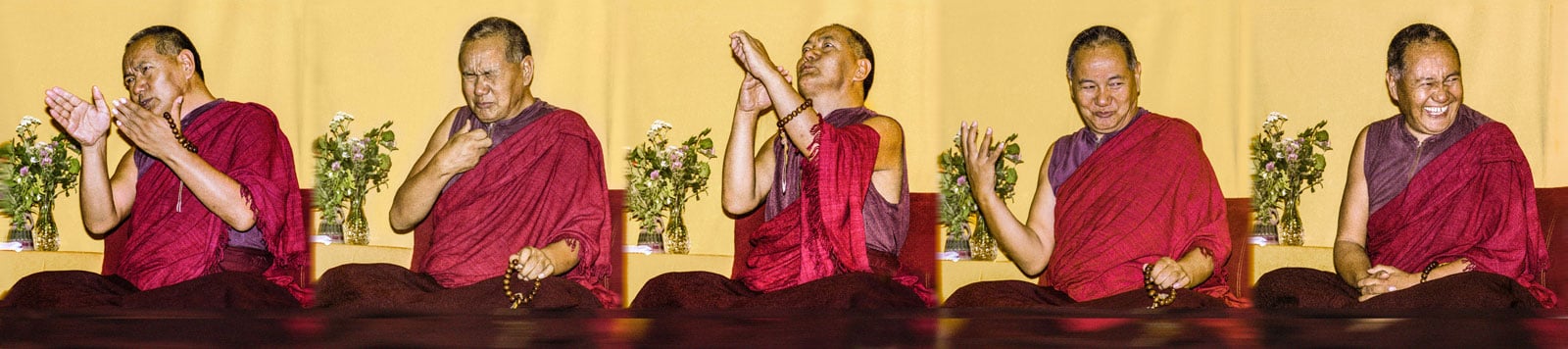
Mind Retreat
Lama Zopa Rinpoche gave this teaching at Tushita Meditation Centre, Dharamsala, June-July 1982, to students doing the Vajrasattva group retreat that took place right after the IMI Sangha's Guhyasamaja group retreat, which followed the First Enlightened Experience Celebration (EEC1). Edited by Ven. Ailsa Cameron.
Please note that the meditation on the three kayas should be practiced only by students with a Highest Yoga Tantra initiation.

First Discourse (29 June 1982)
I planned to speak just one time, that night after puja if it finished quite early. I did not intend to speak another time. However, some people have asked similar questions about doing retreat and others have asked questions about the kindness of mother sentient beings. I think everybody has heard enough about the kindness; everybody has heard about this many times from different teachers.
The subject of kindness is contained in the outlines of the lamrim and in the lamrim commentaries, but if you don’t read each subject skillfully, even though the books do explain the kindness, it won’t appear to you that they are talking about kindness. The kindness of mother sentient beings and how they are so precious are explained very extensively and effectively in such texts as A Guide to the Bodhisattva’s Way of Life in the section of exchanging self for others.
Because it might help some people, I thought to talk a little on the fundamental retreat rather than on such specific points as the recitation of mantra. I have no advice to give other than what was taught by Guru Shakyamuni Buddha, or other than what is in the lamrim. There will be nothing new in what I explain.
However, even though I will be talking on subjects that you have heard before, each time you hear lamrim again it can be very effective for your mind. It can go right inside your heart. For example, if you have a recurrent fever for which you have taken medicine many times before, the medicine still helps when you get the fever again. Even though what you hear is nothing new, it can still somehow change the mind.
When His Holiness Zong Rinpoche gave a commentary here on Lama Tsongkhapa’s lamrim, The Lines of Experience, Rinpoche said that when you hear that someone else is dead, you should think, “This is advice to me that I’m also going to die.” Rinpoche was saying that hearing that someone has died should persuade you to practice Dharma. It is advice to you that, like this person, you will also die unexpectedly one day, so you should hurry up and practice Dharma.
Because I have accumulated a little merit, I have heard lamrim teachings many times from the holy mouths of highly realized gurus. In regard to the words, I don’t hear anything new, but each time I hear these teachings I find them very effective for my mind, so I write notes.
Before talking on the main subject of mental retreat, I thought first to talk a little on the essence of Vajrasattva, on what Vajrasattva is. It might benefit some people.
In Vajrasattva, one meaning of vajra is emptiness only, or tong pa nyi in Tibetan. Emptiness is permanent and indestructible; it cannot be changed through a cause in the way the impermanent phenomena can. Because it is indestructible, emptiness received the name “vajra.”
“Sattva” refers to the Buddha’s holy mind, the transcendental wisdom of great bliss, which single-pointedly focuses on its object, emptiness, or the vajra. Another way of expressing this is to say that emptiness is covered by the transcendental wisdom of great bliss. Vajrasattva means the transcendental wisdom of great bliss (sattva) abiding single-pointedly on emptiness (vajra).
There are three types of enlightenment mentioned in the Madhyamika teachings. The small enlightenment of the Hearer; the middle enlightenment of the Self-Conqueror; and then sublime enlightenment. Arhats who have achieved the small or middle enlightenment have the wisdom that fully realizes emptiness and concentrates single-pointedly on emptiness, and so do arya bodhisattvas. However, their wisdom does not concentrate single-pointedly on emptiness without subtle dual view. Even though they have the wisdom that fully realizes emptiness and concentrates single-pointedly on it, subject and object are not one, without the slightest dual view, like having poured water into water. The wisdom that realizes emptiness of the arhats and arya bodhisattvas is not the definitive meaning of vajra. It is not the transcendental wisdom of the vajra in Vajrasattva; it is not the definitive meaning of vajra.
The transcendental wisdom of great bliss of supreme enlightenment focuses single-pointedly forever on emptiness, but has no subtle duality between subject and object. Subject and object are inseparably one, like having poured water into water. This transcendental wisdom of great bliss does not last for a certain number of years but forever. It focuses single-pointedly and forever on absolute nature. This transcendental wisdom is the definitive meaning of “vajra”; the Buddha’s holy mind, the dharmakaya, is the definitive meaning of vajra. The transcendental wisdom of great bliss is called “vajra” because it is forever inseparable from its object, emptiness, or absolute nature. It does not move even for a split-second; it is oneness forever with the absolute nature of all existence.
Now, if the Buddhas simply abide in this state of dharmakaya and do not manifest, they cannot do works for other sentient beings. So, in order to work for sentient beings, this transcendental wisdom of great bliss, this dharmakaya, the definitive meaning of vajra, manifested in the interpretive meaning of vajra, the pure illusory holy body of the sambhogakaya aspect, which is white in color, has one face and two arms, and is single or embraces a wisdom female. This aspect is composed of pure subtle wind.
The definitive meaning of vajra, the transcendental wisdom, manifests in this aspect to do works for us and to guide us. The “vajra,” the transcendental wisdom of great bliss, this holy mind of dharmakaya, is unified inseparably with “sattva,” the holy body of the rupakaya. The holy body, the rupakaya, has this particular aspect, which is white in color and has one face and two arms. It is the Highest Yoga Tantra aspect, it embraces a wisdom female. This holy body of rupakaya is inseparable from the holy mind of dharmakaya, the vajra, just like our present subtle wind and subtle mind are inseparable. The holy mind of dharmakaya unified with the holy body of rupakaya is Vajrasattva.
The tantric teachings use the term Shri Vajrasattva, Glorious Vajrasattva, or pal dorje sempa in Tibetan. Vajrasattva is glorious because he has perfected all the cessations, so that not even the slightest stain remains, and he has perfected all the realizations.
When we recite one Vajrasattva mantra each day with faith that the mantra has the power to purify negative karma, our negative karmas and obscurations are lessened. Even this small amount of purification is the start of the process of accomplishing the “Shri” in Shri Vajrasattva; it is the start of completing the quality of the cessations. Each time we plant seeds on our mind by hearing teachings on emptiness, by meditating on emptiness, by remembering or using the words “empty of true existence,” or just reciting the word “emptiness,” we are engaged in the process to achieve “Shri,” the completion of realizations. Each time we meditate on emptiness or even read about emptiness we leave impressions on our mind. And each time we generate compassion for all sentient beings, or even for one particular human being with a problem or one particular animal, we are accomplishing the “Shri.” We are increasing the very small quality of “Shri” that we already have.
The same applies to each time in our daily life that we try to stop the arising of negative minds such as pride, anger, and attachment. Each time we control our mind and transform it into virtue by applying the remedy of the lamrim meditations, each time we try to stop even a small mistake of the mind, we are accomplishing the “Shri” in Shri Vajrasattva. Each precept we protect every day is also a means of achieving Vajrasattva’s qualities, or “Shri.” And each prayer we make to Vajrasattva is part of the process of accomplishing Vajrasattva’s state, “Shri.”
To achieve Vajrasattva’s state, the unification of the pure holy body of rupakaya and the pure holy mind of dharmakaya, the unification of no more learning, we must first achieve the unification of learning. To achieve the unification of learning, we must first receive the word initiation, which leaves the potential to achieve the path of the unification of learning and which ripens the mind to meditate on this path.
To achieve the path of learning, we must accomplish separately the paths of the clear light and illusory body. In order to achieve the path of the clear light, we must receive the wisdom initiation, which leaves the potential to achieve the path of clear light, of which there are two types, the clear light of example and the clear light of meaning. Receiving the wisdom initiation ripens our mind to meditate on the path of clear light.
To achieve the illusory body, we must receive the secret initiation, which leaves the potential to achieve the path of the illusory body and ripens the mind to meditate on the path of the illusory body.
In order to accomplish to the paths of the clear light and the illusory body, we need to accomplish the preliminary realizations of the graduated path of the generation stage. In order to accomplish this, we must receive the vase initiation. Receiving the vase initiation leaves the potential in the mind to generate the realizations of the generation stage and ripens the mind to meditate on the graduated path of the generation stage.
These four initiations have to be received from a vajra guru. The conclusion is that to achieve such the state of Vajrasattva, a vajra guru who reveals the four initiations is essential. The vajra guru is the very root of our achieving the Vajrasattva state, of our becoming Vajrasattva. Therefore, in order to become Vajrasattva for the benefit of other sentient beings, to accomplish the works for sentient beings, the very root is correct devotion to the gurus who reveal the Dharma. And among these gurus, we must follow very carefully the vajra guru, who reveals the four initiations. Our whole achievement of the state of Vajrasattva depends on this root.
Second Discourse (30 June 1982)
As I mentioned yesterday, each time you recite the Vajrasattva mantra your obscurations are lessened. And each time you accumulate merit, each time you practice patience, each time you generate compassion, you become closer to the state of Vajrasattva, which is the complete cessation of all obscurations and the perfection of all realizations. Every day when we are able to control the rise of delusion or when we try the mind one with the lamrim, we are becoming closer to Vajrasattva.
The vajra in Vajrasattva is the holy mind of all the Buddhas, the transcendental wisdom of great bliss, the dharmakaya. This holy mind manifested in the sambhogakaya aspect of Vajrasattva to guide sentient beings. Not only that, but it also manifested in the supreme holy body of transformation, the nirmanakaya aspect (or tulku, in Tibetan), as the Buddhas of the five families and the hundreds of other aspects of Buddha. It also manifested in various ordinary aspects as a monk, a king, a lay person, or a mara, as whatever was necessary to suit the various sentient beings. Even for us, this holy mind appears not only in the sambhogakaya and nirmanakaya forms of Buddhas, but also in the ordinary forms of various virtuous teachers. It does not necessarily appear as a teacher, but can sometimes appear simply in the form of a friend or of someone who is always bothering us, and thus persuading us to practice patience. It can also appear in the form of an animal, such as a wounded dog or some other object of compassion. When we see very sick people or a suffering animal, we generate compassion and try to help them, and in that way we accumulate merit. The dharmakaya manifests in many different ways, not just as a teacher who reveals Dharma and gives initiations. It can manifest in the form of a beggar to whom we give money and thus accumulate merit. It manifests in forms that guide us according to the capability of our mind.
The vajra, the dharmakaya, manifests in various forms to guide us in our everyday life, and these manifestations change as our mind progresses. By manifesting in various sambhogakaya, nirmanakaya, and ordinary forms, the dharmakaya fulfills the wishes of sentient beings. They become the condition for us to accumulate merit—by manifesting as a virtuous friend, for example. In this way, we can then get what we want; we can achieve whatever temporary or ultimate happiness we wish. Shri Vajrasattva fulfills the wishes of all sentient beings through such effortless, vast activities.
Each time we do a session of meditation on Vajrasattva, Vajrasattva is guiding us. Even if simply recite the Vajrasattva mantra one time, Vajrasattva is helping us by enabling us to purify that much negative karma. Vajrasattva is constantly helping and guiding us. Vajrasattva has infinite compassion and never renounces us as an object of compassion. Vajrasattva is saving us from falling into the abyss of the lower realms.
As I mentioned yesterday, the very root of the achievement of the state of Vajrasattva is the vajra guru, who bestows the four initiations and reveals the vajra teachings. The whole thing depends on the vajra guru. As the embodiment of Vajrasattva, the guru reveals the lamrim teachings, and by practicing them, we purify and accumulate merit. The guru also gives us the four initiations. As we train our mind in the graduated tantric path, our mind becomes more receptive and capable and gradually we become Vajrasattva. Our mind becomes the holy mind of Vajrasattva, the holy mind of dharmakaya. This subtle mind is free of all stains and is one with absolute nature. The pure subtle wind associated with it then manifests in the particular aspect of Vajrasattva, male and female in embrace. There is a link to our present subtle body and mind. If we train our mind in the path by practicing purification and accumulating merit, we can actually manifest in this form for the sake of sentient beings through achieving the definitive meaning of vajra, this stainless subtle mind. When our mind becomes the definitive meaning of vajra, we are also able to manifest as sattva.
There is a word-by-word explanation of the meaning of the mantra, but it might be helpful to have an overall view of its meaning. The mantra is recited in the form of a request to Vajrasattva. “You, Vajrasattva, have generated compassion...” As mentioned in the teachings, with the thought to benefit other sentient beings, Guru Shakyamuni Buddha trained his mind in great compassion for a long time, for eons, and completed the works for self and the works for others and accomplished the state of omniscient mind. Buddha now works effortlessly to guide sentient beings. Buddha always looks at sentient beings with compassion; his holy mind is never distracted from the object of sentient beings for even one second, and he does works with the holy body, holy speech, and holy mind in accordance with the level of mind of each sentient being. Because of this, sentient beings receive incredible benefits in terms of peace and happiness. Each of us receives peace and happiness, not only now in our everyday life but in the three times. The very root of this great result is great compassion, the wish to personally free sentient beings from suffering.
The whole thing came from this root, great compassion, so we can see that compassion is incredibly important. We can understand how important it is to practice compassion in our everyday life by looking at story of Guru Shakyamuni Buddha. We can now receive all this guidance from Guru Shakyamuni Buddha because of the very first time that Buddha generated great compassion for sentient beings. In one of his past lives, Buddha was born as a hell-being, and along with another hell-being, he had to pull a carriage with a hell guardian on top over the red-hot iron ground. The other hell-being was in such suffering that he could no longer pull the carriage. Buddha felt such unbearable compassion for him that he decided to spare the other hell-being the suffering and pull the carriage by himself. Buddha thought, “Instead of his having to suffer, I will experience the whole suffering of pulling the carriage. And may I also experience all the suffering of other sentient beings who are suffering now like this and of those who will have to suffer like this in the future. May I experience this suffering on behalf of all those sentient beings.”
This is the very first time that Buddha generated great compassion. As a result, Buddha’s consciousness was immediately transferred from the hell realm to a deva realm (either Tushita or the Thirty-three Realm). This very first time that Buddha generated great compassion is the very root of all the incredible benefit that Guru Shakyamuni Buddha has brought the world, his completion of the works for self and others and even the guidance that we presently receive by taking refuge in Buddha.
“You, Vajrasattva, have generated great compassion and are best as the samaya because you work effortlessly to guide me and other sentient beings.”
We use the term “best” in the same way that we say an expert musician is the best at playing music. The word “me” is not actually in the mantra, but it is effective to always relate to yourself. “Sentient beings” might be mentioned.
The Tibetan word for samaya is dam-tsig, and this can have two meanings. Dam can mean advice such as that given by the vajra guru during an initiation to avoid the fourteen tantric root falls (the first of which is criticizing the guru) and the secondary vices and to practice the mother tantra samayas. Dam can also be another way of saying “seal.” Tsig means burn. During an initiation the vajra guru advises you that if you want to achieve the holy mind of Vajrasattva, the transcendental wisdom of great bliss if you want, you have to observe various precepts. If you transgress this advice, you will be burned in the fire of the hells.
This is the basic meaning of dam and tsig, and the term dam-tsig, or samaya, means something that you cannot transgress. And “as the samaya” refers to Vajrasattva. It means that because Vajrasattva generated great compassion for sentient beings, he is not beyond the samaya of doing effortless actions to guiding you and all other sentient beings. Just as a reflection of the moon appears in every body of uncovered water, Vajrasattva appears whenever the mind of a sentient being is ripe and then acts effortlessly to guide that sentient being. Vajrasattva is never even for a second beyond this power of working effortlessly for sentient beings. If we take refuge in Vajrasattva, it is impossible for Vajrasattva not to guide us. Vajrasattva always has this power.
The last part of the mantra says, “No matter what happens, whether my life is happy or suffering, please (the “please” actually comes at the very end with the final request, but it doesn’t matter) guide me with great compassion and a pleased mind and never abandon me.”
Compared to our previous attitude of allowing delusions to arise and doing actions that created the karma to be reborn in hell, our action of reciting the Vajrasattva mantra to purify negative karmas and for the happiness of future lives or ultimate happiness pleases Vajrasattva. Vajrasattva is happy because we are attempting to create the cause of our own happiness and not the cause of suffering. Of course, the best way to please Vajrasattva is to recite the mantra with a motivation of bodhicitta, thinking that we are purifying our negative karma for the sake of other sentient beings. Since we are creating the cause, it is worthwhile to request Vajrasattva not to abandon us and to please guide us with great compassion and a pleased mind.
We also request Vajrasattva, “Please stabilize my realizations of the paths and bhumis.” This is a request that Vajrasattva stabilize and not allow to degenerate whatever experiences of the path we have, which includes any wisdom, compassion, patience, or other good quality that we have developed. Since we haven’t achieved the paths and bhumis, there is nothing actually to stabilize, but we can relate the request to our present level of mind by asking that whatever good quality of mind we have not to degenerate. It is important to stabilize what we already have.
The next request is, “Please stabilize my temporary happiness.” I think that we are probably requesting this because if we do not have temporary happiness, we cannot practice Dharma. For example, when we have excruciating toothache, pain in our knees, or we are very hungry, we cannot think about anything else and we don’t want to do anything. We just lie around. We have no energy to say prayers or to do some meditation. If we are not happy, we cannot practice Dharma. Of course, it’s different for someone who has trained their mind in thought transformation. His mind cannot be disturbed whether he is experiencing great happiness or great suffering. No matter what happens, nothing hinders his Dharma practice. But for most of us, unless everything is suitable, we cannot practice Dharma. If we are too happy we cannot practice; if we are suffering too much, we give up the Dharma. To maintain our Dharma practice everything has to be conducive. I think this is the purpose of asking Vajrasattva to stabilize our temporary happiness.
We then ask Vajrasattva, “Please grant me all the actions and the general and sublime realizations.” There are eight types of general realizations, and sublime realization is enlightenment.
The fourth request is, “Please make it possible for the five transcendental wisdoms to definitely abide in my heart.” The five transcendental wisdoms are signified by “ha, ha, ha, ha, ho.”
This is the whole meaning of the Vajrasattva mantra when you put together all the parts. In each session, before you start to recite the mantra, remember the meaning of the mantra one or two times at the beginning, in the middle, and at the end. In this way, you will have a strong feeling for the mantra as you recite it. Your recitation will be very rich and very powerful. If you review the whole meaning, your mind will be happier because you will be clear about what you are requesting. I think it is more effective to reflect on the whole meaning of the mantra rather than to consider the meaning of each individual word every time.
Some people have doubts about the benefit of visualizing Vajrasattva on their crown and wonder how it can bring about purification. Many years ago, when Lama Yeshe and I came to Nepal from India, Zina, our very first student, was our only student, and I tried to translate for her when Lama Yeshe was teaching. A French doctor and a French artist, Sylvia, lived with us for quite a long time—three years, I think. They did their own type of meditation. The doctor was young and had a very good heart; he was a very nice person and very keen to help his patients in Bir Hospital, one of the public hospitals in Kathmandu. He was also very quiet and didn’t talk much.
This doctor actually did a lot of meditation. When he returned home from Bir Hospital each day, he would have some tea then always do meditation in his room. On Sundays he would go up to Kopan. At that time we were staying at Boudhanath, not at Kopan. We were staying in the house of Chime Lama’s son; it has a double vajra. Kopan was in our minds, but we had not yet made it. This doctor used to go to Kopan on Sundays to meditate.
He asked for some meditation advice from Lama Yeshe, and Lama gave him the Vajrasattva meditation to do, advising him to visualize Vajrasattva on his crown. The doctor then asked, “What is the difference between visualizing shoes on my head and Vajrasattva?” I think for him shoes were more real because he could see them, whereas he could not see Vajrasattva. He didn’t get any feeling from visualizing Vajrasattva.
This kind of question is the result of not having a fundamental understanding of refuge, of the qualities of Buddha, and faith in them. Without this understanding and faith, doubts then arise about the point of visualizing something that you cannot see.
Many years ago, when Lama Yeshe and I went to Australia for the first time, we gave a meditation course at Diamond Valley in Queensland. One of the students, a very tall Australian man, was helping to translate into English the Four-arm Chenrezig meditation written by Lama Yeshe. He told Lama Yeshe that he didn’t get much feeling from thinking of light coming from Chenrezig’s heart, but he could understand showers of light coming from Lama Yeshe’s heart. I think this is actually very good. Many Tibetans, for example, have more faith in something they can’t see than in something they can see. They regard someone they can see, such as a guru, as ordinary (which means having faults), like themselves, so generally find it difficult to have faith in them. having mistakes. However, they find it very easy to generate faith in some separate being such as Chenrezig or Tara, which they can only see in pictures. This Australian man, however, couldn’t make much sense out of visualizing light coming from Chenrezig, but got a lot of feeling from visualizing light coming from Lama Yeshe’s heart. I think his feeling of happiness from visualizing light coming from Lama’s heart is very good.
It is said in the tantric teachings that wherever there is existence, there is omniscient mind. There is not a single atom that is not the object of the omniscient mind. The omniscient mind is Buddha’s holy mind, the dharmakaya, and that subtle mind is always inseparable from the subtle wind, which is the holy body. Wherever the omniscient mind is, the subtle wind that is the vehicle of that subtle mind is automatically there, so the holy body is there. We can see Vajrasattva on the altar, we can see Vajrasattva on our crown, we can see Vajrasattva in the bathroom. If we have created the cause through our faith and positive karma to see Vajrasattva, there is no resistance from the side of Vajrasattva. Vajrasattva doesn’t say “This is a dirty place, so I cannot be here” or “This is a clean place, so I can be here.” The only impediments to our seeing Vajrasattva come from our side. If we have created sufficient cause, we can see Vajrasattva. There is not one single atom that is not covered by Vajrasattva’s holy mind, so Vajrasattva is everywhere. Our seeing Vajrasattva depends on our mind, on our having created sufficient cause from our side.
For example, when some lamas went to see the previous Dalai Lama, the Thirteenth Dalai Lama, they saw him in the aspect of Chenrezig. His Holiness Serkong Dorje Chang, in his previous life, saw the Thirteenth Dalai Lama sitting on his bed in the aspect of Chenrezig called “the nature of the mind resting.” This aspect of Chenrezig, similar to that of Tara, rests on its left arm on a moon disc. People with enough good karma and devotion have the pure vision to see these aspects of deities. There are many such stories.
People whose minds are obscured, on the other hand, would see an ordinary aspect that is worse than we see. Guru Shakyamuni Buddha had been enlightened an inconceivable length of time previously; he had completed the collections of merit and eliminated all stains. Buddha’s holy body was adorned with the holy signs and exemplifications, and even ordinary people could see an arm span of beams surrounding his holy body all the time. However, some Hindus who criticized and generated heresy towards Guru Shakyamuni Buddha, did not see any aura at all; they simply saw a very ordinary monk walking the streets asking for alms. These Hindus could not see what ordinary people could normally see.
Also, a Tibetan woman who lives in Kathmandu went on pilgrimage to Nalanda, in India, where only a few huts and some ruins of the meditation hall are left. When this woman was standing in the ruins of the meditation hall, for several minutes she saw Guru Shakyamuni Buddha seated on a throne, then afterwards he disappeared. She also saw a small figure of Guru Shakyamuni Buddha on her hand during teachings from His Holiness the Dalai Lama in Bodhgaya.
If doubt arises about the benefits of visualizing Vajrasattva, remember similar stories you have heard during lamrim and tantric teachings. Such stories help to stop doubts.
The most important of the four remedies, the one that makes purification, or confession, powerful, is repentance, feeling sorry about the previous negative karmas that we have accumulated. Remember that each complete non-virtuous action results in four types of suffering. After recalling this, try to remember how many times you have committed each of the ten non-virtuous actions. Then try to see that each of these results in four sufferings.
After considering this life, think about the negative karmas you have created during beginningless past lives. There are many heavy negative karmas that you do not remember committing in this life, but still you cannot really say that you have not committed them in past lives, because you cannot remember your past lives. The stronger the repentance you are able to generate, the more powerful will be your purification with the Vajrasattva mantra. You will purify more negative karmas and obscurations.
It is also helpful to remember that each of the four remedies has the power to stop the experience of a specific suffering result. The power of the object, which means taking refuge and generating bodhicitta, stops experience of the possessed result, which has to do with the environment. After you have finished experiencing the karma of rebirth in the lower realms, the karma for a human rebirth ripens, and you are born in the human realm, but in an undesirable place, which is the possessed result of an action such as killing. Even when you are born as a human being, the environment is very ugly and undesirable, somewhere where it is difficult to relax the mind. You are reborn in a place that you enjoy. The first remedy, taking refuge and generating bodhicitta, mainly stops the experience of the possessed result.
Saying prayers and reciting mantras is the remedy to the ripening aspect result, which means a suffering rebirth in the lower realms. This remedy has the power to stop other suffering results but it particularly stops the ripening aspect result.
The power of repentance, which involves recognizing an action as wrong and regretting it, is the remedy to the suffering result of experiencing the result similar to the cause. In the case of the past negative action of killing, even when you are born again as a human being after some time, you are killed by other people.
The power of “changing from the vices,” or making a commitment not to do the negative action again stops the experience of the suffering result, creating the result similar to the cause. Even when you are born as a human being, you again create the same negative karma of killing because of your past habit of killing. Because you do the action of killing in this life, you again have to experience the suffering result of rebirth in the lower realms. After exhausting that karma, or even before, when other karma to be born as a human being ripens, you are again born as a human being, but you again do the action of killing, which is creating the result similar to the cause. This cycle goes on and on and on. Each time you are born in the upper realms, you again accumulate negative karma in the same way, so the process goes on and on, endlessly. In this way, there is no end to your experience of suffering in samsara. Making a vow not to commit a negative action again stops the particular suffering result of creating the result similar to the cause.
While you are saying the Vajrasattva prayer, remembering these four powers and their function will make your mind happy.
It is also very good to remember the kindness of Lama Yeshe during the retreat—and not only during the retreat, of course. I think it is very helpful for the mind to remember Lama’s kindness again and again. In this way you will also receive blessings in your heart, which will enable you to change your mind for the better. I think that doing a retreat like this is extremely good and that you are highly fortunate. This is Lama’s skillful method. I’m not being critical, but the thought came into my mind that in some places you study, study, study, and even though the subject you study is Dharma, nothing happens in terms of your mind. This doesn’t mean that you are not practicing Dharma unless you are doing retreat, that you are not practicing Dharma unless you are in silence and hiding yourself away in a room. However, nothing will be done if you study for years and years without doing a single retreat or any practice of purification, such as Vajrasattva, or practice to accumulate merit. You might plan to do retreat some time in the future, but your life will be filled with distractions, then one day your life will end and you will find that you didn’t accomplish anything. You might have notes piled up in your room; you might have a lot of Dharma on paper, but your mind will be empty at the time of death. You mind will be full of worry, not full of Dharma. I don’t think that this is a skillful way to live your life.
Also, it is not skillful not to do any study, not to have a good fundamental understanding of Dharma, and simply be satisfied with spending your whole life doing one or two types of meditation on a specific deity. Your understanding of Dharma does not have to be extensive, but you need to have correct, clear understanding of the fundamental points. Your understanding of the lamrim may not be as extensive as that of some geshes, who have studied it for many years, but you need to have correct understanding of the basic topics, so that you will make no mistakes in your practice. By putting your correct understanding into action, you will then achieve the result.
I think that you should study and also do retreat on both sutra and tantra. There are many ways to combine study and retreat. You can do them together or sometimes do more study than retreat and at other times more retreat than study. In this way, you can accomplish a lot in a short life, and even within a few years or a few months. In other words, your life will become very rich, and you will have left many impressions on your mind by hearing many tantric and various other teachings. However, unless you do practices that purify negative karma and accumulate merit, it is very difficult for study alone to really benefit your mind. It is very difficult to make it possible to have in your mind the path that the texts talk about.
I think the way that Lama Yeshe guides his students is highly skillful, and during the retreat remember again and again his kindness. In each session during the retreat you will purify much negative karma and accumulate much merit. You will accumulate infinite merit each time you generate a motivation of bodhicitta, for example. Remember over and over again that you have received all this benefit through the kindness of Lama Yeshe.
After each mala of mantras or at the end of each session, it is important in terms of purification to generate strong faith that all the negative karma has been purified, that no negative karma exists. Someone asked a question about how we should understand that the negativity does not exist. It is very important to relate this to emptiness, because it is then very powerful to think that the negative karmas do not exist. One way to approach this is to think that none of the negative karmas or obscurations exist even in name. No matter what language it is, if something does not have a name, it does not exist.
Think that Vajrasattva’s omniscient mind could not find the slightest negative karma or obscuration within me, within these aggregates. The negative karmas are completely empty; they do not exist even in name. Then contemplate that complete emptiness, that complete non-existence, for a short time.
In relation to emptiness, another way to approach this is to first think, “When I think about negative karma, how does it appear to my mind?” Examine how negative karma appears to you. When you look at negative karma, it looks as if it exists purely from its own side, without depending on its base or on the thought that merely labels it. While you are thinking of how negative karma appears to you, point out the falsity of this appearance, “Oh, in fact this does not exist. It is completely empty.” The negative karmas, which appear to exist from their own side, are became empty of existence from their own side. They do not exist even in name; they are completely empty. Contemplate this emptiness for a short time, for just a few seconds. Concentrating on emptiness in this way is extremely powerful. Remembering emptiness while you are reciting the Vajrasattva mantra brings extremely powerful purification.
Somebody asked a question about the number of mantras to recite, but I don’t think there is a specific number. Lama Yeshe must have explained the commitment to you during the initiation. I don’t think there was any commitment to do a specific number of mantras; the commitment was to do the retreat for three months. However, if you have been personally advised to do a certain number of mantras, you should complete number.
You should feel happy frequently that you have the opportunity to do this retreat. When you have some suffering such as a stomach or some other problem relate it to the suffering of others. You find even such a small pain unbearable and disturbing to your mind. Then think of others who are much worse off than you are. Remember the sufferings of the hell-beings, hungry ghosts, animals, and other human beings. Think of sick people in hospital who do not have one small problem but many problems and are experiencing great pain.
Think of a wounded dog, for example—a skinny dog with broken legs. You might not get much feeling if you think of a cute, pampered puppy. In certain frames of mind you might even feel, “I have too many problems as a human being. If I was a pup, I would have no responsibility, no problems.” It is possible to think this way. Or to think that you would like to be a beautiful butterfly.
Or think of lobsters waiting to be killed in a restaurant. Think of the crabs and lobsters piled up in shops; they are still breathing and moving round a little. Think of snakes or scorpions—you find many scorpions here. Think of a scorpion and ask yourself, “Do I want to become like that? If I had such a body, would I be happy or not? How would it be?” It would be disgusting, of course. You would not want to be like that for even a second. Without talking about other sufferings, just consider having such a terrifying body. Nobody wants to see or touch a scorpion. People even run away when they see a scorpion or kick it out of the room.
I now have three or four scorpions here, and I find them very helpful for my mind. These scorpions, these mother sentient beings, our own mothers in past lives, didn’t know that they were going to be born as scorpions. They didn’t plan to be born as scorpions. Taking a scorpion’s body is the complete opposite to their wish in their past life. It’s never what they wanted, but out of ignorance, without choice, they have been born like this. Either they didn’t know about karma or had no faith in karma, or even if they had some understanding of karma—perhaps they were a human being who heard some Dharma—they didn’t put it into action. They were careless and didn’t protect themselves from negative karma. Without choice, without the slightest wish from their side to be born like this, they then had to take the body of a scorpion.
Just by thinking like this you can see how incredibly pitiful sentient beings are. If they had deliberately taken their rebirth, that would be something else; but without any wish or control, they end up with such a terrifying body. The more ugly or terrifying the body, the more the animal becomes an object of compassion. Animals that look ugly or terrifying are objects that nobody wants; people, and other animals, renounce them as objects of compassion and kill them or throw them out. This makes the animal more of an object of compassion.
I don’t know whether scorpions have ears or not. I know that they recognize milk, because the first scorpion came to drink milk many times. He looks very pitiful when it drinks milk, with his claws down in the milk. They might recognize the milk because I sometimes put some milk on their body. I asked the meditator Gen Jampa Wangdu what food scorpions eat. He said that they are classified as nagas, so they might eat white food. This is why I tried milk, and it worked. I haven’t tried it yet with tsampa.
You can think that by doing this number of weeks or days of Vajrasattva practice—or even one session—you have purified so many negative karmas that you have accumulated in the past, the results of which you do not wish to experience—for example, the suffering body of an animal body. If I hadn’t done this purification, I would definitely have to experience these results in the future. Feel happy at the thought that you have purified so many thousands, millions, of these negative karmas.
Third Discourse (03 July 1982)
The main subject I planned to speak on from the beginning was mental retreat, the fundamental retreat, rather than on rituals.
I find the following quotation very effective for the mind. It is advice given to the great yogi Luipa, one of the lineage lamas of the Heruka Chakrasamvara teachings, when Luipa saw Heruka. It is a short verse, but it contains the essence of the lamrim and of the tantric path.
Give up stretching the legs
And give up being a servant to samsara.
Vajrasattva, the great king, persuades us to do this again and again.
This is not saying that you cannot sleep during retreat; that you can’t lie down and stretch out your legs at night. This is not the advice that Heruka is giving the great yogi Luipa. The actual meaning of “give up stretching the legs” is to give up allowing the mind to be controlled by the evil thought of the eight worldly dharmas, which seeks only the comfort of this life. For example, when we study or meditate, we can’t stretch our legs if we are with other people, but if we are alone and we start to feel a little tired, the thought of the worldly dharmas, the thought of seeking comfort, arises, and because our mind follows that thought, we find it very easy to physically “stretch the legs.” We can very easily miss sessions or even our commitments, and spend our whole time sleeping, which is completely stretching the legs. This is a great waste of time, because in those hours we could have made our life highly meaningful. We have missed all that great benefit. The fundamental mistake is allowing our mind under the control of the evil thought of the worldly dharmas.
In our daily life the reason that the four actions—eating, walking, sleeping, and sitting—and all our other actions do not become Dharma is that our mind is under the control of the eight worldly dharmas. And even when we try to practice Dharma by doing a retreat or performing a particular Dharma action, it is very difficult for our action to become pure Dharma. Again, this is because of the evil thought of the eight worldly dharmas. Even when we try to practice Dharma purely, it does not become pure Dharma because of this thought. This is why our everyday actions of washing, talking, and so forth do not become Dharma, do not becomes ways to make our life highly meaningful,
In this way we waste our life. We waste one day, one week, one month, one year, until we have wasted our whole life. If we count up, like making a bill, all the time that we really made our life highly meaningful, the total is very small. Most of our life is wasted. Even when we try to practice Dharma, our actions do not become Dharma, apart from some exceptional actions that do become Dharma, but not pure Dharma. Our greatest enemy, the one that makes us waste our life, however, is the evil thought of worldly dharma, which is contained in the expression “stretching the legs.” Heruka’s advice to “give up stretching the legs” means that if we wish to have temporary and ultimate happiness, we have to give up the evil thought of worldly dharma.
Therefore, the very first fundamental retreat is retreating from the evil thought of the worldly dharmas. And this applies to whatever retreat we do, whether it is an Action Tantra retreat or a Highest Yoga Tantra retreat. Since we are doing the retreat to achieve this goal of temporary and ultimate happiness, we need to make the retreat we are doing a real cause for that result, which means it has to be a retreat from the thought of worldly dharma. If we do not make our retreat a retreat from worldly dharma, it doesn’t really matter what else we do in our retreat place. Even if we put hundreds of signs saying “Silence” and “Do not disturb” outside our retreat place, if we are not retreating from this very first thing, the eight worldly dharmas, we are not actually doing retreat. Even if we are experiencing no external disturbances from people making noise and other things, we are not actually doing retreat, and our recitation of mantra and other activities inside our retreat house do not become Dharma, since are not doing retreat from the worldly dharmas. And as I mentioned before, even our general actions do not become Dharma
If we do just this very first retreat, however, not only the particular Dharma actions that we perform, but every action we do becomes Dharma. An effective way to give up stretching the legs, to give up the evil thought of worldly dharma, is to think about perfect human rebirth (the freedoms and ten richnesses; the usefulness of it, and the difficulty in receiving one again) and impermanence and death, especially that the time of death is indefinite. In other words, it is effective to meditate on the graduated path of the being of lower capability.
If you are doing a Guhyasamaja or Heruka retreat, for example, regardless of whether you are able to meditate in the clear light during sleep, visualize that you are woken by the sound of the four dakinis singing to you. During a Heruka retreat, you are advised to think that the four dakinis, who are embodiments of the four immeasurable thoughts, wake you by singing a short song about emptiness, which persuades you to practice Dharma. The four dakinis then absorb into your heart. However, you can also think that Heruka is giving you the same verse of advice that he gave to the great yogi Luipa.
From your side, you then make the determination not to waste your life by following the evil thought of worldly dharma, which prevents your actions from becoming Dharma. Think, “From now until my death, this year, this month, this week, and especially today, I will not allow myself to be controlled by the evil thought of worldly dharma.” Make this determination to accomplish this very first retreat, the retreat from the evil thought of worldly dharma.
If you want to do this meditation more elaborately, you can go through each of the eight freedoms and ten richnesses individually. Reflect on the fact that if a tiny spark lands on your body, you cannot stand it even for a second; you cannot meditate. If you were now in the hell realm caught in the red-hot iron house, you would find the pain unbearable. If that pain materialized, it could not fit in the whole sky. You would definitely have no opportunity to practice Dharma. After checking how you react to a tiny spark and how it would be if you were now in the fire of the hells, return to your present situation and recognize the great freedom you have at the moment through not being born in the hells and through having found a perfect human body with the opportunity to practice Dharma. Think, “How wonderful this is! How fortunate I am not to have been born in hell!”
Then think that by not being born in hell and by having found a perfect human rebirth, you can achieve the three great purposes. You have the opportunity to achieve any happiness that you wish; you can achieve the body of a happy migratory being in the human or deva realm; liberation, or nirvana, which means the cessation of suffering; or supreme enlightenment.
Because you have not been born in hell and instead have a perfect human body with which you can practice Dharma, you have the freedom to achieve rebirth in the human or deva realm, the first of the three great purposes. This perfect human body with the freedom to practice Dharma through not being born in hell is much more precious than a huge mountain of diamonds or wish-granting jewels (choose whichever image is more effective for your mind). Then think, “Wasting even a few seconds of this perfect human rebirth is a much greater waste than losing a huge mountain of diamonds.” Allow to arise the feeling of how precious a mountain of jewels is then consider the fact that wasting a few seconds of your perfect human rebirth is a much greater loss than losing that mountain of jewels.
Also, with your perfect human rebirth you can achieve the second great purpose, liberation, or nirvana, with the cessation of suffering. This perfect human body with the freedom to practice Dharma and achieve liberation through not being born in hell is much more precious than diamonds or wish-granting jewels equal in number to the dust particles of this earth, and wasting even a few seconds of this rebirth is a much greater loss than losing that many diamonds. In this way, appreciate the preciousness of your perfect human rebirth.
This perfect human rebirth with the freedom to achieve highest enlightenment through not being born in hell is much more precious than the whole of space filled with wish-granting jewels. Trying to generate faith in the existence of such a thing as a wish-granting jewel is not the main point. A wish-granting jewel is the most precious material possession, because it fulfills whatever wishes you have for comfort and pleasure. It is explained in the teachings that in the past bodhisattvas and kings found wish-granting jewels in the ocean. If it is effective for your mind, imagine there is a precious jewel that brings every comfort and pleasure in response to your prayers and that the whole sky is filled with these jewels. Then think that wasting even a second of your perfect human rebirth is a greater loss than losing all these jewels. Your perfect human rebirth is much more precious that the whole sky filled with these jewels. If you have time, it is very effective to think in this detailed way.
Relate to each freedom in this way, and then consider how useful, or meaningful, it is, and how it will be difficult to find again. Also reflect on the fact that this freedom you have now will not last. The duration of life is very short and this life can be stopped at any time, even today. It could even be stopped during this session. When you consider each freedom and each richness in this way, you realize how unbelievably precious all these eighteen factors are. It is inexpressible.
After you have done analytical meditation in this way on each of the eight freedoms and ten richnesses, reflect on our extremely difficult it is to gather all eighteen of these essential qualities of a perfect human rebirth. Knowing that you have gathered all eighteen of these essential qualities in your present body, appreciate how precious your body is. Repeat over and over, “This is so precious.” After you have generated some feeling for how precious your perfect human body is, do fixed meditation on this point by thinking over and over, “This is so precious, this is so precious, this is so precious....” You can either recite, “This is so precious” over and over again or recite the mantra while you do fixed meditation on how precious your perfect human body is. With your mind placed on this, recite a mala or half a mala of mantras. This is very effective. If you do analytical meditation followed by a little fixed meditation, your understanding of the preciousness of your perfect human rebirth will become stronger and more stable.
If you train your mind in this way, even in the break times, the thought that your perfect human body is extremely precious will arise effortlessly, just as the thought of hunger or attachment arises effortlessly. You don’t make a plan, “On this day at this hour I’m going to feel attachment”; attachment arises effortlessly without any preparation. With greater understanding of how precious your perfect human rebirth is, you will automatically stop meaningless actions, even in the break times.
You can then do fixed meditation on how precious it is to have gathered all these eighteen factors that are necessary conditions for the practice of Dharma. After doing analytical meditation on the three ways in which this perfect human body can be made highly meaningful, also do fixed meditation on that. And after analyzing the difficulty of finding such a rebirth again, also do fixed meditation on that.
Meditate next meditate on impermanence and death, which has three outlines. The first outline, that death is definite, is easy to understand, but you need to think more about the other two outlines. It is very effective to think about the fact that our life is continuously finishing and nothing can be added to it. We can relate to this outline from morning until night. The Kadampas gave four pieces of advice in relation to this, and it is effective to relate everything we do in our daily life to these examples. No matter how many years we are going to live, from this second we have left only a certain number of seconds, minutes, hours, days, months, weeks, months, years.
It is very good sometimes to spend a whole hour simply looking at your watch and relating it to your life. You have only a certain number of seconds left from now until your death. Just watch a whole hour go by. As each second goes by, your life is running out; as each second goes by, your life is getting shorter and shorter. If you have a clock with a loud tick, you can recite mantras with the ticking. With all these meditations, it is very good if your mind is thinking about lamrim and your speech is reciting Chenrezig mantras, Vajrasattva mantras, or whatever other mantra you want to recite. You will then be accumulating merit with all your three doors: your body will be abstaining from non-virtuous actions; your speech with be reciting mantras; and your mind will be meditating on lamrim. The actions of your body, speech, and mind will not be wasted but will be made meaningful for you and for others.
It is extremely worthwhile to spend a whole hour doing this, instead of simply thinking about useless things, instead of allowing your mind to make a tour of the whole world. If other people see you watching a clock for hours, they might think that there is something wrong with your mind but as long as you know that you are not crazy it is fine. I think that this meditation is very, very effective.
You can also do this meditation with your breathing. Rather than practicing simple mindfulness of your breath, you relate it to impermanence and death. This can be very effective in overwhelming the evil thought of the worldly dharmas. It is explained in the teachings that we generally breathe around 21,000 times in one day. Each time your breath comes in and goes out, think that your life is running out. With each breath, that much of your life has finished, and you are that much closer to death.
If this doesn’t make much sense to you and you get much feeling from thinking about becoming closer to death, as you breathe in think, “I am now that much closer to the hells.” If you don’t get much feeling even from this, think about karma. Ask yourself, “From the time I was born until now, have I created more virtuous karma or more non-virtuous karma?” From considering this, you will get some feeling about becoming closer to death and closer to the hells.
If we have feel unbearable compassion for other sentient beings, we will not waste our life. Even without necessarily thinking about impermanence and death, about the fact that we will be born in the hells, we will do whatever actions are of the greatest benefit to others. Having great compassion for all sentient beings and working for their enlightenment is the most beneficial thing we can do for all sentient beings, but it is difficult unless we understand and have some feeling for death, the hells, and karma. Actually, I think it is impossible. If you have strong compassion, you generally dedicate your life to helping sick people or animals and so forth, but if you have no understanding of death and karma, simply having strong compassion is not enough.
Simply feeling some strong compassion when you see a wounded animal or a sick person is not enough. Even if you do everything you can, according to your capacity, to help that being, just that alone is not enough to free all sentient beings from the suffering of samsara and lead them to enlightenment. Simply helping others in this way cannot accomplish the great work for all sentient beings.
Also, when you go walking for an hour, meditate on impermanence and death. With each step you take from your room, that much of your life has gone. With one step, that much or your life is finished; with two steps, that much of your life is finished; with three steps, that much of your life is finished; with four steps, that much or your life is finished. You don’t need to go to some dangerous place where you have to look where you are going. While you’re walking along, practice mindfulness of impermanence and death in relation to each step that you take. Think, “With this step, I have become that much closer to death. With this step, my life has become that much shorter.”
There is nothing you can do about the life that has gone. You can’t say, “Oh, I wasn’t happy yesterday, so I want to have yesterday again” or “I wasted yesterday, so I want to live yesterday again.” There is nothing to do about the life that is finished. You can only do something with the time you have left.
When you go to the market, the post office, or a restaurant and when you return home, each time you take a step think that you are getting closer to death, that much of your life is finished.
Do the same thing when you write a letter. When you write “Dear” at the beginning and with each word that you finish writing, that much or your life is gone. When you have written half of the letter, that much of your life is finished. When you write “Yours sincerely” at the end, that much of your life is finished and you are closer to death. With the many words you have written on that one page, your life has become that much shorter; you have become that much closer to death.
It is the same when you recite mantras. The long Vajrasattva mantra is a little too long, so it might be more comfortable to recite the short one, OM VAJRASATTVA HUM, or OM MANI PADME HUM. Each time you finish a mantra, each time you move a bead, your life has become that much shorter. When you finish one mala of mantras, that much of your life has gone. That much of your life has finished, and you are that much closer to death. Also, while you’re reciting “om mani padme hum, om mani padme hum, om mani padme hum,” you can practice fixed meditation on impermanence and death. Be mindful that your life is running out.
What is the point of meditating like this? The answer from the depth of your heart should be, “I must not waste my life. I must practice pure Dharma. I must make my life highly beneficial by practicing the two bodhicittas. I will do whatever is of greatest benefit to sentient beings.” By thinking in all these different ways about impermanence and death, you should reach this conclusion.
It is the same when you are talking. With each word you say, that much of your life has gone. This is especially good to remember when you gossip, when you talk about meaningless things that cause delusions to arise. With the many words that you spoke, that much of your life has been wasted. You have wasted that much of your life, which can be made highly meaningful for your and for all sentient beings. You can see the waste when you relate it to the number of words that you spoke.
It is especially effective to relate this meditation on impermanence and death to driving a car. As you drive alone, your life is running out, and you are getting closer to death. If the car you are driving or in which you are being driven is going very fast, with each second you are quickly becoming closer to the place you are going. You can think of the place you are going as the hells. If you don’t get much feeling from thinking that, think that you are in the car on the way to your place of execution. Think of how it would be if you were in such a situation. In exactly the same way, your life is finishing so quickly; you are getting closer to death.
While you are meditating in this way, frequently remind yourself of the conclusion, that you should never waste whatever time you have left. If your mind is distracted and you feel lazy and unenthusiastic about study or practice, do this meditation while you are walking, watching your breath, or watching a clock. When you think about how your precious human life is getting shorter, after some time you won’t be able to carry on doing the same meaningless actions such as gossiping. Somehow you will have to stop wasting your life and do something meaningful, something that benefits at least your own future life.
The third outline is that we will have to die without having practiced Dharma during our life. During our lifetime, we are constantly getting closer to death, and even if we have the opportunity to practice Dharma, we don’t do the practice. I don’t remember the exact quotations from Lama Tsongkhapa’s Great Exposition of the Stages of the Path to Enlightenment and the sutra teachings, but it is very effective to think in the following way. If we live for a hundred years, we spend the nighttime sleeping, so half of that time is wasted, which leaves us with fifty years. From this fifty years we spend twenty years as a child, and most of this time is wasted in just sleeping, screaming, and playing. Another twenty years is spent as a very old person who cannot see clearly or hear properly. Such an old person cannot do Dharma practices because of the degeneration of their body and cannot achieve the results from the various practices that they could when they young. You can understand this by looking at the people in an old folks’ home.
From the fifty years, we are now left with ten years that we can use to practice Dharma. So much of this ten years goes in sleeping during the daytime, fighting, quarreling, gossiping, being sick, and so forth. If you actually think in detail of all the hindrances to practicing Dharma, the time that is available is very little, almost nothing. If we add up the total time that is available for us to practice Dharma, it comes to less than five years.
After meditating on each of these outlines, make the determination, “I must practice Dharma purely while I have the opportunity.”
Next think of the three reasons that the actual time of death is indefinite. There are more conditions for death than conditions for living, and even the conditions for living can become conditions for death. Think also of the 424 diseases that can cause death, as well as the various types of spirits such as the 360 dens and 80,000 interferes, which can interfere with life. This is easy to understand and something we can see for ourselves; we are not talking about something that is happening in the pure realms. Even today in this world, so many people are dying. Even people who were perfectly healthy yesterday are dying today. So many people will be die today in car accidents, be killed by other people, or be burned in house-fires. There are many examples of conditions that are meant to prolong life that become conditions of death. You could simply feel thirsty, and the minute before you got the glass of water, you could die. There are many stories of people who feel thirsty and ask someone to bring them some water, and even before they drink the water, the person dies.
In a previous course in Nepal I mentioned the story of an Englishman who came to Nepal to make some movies in the mountains of Solu Khumbu. One night he was showing his films to a cinema audience in England. The audience was watching the film, but after some time the screen went blank and it looked as if the film was burning in the machine. When someone went to check what had happened, they found the man dead in his chair beside the projector. Before the film started, there didn’t seem to be anything wrong, but while he was showing the film, he suddenly died.
Think in detail of these outlines. First think of the quotations, then think of the reason. This precious human body qualified by eight freedoms and ten richnesses is highly meaningful and will be difficult to find again. Also, it is definite that we are going to die, that this body will become non-existent. It is definitely going to happen this year; it is definitely going to happen this month; it is definitely going to happen this week; it is definitely going to happen today. Completely decide that it is definitely going to happen today. Be convinced of this. Don’t let your mouth recite, “I’m going to die this year, this month, this week. I’m going to die today,” like reciting a mantra, while your mind is thinking that you are actually going to live for a long time. If you are doing this, your meditation on impermanence and death is not mixed with your mind. And you will not gain much benefit if the meditation is separate from your mind. The most important point when you meditate on impermanence and death is to mix the meditation with your mind, to have it become one with your mind. You are meditating on impermanence and death to transform your mind, to subdue the unsubdued mind. As you say the words with your mouth, try as much as possible to mix their meaning with your mind. If you throw flour on water, it simply stays on the surface. When you meditate on emptiness, bodhicitta, or impermanence and death, mix the meditations as much as possible with your mind. If you mix the meditations on impermanence and death with your mind, your mind then becomes Dharma. If you do not mix the meditations with your mind, your mind does not become Dharma and you are like a tape-recorder talking about impermanence.
After thinking about each of these outlines, the usefulness of a perfect human body and the difficulty in finding one again, think, “I’m definitely going to die this year, this month, this week, today.” It is not enough just to say to think the words. Really feel in your heart that you are definitely going to die today.
Remember that many people who were not sick have suddenly died today. The same thing can happen to you. As you are going to the toilet or as you are sitting in meditation, you could suddenly find yourself paralyzed, and people will be running around busily to take care of you. All of a sudden something could happen.
I find what Lama Tsongkhapa’s mentions in Great Exposition of the Stages of the Path to Enlightenment effective for the mind. Lama Tsongkhapa says that simply having fear of death is nothing special—those who don’t practice Dharma and even animals have such fear. This is not what we are trying to generate through our meditation. We will not be able to stop death for a while, so we have to go through this experience. (This means that we are not yet an arhat or a higher bodhisattva and beyond the experience of birth and death under the control of delusion and karma.) Lama Tsongkhapa says that the fear we should generate is the fear that we haven’t made any preparation for the happiness of our future lives. Generating fear through thinking of impermanence and death causes us to hurry up and practice Dharma as preparation for the happiness of our future lives. Thinking of impermanence and death persuades us to make preparation quickly for the happiness of future lives.
Lama Tsongkhapa also says that thinking you are definitely going to die today is good, because even if you don’t die, you have more opportunity to accumulate merit, and it is especially good if you do die, because you have done some practice in preparation for your future lives. This is incredible advice from Lama Tsongkhapa. We should think like this from the moment we get out of bed in the morning. Whether you think briefly about this or in more detail by going through the outlines as I mentioned, you should conclude, “Today I am definitely going to die.” Be completely convinced of this. Once you have decided this, no matter what you do, you are never preparing to live, but only making arrangements for your death and the happiness of your future lives. When you think, “I’m definitely going to die today. I’m definitely going to die in this session,” your future lives seem very close. Your future lives are right in front of you. This life becomes nothing important. What is there in front of you is only your future life; what you have to think about is only your future life. This is how it appears to you.
Deciding that you are definitely going to die today doesn’t give the eight worldly dharmas any opportunity to arise in your mind. The appearance of this life seems so short to you, that you don’t see any point in following the evil thought of worldly dharma.
After thinking about all this, you reach the conclusion that this year, this month, this week, and especially today, in the hours you have left, you are going to make your life most beneficial for all sentient beings by practicing the two bodhicittas. Make the determination that this is how you are going to use whatever time you have left. This is the first fundamental retreat. In dependence upon how much you are able to retreat from this evil thought of worldly dharma, your mind during the retreat will be that much more peaceful. Stopping the arising of the evil thought of worldly dharmas by thinking of such things as impermanence and death automatically lessens distractions. You experience less sinking thought and scattering thought and your meditation becomes clearer and you are able to concentrate longer. And the more you are able to prevent the rise of worldly thoughts, the more you are able to receive the blessings of the deity. Also, your mind will experience incredible peace and bliss. It will take you by surprise. It is something that you cannot even imagine. You will think, “How wonderful it would be if my whole life could be like this.” Averting the rise of the eight worldly dharmas results in incredible peace and bliss and you receive the blessing of the deity.
The second fundamental retreat is, “Give up being a servant to samsara.” All the sufferings of samsara come from karma, karma comes from delusions, and all the delusions come from the ignorance that holds the I to be truly existent. How does this ignorance arise? The I, which is merely labeled on its base, the aggregates, appears as if it is not merely labeled but as if it exists without depending on the base to be labeled, the thought that merely labels, and the name “I.” There appears to be an I that exists from its own side independent of all these things, and we believe this appearance of the I to be true. We cling to this real I, which appears to exist from its own side without depending on the labeled base, the aggregates, the thought that labels, and the name. The ignorance that holds the I to be truly existent arises on the basis of this appearance, then when we meet different objects, attachment and anger arise, and we create karma. This is how samsara is formed; this is how we experience suffering in samsara.
We have traced the result back to its very root cause, so now what should we do? Since this is the evolution of suffering, what should we do? At this point I find it effective to think about what is said in The Heart Sutra, or The Essence of Wisdom, “Also look at the five aggregates in pure emptiness.” “Also” means look not only at the I, the self, in pure emptiness, but also at the five skandhas. Just like the I, the five skandhas are empty of independence or true existence. You then look at how each skandha is empty. First of all look at how the skandha of form appears to you. While you’re looking at the aggregate of form and it is appearing to you in its normal way as real, or truly existent, look at the emptiness right on that same object without separation. Geshe Rinpoche explained this the other day. While you are looking at the skandha of form and seeing it as truly existent, meditate on its emptiness. Take the body, for example. On the group of these parts, the limbs and so forth, a body seems to exist from its own side, independent of the basis of labeling and the thought that labels.
In a similar way, when you look at your leg—perhaps someone has stretched their legs—if you examine the way you see your leg, there appears to be a leg on the toes, feet, bones, skin, blood vessels, and so forth; there appears to be a leg on all these together.
It is the same with your hand. You don’t see the hand on any particular part of the hand, but on all the parts together there is a hand that exists without depending on the basis of labeling of the thought that labels; there is a hand that exists from its own side. This is what you see if you examine your view well. So, while you are looking at this unlabeled hand, recognize that it is the one that does not exist. Look at the emptiness of that hand. That hand does not exist anywhere. Seeing that the hand is empty of being a hand that truly exists, however, does not interfere with the fact that you do have a hand.
Look at each of the skandhas and meditate on their emptiness in this way. Also examine your view of the five sense objects (form, sound, and so forth) and meditate on their emptiness. It’s very interesting.
The conclusion is that after thinking about the meaning of this second line of the quotation, you again make the same decision, “Since the entire suffering of samsara comes from the ignorance that holds the I to be truly existent, this year, this month, this week, and especially today, I am not going to allow my mind to be controlled by the ignorance that believes in true existence, especially in the truly existent I. I am going to practice absolute bodhicitta, aware that subject, object, and action are merely labeled on the mere appearances. I’m going to meditate that everything is a dream. All the time, whether I am in a session on a break, I am going to practice this awareness and not allow my mind under the control of the ignorance that holds to true existence.”
When you watch a movie or television, the scenes change very fast, and you apply a different label each time something different appears, “Now there’s a horse,” “Now there’s an army,” and so on. As you see different forms, you apply different names to them. As each different form, each different figure, appears to you, you simply call it a different name. In response to the mere appearance of a different form to your senses, you use a different name. When you see a figure with the appearance of four legs, a tail, a long nose, and covered with hair, you call that “horse.” When you see a figure that stands upright and doesn’t have a tail or a body covered with hair, you call it a “human being” or “man” or “woman.” You apply different labels to the mere appearance. And when someone puts a knife into somebody else’s body, you apply the label “killed” to that action. In this way, names are merely labeled on the mere appearance of different forms.
It is the same in dreams. As one dream follows another, again we apply different labels to the mere appearance of different forms. And it is similar in our daily life. From morning until night, we apply different labels—“people,” “house,” “animal”—to the mere appearance of everything that appears to our senses. We give different names according to the different bases. This base, which we call “watch,” is different from this base, which we call “inner offering.” According to the appearance and function of the base, we apply a different label. On the mere appearance and function of this object we label “bell”; on the mere appearance and function of this different base, we label “vajra.” In the way we merely label on the mere appearance of the base.
I would like to explain a little about the meaning of the term “merely.” I think that we generally tend to agree with the thinking of the first of the Madhyamika, or Middle Way, schools. Like the Svatantrika-Madhyamika school, we accept that this vajra is labeled; we accept the importance of the name, or label, “vajra.” But we find it easy to believe that the vajra has some existence from its own side and difficult to understand that there is no vajra from its own side. It is very difficult for our mind to realize this.
The Svatantrika-Madhyamika doctrine asserts that the vajra is labeled, but it also exists from its own side. If it had no existence from its own side, there is no way that it could exist. I think this is similar to way we think. Most people would find a concept that is easy to believe in, because it is difficult to figure out how something could exist without having some existence from its own side. We think that there should be some existence from its own side, and since this is also what appears to us, it is easy to think in this way.
However, the Prasangika-Madhyamika view, which is the reality, asserts that if there is existence from the side of the vajra, if the vajra exists from its own side, it means that the vajra has to exist without depending on the basis of labeling and the thought that labels, and the name, and that is impossible. There is no such vajra. You have first to think about the meaning of a vajra that exists from its own side. The words “from its own side” mean without depending on anything. When you think of the meaning of that, the vajra that you believe should have some existence from its own side becomes lost. There is nowhere you can point it out. So, there is no vajra that exists from its own side at all. Not even an atom of such a vajra exists. As long as the vajra exists, there is no way it can exist from its own side. Using the term “merely” and saying “merely labeled” cuts off the idea that there is some existence from its own side. It eliminates the wrong conception that there is some existence from its own side. In that way it makes us realize that the vajra is completely empty of that vajra that exists from its own side.
So, from morning until night, we merely label on the mere appearance of everything we see, hear, and so forth. It is like this with everything that we experience with our senses. From birth until death, we merely label on the mere appearance of everything that we see, hear, and so on. “Good” and “bad” and everything else are merely labeled on the mere appearances. For beginningless lifetimes up to enlightenment, everything is merely labeled on the mere appearance.
We should reach the conclusion, “I’m going to practice without allowing my mind to be controlled by the ignorance that holds to true existence. I’m going to practice awareness that everything is merely labeled on the mere appearance. It is all a dream.” You can say “It is all a dream” or “It is all like a dream.” Use whichever is more effective for your mind, whichever weakens more your view of true existence. If you think again and again in this way, it is possible that when you dream at night you will be able to recognize your dreams as dreams. If you train your mind in this way and can recognize your dream as a dream, you can also do sessions during your dreams. You can do more sessions and finish whatever you didn’t get done in the daytime. If you can do meditation in your dreams, it is very effective because your mind is very subtle at that time.
During the daytime think, “This is a dream.” No matter what you are doing—talking to people, meditating—remember again and again “I am dreaming.” The impression from this will mean that at night when you do dream, you will recognize your dream as a dream. Sometimes when you are dreaming, because you know it is a dream, you can then you do funny things such as throwing rocks or sharp things at yourself; you will know that you won’t be hurt because you know that it is a dream. Recognizing your dreams as dreams is also helpful in certain special tantric practices.
This is the second fundamental retreat, retreating from the ignorance that holds to true existence. Another way of expressing this is to say that for your mind there is a truly existent appearance. We cannot stop this truly existent appearance until we become enlightened, except for times when we are an arhat or an arya bodhisattva who is concentrating single-pointedly on emptiness. Until we become enlightened, we will experience this truly existent appearance, but the whole problem comes from our clinging to this appearance as true. This causes the confusion. The remedy to this is not to believe in and cling to that appearance. Even though everything will appear to be truly existent, we should not cling to that truly existent appearance. Instead of that, think “I, object, and action are merely labeled on the mere appearance” or “This is a dream.”
The third fundamental retreat is bodhicitta. The quotation says, “Vajrasattva, the great king....” The “vajra” in Vajrasattva refers to the unification of the vajra holy body and vajra holy mind of the Vajradhara state and “sattva” refers to bodhicitta, the altruistic thought that wants to achieve that state. And “the great king” refers to the tantric path. Vajrasattva, the unification of the vajra holy body and vajra holy mind, is not separate from the altruistic mind of bodhicitta.
From where did all the sufferings of samsara come? They came from me. And all the happiness and perfections of the three times are received from other sentient beings. If you examine the sentient beings of the six realms—the hell beings, the hungry ghosts, the animals, the human beings, the asuras, the suras—you will feel how everything came from them; you feel in your heart the kindness of all these beings, as well as the intermediate state beings.
Think, “For beginningless past lives up to now, I have been left in samsara and have been experiencing suffering. I still have no realizations; still nothing has happened to my mind. All these are the shortcomings of always wishing everything to be perfect for me, which is the expectation of the self- cherishing thought. My mistake has been to always be concerned about myself, wanting myself to be happy and renouncing others. All my problems come from this, and this is why so far nothing has happened and I’m still left suffering in samsara.
“So, from now on, what am I going to do? Instead of cherishing myself I’m going to cherish only other sentient beings and with my three doors of body, speech, and mind I am going to work to bring the greatest benefit to other sentient beings.”
Decide that this is what you are going to do this year, this month, and especially today.
To relate this motivation to the tantric path, the great king, the next line in the verse says, “Persuades us to do this again and again.” In order to bring sentient beings the greatest benefit, their enlightenment, we first have to enlighten ourselves. It is more effective to first think, “I’m going to enlighten sentient beings” and then think, “As the method to do this, I’m first going to achieve enlightenment.” This makes it obvious that enlightening sentient beings is our main work and that achieving enlightenment ourselves is secondary and simply a means to achieve our primary aim. On the other hand, if you first say “I’m going to become enlightened” and then mention “In order to enlighten sentient beings,” it looks as if your enlightenment is your main goal and that enlightening other sentient beings is part of the process of accomplishing that. It’s almost as if unless you think something about enlightening sentient beings, you yourself cannot become enlightened, so you are somehow forced to think of sentient beings. It is wrong to have your own enlightenment as your main aim and consider the enlightenment of others as secondary to that. If you watch your mind while making the motivation by mentioning first your intention to enlighten other sentient beings, you will find that it weakens your self-cherishing thought.
Then think, “From my side for each sentient being I am willing to experience suffering in the hells for a number of eons equal to the number of the dust particles of the earth or the drops of water in all the oceans on the earth. I am willing to suffer for that many eons for the benefit of each sentient being, to free each sentient being from suffering.”
If you have difficulty generating much feeling for the sufferings of the deva realms, consider that even though a god of the form realm, for example, is temporarily free from the suffering of suffering and the suffering of change, they are still under the control of delusions and karma, they still experience the suffering of pervasive formation. And beings are in the form and formless realms only for a certain period, and they then have to take rebirths in lower states. Even if you don’t feel much compassion for their present suffering, think of what will happen to them in the future; their high rebirth does not last. Also, compared to the peace and bliss of arya beings, arhats and higher bodhisattvas, the worldly gods in the realms at the peak of samsara are in hell. If the gods of the upper realms could see the great freedom and bliss of the arya beings, they would see themselves as living in hell. They would find it unbearable to be in those samsaric realms for even a second. Think that living in the upper realms is like living in hell. It is unbearable that those beings are in samsara for even a second.
How much compassion you will feel during this meditation will depend on how deeply you have thought about the kindness and preciousness of other sentient beings, about how all your perfections come from others. You need to do more than simply repeat what is said in the texts. You need to feel from your heart that other sentient being are precious and kind, that you are dependent on them for all your perfections. You will then feel unbearable compassion for them, as a mother feels when her one beloved child falls into a fire. As much as possible, you should feel that sentient beings suffering in samsara for even a second is unbearable. You should feel the way you would feel about yourself if you were suddenly born in hell or you were a mother whose only child had fallen into a fire. Even though the mother herself is not in the fire, when her child falls into the fire, because of her incredible love and compassion for the child, she feels as if she is in the fire.
Then think, “I must achieve enlightenment immediately; therefore, I am going to do this retreat.” You can say that you are going to achieve enlightenment right now, or depending on your mind, you can say, “No matter how many hundreds of eons it takes to generate the path or how difficult it is, I will do it.” Then think, “Vajrasattva, the great king, persuades my mind in this way again and again.”
This is retreat from the self-cherishing thought. If you retreat from the eight worldly dharmas, your whole retreat becomes pure Dharma and cause of the happiness of future lives. On the basis of this first retreat, you then do the second retreat, which is retreat from the ignorance that holds to true existence. With this second retreat, all your sessions become the remedy to samsara. Your retreat becomes a method to eliminate the root of samsara. On the basis of that, if you then retreat from the self-cherishing thought, your whole retreat becomes the cause to achieve omniscient mind. All the tantric practice you do then becomes the cause of omniscient mind, the quick method to achieve enlightenment.
When great yogis such as Thogme Zangpo, who wrote The Thirty-seven Practices of a Bodhisattva, Geshe [Rinchen Zangpo], and Kara Gomchen, meditated in a hermitage, instead of putting signs saying “Do not disturb” or “In silence” outside their retreat place, they would write a message to the protectors, “If I follow the eight worldly dharmas or self-cherishing thought, please destroy me immediately.” This is what they put at the door of their house.
You can also mark your retreat boundaries with stones, prayer flags, the syllable HUM, or something else. There are two basic ways to do this. One way is to generate yourself as the deity or as protectors such as the four guardians. You can either place the four guardians at the four sides of the house or simply put one guardian outside the door for protection. You also offer torma to the main deity. The other method is to put stones or something else to mark the corners of your retreat boundary, the line outside of which you will not go and inside of which the people that you have not visualized in the mandala at the beginning of your retreat should not come. The people you visualize in the mandala include servants, doctors, and so on.
One point to remember is that in addition to this physical discipline, you should not allow your mind to be controlled by the eight worldly dharmas, the self-cherishing thought, or the ignorance that believes in true existence, as well as ordinary conception and appearance. You should remember to keep your mind free of these wrong conceptions in the retreat. On the basis of the three fundamental retreats, the particular tantra retreat is retreat from ordinary, or impure, conception and appearance. This means constantly visualizing yourself as the pure deity in the pure mandala. You should constantly have the clear appearance of the deity and the divine pride that you are the deity.
On the basis of the three principal paths, there is this fourth fundamental retreat, which is related to the practice of tantra. We need to seclude ourselves from these four fundamental things. The main retreat is actually not recitation of mantras but these four fundamental points. How purely and perfectly you do the retreat depends on how much you are able to transform your mind by retreating from these four things. How well you do a retreat does not depend on how many mantras you are able to recite inside your retreat place or how long you are able to maintain silence or go without food.
You can practice the three fundamental retreats during your sessions by generating some renunciation or a simulated motivation of bodhicitta. However, you can also practice the three principal paths during the break times. If you make offerings to the merit field with renunciation of samsara, for example, your action at least becomes the cause of nirvana. After you have set out the offerings on the altar or while you are setting them out, thinking that what you are doing is a dependent arising, merely labeled, or a dream is a remedy to the wrong conception that holds subject and object to be truly existent, so it becomes a remedy to samsara. And if you make the offerings with a motivation of bodhicitta, you create the cause of enlightenment.
It is the same when you give a little money or food to a beggar. You can do the practice of charity with these three principal paths: with renunciation; with the thought that it is illusory, merely labeled, or a dependent arising; and with bodhicitta. When you sweep your room, offer food, and also when you dedicate the merits, again you can do these actions with the practice of the three principal paths. You can think that you, the person dedicating; the merit you are dedicating, and the object of your dedication are all merely labeled or dependent arisings.
By combining everything with practice of the three principal paths, you are following one of the twenty-two pieces of advice given in thought-training practice, “Renounce food that is mixed with poison.” For example, accumulating merit by practicing charity, making offerings, or offering a mandala with the wrong conception that holds everything to be truly existent is regarded as poisonous food. If you combine practice of the three principal paths with whatever practice you are doing, however, you do not mix your practice with the ignorance that holds to true existence. It is just a matter of training yourself, and gradually it will become natural and effortless.
When you are sitting in your retreat room, it is very good to think, “As long as I am in this room, I shall never allow to enter the eight worldly dharmas, the wrong view of self-existence, and the self-cherishing thought, as well as the impure conception of an ordinary I and an ordinary appearance of it. These concepts cannot come into this room. I cannot allow them to arise.”
Frequently remember this. Think again and again, “While I am in this room, I cannot allow these concepts to arise. Otherwise, I am not retreating.”
When you start the sadhana, although there might be slight differences in the process of visualization when you generate yourself as the deity in the Vajrayogini, Guhyasamaja, Yamantaka, and Heruka sadhanas, the general form is the same. For example, in the Heruka sadhana, the lineage lamas absorb into you one by one in the form of blue light, which symbolizes the non-dual bliss and voidness of their holy mind. They absorb into your heart, and your whole body is then transformed into blue light. At your heart is a HUM, and your whole body absorbs into the HUM. When the direct and indirect lineage lamas absorb into your heart, you should feel the unbelievable bliss, and if possible that bliss should understand voidness, but in the form of blue light.
The HUM then gradually dissolves in emptiness, and this is ordinary emptiness, like space. If you have previously experienced seeing the truly existent I as empty, remember that experience when you see the ordinary space-like emptiness. It is like the clear light vision at the time of death, like dawn time in autumn. Remember your previous experience: the I, the self, is completely empty; it doesn’t exist at all. You cannot find it anywhere. If you have had any experience before of completely losing the I, remember it at this time. While ordinary emptiness is appearing to you, remember the emptiness of the I.
If you have no such previous experience, while you are seeing the appearance of ordinary emptiness, which is like the sky of an autumn dawn, watch how you, the meditator, is appearing. Watch the I, not your body. Look at your self. There is space, but somewhere there is a real I. It is not very clear, as if it is in fog or in shadow, but there is something there that appears to exist from its own side.
Relate to this I in the way that you relate to the I that becomes the ruler of the whole world in a dream. The I that is the ruler of the world does not exist. It is non-existent; it doesn’t exist at all. It is the same here. The I that looks to be somewhere there is also in fact completely empty. As much as possible, try to relate the example of a dream to this meditation to see the emptiness of that I.
Alternatively, you can think that you are holding a golden vase in your hand. Then ask yourself, “Do I have a golden vase in my hand?” It is clear that the golden vase in your hand does not exist; it is completely empty. In the same way, this I that is unclear but looks as if it exists from its own side is completely empty. Apply this example to understand the emptiness of this I that appears to be real. As much as possible try to see that it is completely empty. Identify the appearance of the truly existent I. I don’t mean that the truly existent I exists, but the appearance of it does exist. When you recognize the appearance of the truly existent I, while you are concentrating single-pointedly on it, with one part of your mind, think, “In fact this is completely empty.” While you are looking at the appearance of the truly existent I, keep on thinking, “This is completely empty, this is completely empty.”
If your mind has been ripened through the accumulation of merit, it is possible that simply doing this will enable you to realize that the truly existent I in which you normally believe is in fact completely empty. You do not find anything to hold on to. This real I, which appears to exist from its own side, is sometimes identified on the body and sometimes on the mind. When you think about the past, for example—“I traveled to this country, and from there I went to that country, where I was robbed”—you visualize the I on the body. But when you think that you have been migrating between the six realms during beginningless lifetimes, if looks as if the I is on the mind, on the stream of consciousness. However, we think that there is a real I, a truly existent I, on the body or on the consciousness. However, completely decide, “This I does not exist at all.” It doesn’t matter whether you use the term “truly existent I.” The important point is to completely decide, “I, the meditator, do not exist at all.” As much as you can, take the side that it doesn’t exist.
That understanding of the non-existence or emptiness of the truly existent I has the nature of great bliss. The wisdom that sees that the I is empty has the nature of great bliss. Like the whole sky can be covered, bliss covers the whole emptiness. And that bliss sees that the I is empty. On the basis of that, you think, “This is my future result-time Heruka dharmakaya.” After building up this pure base, you then completely decide, “This is me.” You do the same thing when you are doing Yamantaka, Guhyasamaja, or Vajrayogini practice.
You stay there for some time, as long as your concentration lasts. You then arise in the form of a blue light. The size you visualize the blue light doesn’t really matter. The base on which you labeled, “This is dharmakaya. This is me,” now manifests as a blue light. The blue light is transparent, like a butter lamp or like a clear blue sky. Maintain continuity of your experience of the bliss that is understanding voidness. Then think, “This is my result-time sambhogakaya.” Stay there for some time. The light can be the size of your body or whatever; the main point is that the blue light is very clear. Concentrate on that clear, blue light. Visualizing this blue light clearly is helpful when you later transform into the deity. The holy body of the deity is then clearer and more radiant.
A lotus and sun disc then manifest from the light. This incredibly beautiful, clear blue light, which has the nature of dharmakaya, of bliss that understands voidness, then manifests in Heruka, with one face and two arms. Again, concentrate on this for a little while.
While you are in the aspect of Heruka, whether in the simple or elaborate form, or when you recite the mantra, there are two things to purify. If the impure, ordinary appearance is stronger, you should put more effort into the pure clear appearance of yourself as the deity and of the mandala. If the concept of the ordinary I is stronger, put more effort into developing divine pride. Which one you emphasis during the recitation of mantra and at those other times depends on which one is stronger in your mind.
There is a reason that after becoming empty you visualize just blue light before you become the deity. If you suddenly visualized the deity on the basis of your ordinary body, it would be very difficult to stop ordinary pride and appearance because your mind is so accustomed to them. It is a skillful means used by the lamas. You become empty, so it is not your ordinary body that you visualize as the deity. This method completely stops the ordinary appearance and pride in that appearance. You purify in emptiness, manifest in light, and then in the nirmanakaya form of the deity. Purifying completely in emptiness in this way makes your visualization of the deity more stable. The more you purify in emptiness, the more you are able to stop the impure appearance and ordinary pride. You visualization of the deity is then clearer and more stable, which means that your generation of divine pride is also better, because it depends on the clarity of your visualization.
In terms of divine pride, even though you have visualized yourself as the deity, it is still possible to have the ordinary pride, or conception, of a truly existent I arise. Because of this, you also hold the deity’s holy body that you have visualized to be truly existent. To stop the arising of this wrong conception that clings to the I and the deity’s holy body as truly existent, you need to maintain continuity of the dharmakaya experience that you generated at the very beginning of the sadhana after everything became empty. Try to continue your experience of the bliss that sees the I and also the deity and the mandala as empty of existing from its own side. You should continue this experience all the way through the session and even during the break times. Remember it again and again.
This bliss that sees the I as completely empty and even the holy body of the deity, which is called “Heruka,” are completely empty. What looks like a Heruka that exists from its own side on this holy body is completely empty of existing from its own side. While you are experiencing bliss, that bliss should spontaneously understand that the I is empty of existence from its own side and Heruka is empty of existence from its own side. What looks as if it exists from its own side is empty of existence from its own side.
When you think very strongly in this way, you don’t need to worry, “If there is no I, how can I do sessions, recite mantras, or offer mandalas? How can I do all this transforming into deities, offering, and absorbing back if there is no I?” Just maintain your awareness of the bliss that understands that the I that looks as if it exists from its own side is empty of existence from its own side. And it is the same with Heruka. Be convinced that this is empty of existence from its own side. This can never interfere with the activities you do during the sadhana.
You won’t need to think, “The I that is merely labeled on this pure base is doing all these activities.” It will naturally happen. At the same time you will be doing all these activities to accumulate merit. There is no need to worry about that part at all. Your main concentration should be on the fact that the whole thing is great bliss. The essence of the holy body is great bliss that constantly sees emptiness. Be constantly aware that the I is empty of existence from its own side and Heruka is empty of existence from its own side. However, if you can’t manage to do this, maintain your experience of bliss.
It is exactly the same with the mandala. The bliss simultaneously understands the emptiness of the I, the mandala, and all of existence. What you meditated on as your future result-time dharmakaya then manifests in the form of the deity and the mandala. However, the bliss has definitive understanding of emptiness; it understands that the I, the mandala, and everything else are empty of existence from their own side. The bliss that understands emptiness manifests in the various beautiful forms of the offerings, offering goddesses, deities of the mandala, and so forth. The whole thing is just the manifestation of the bliss that understands emptiness. On that base, you then label “I.”
Throughout the whole sadhana, you should maintain the experience of bliss, and if you can remember, imagine that the bliss understands voidness and is inseparable from it. This is the most important practice during the sadhana, especially in Highest Yoga Tantra. This is what makes Highest Yoga Tantra the quickest, most skillful way to achieve enlightenment. The main thing is not the recitation of mantra but practicing the remedy to impure, ordinary conception and appearance.
If you can hold your awareness of bliss while you are reciting the mantras, your mind won’t be distracted. It is very helpful in the development of single-pointed concentration. Because bliss, or happiness, is what we want, the bliss can hold your mind on the object of concentration. In this way you are also able to maintain the appearance of yourself as the deity and divine pride. You generate the bliss that has definite understanding of the emptiness of the I, Heruka, and all the rest. On this pure base, you then label, “This is me. I am Heruka.” Just keep the mind on that. First remember the pure base, label it “I,” then hold the divine pride, “This is me. I am Heruka.” This is the correct way to hold divine pride.
While holding divine pride and feeling bliss, recite the mantra. Think that the essence of the holy body is bliss. Sometimes, when the divine pride has weakened, spend more time cultivating divine pride. And sometimes put more effort into clear appearance.
First go through the details of the pure appearance of the deity starting from the crown. Visualize everything as it is depicted in an accurate picture or as it is described in texts or your notes. Sometimes parts that you cannot understand from the text might be explained more clearly in your notes. While you are reciting the mantra, gradually go down the holy body of the deity, examining it in detail. After you have gone all over it part by part, try to picture the general appearance of the deity. You may not get a completely clear picture at first. You may see half of the body and you may be vague about the other half. Just focus single-pointedly on whatever appearance of yourself as the deity Heruka comes to your mind.
Start gradually from the eyes, Spend some time there. When you are training your mind in the graduated path of the generation stage, if the deity has many faces and arms and embraces a wisdom mother, focus first on just the main face, the principal arms, and the rest of the main holy body. Develop single-pointed concentration on that until you are able to see it more clearly than you actually see something with your eyes. You should meditate until it is so clear that you feel as if you could touch it. You should be able to focus with single-pointed concentration on that clear appearance of the deity for a complete session, which means for four hours.
When you are able to do that, you then focus on the gross details of other faces, the arms, and then on the fine details such as the ornaments. When they become very clear, you then visualize the wisdom female. After that you concentrate on the gross and then fine details of the mandala. By training your mind in this way, after a while you will be able to see everything, even the fine details, very clearly. When you are able to concentrate like this for four hours, you have the realization of the gross generation of the deity.
By training our mind in the deity, divine pride will be constantly, effortlessly present, just as our conception of an ordinary I is at the moment.
This covers very briefly certain important points that I wanted to emphasize in relation to a Highest Yoga Tantra retreat. I don’t plan to mention the normal retreat rituals and discipline.
In regard to the recitation of mantra, you can change the visualizations according to what is happening with your mind. Sometimes spend more energy on clear appearance and divine pride, and also on the mantra emanating clockwise through the vajra bodies of the father and mother. Don’t think of the mantra as physical material. The mantra itself should be visualized in the nature of bliss and voidness. The whole point is to support the generation of great bliss. You should understand this point, and then create the conditions to support that. Whenever you have some experience of bliss, remember emptiness. If the energy actually flows sometimes, with some movement of your body happening, meditate on emptiness. Meditate according to the sadhana with the bliss that understands emptiness.
When doing a deity retreat, if images of people arise during the meditation, I find it helpful to think that they are Heruka or Yamantaka or whatever. As much as possible try to relate everything to the deity on which you are meditating. In this way, your mind is more concentrated on the practice of the deity.
Also, if your mind wanders, regard any thought that arises as in the nature of dharmakaya. This practice is not emphasized in the Gelugpa tradition, though the previous Kadampa geshes accepted this practice. It is associated more with the Nyingma and Kagyu traditions. The idea is to see any thoughts that arise, however superstitious, as of the nature of dharmakaya. Think the thoughts are the dharmakaya of Heruka or Yamantaka or whatever. Even though they are not dharmakaya, thinking that they are helps to stop superstition. To me it looks like a beneficial practice. I think you can practice in that way to stop superstition.
While we have the opportunity to do retreat, we should do it as perfectly as possible, because it will then bring much benefit to you and to other sentient beings. It is difficult to say that we will have the chance to do a Yamantaka, Vajrayogini, or Vajrasattva retreat again and again. Therefore, the one time that we do have the opportunity, we should try to do the retreat as perfectly as possible. I think this is very important. You shouldn’t do the retreat because your lama says to do it or hurry to finish the number of mantras you have to recite, like hurrying to finish a job. You cheat yourself if you do the retreat in this way.
It is most important to check again and again, especially during the sessions while you’re reciting mantra but also in the break times, whether you are doing the retreat for yourself or for others. Each morning when you do Six-Session Yoga you offer everything—your merit of the three times, your body, your material possessions—to other sentient beings. So, while you’re reciting mantra, check again and again, “Am I doing this retreat for myself, for my happiness, or for other sentient beings?” When you generate bodhicitta by thinking of the kindness of the mother sentient beings and so forth, self-cherishing thought is weakened a little, but after some time, great mountains of self-cherishing thought gather in your heart. You have to carefully watch your mind. If you are maintaining your motivation of doing the practice for others, it is good, and you can be happy. But if you find you’re doing it for your own happiness, for a good future rebirth or your liberation from samsara, think, “Each of these mantras is for each hell-being, each hungry ghost, each animal, each human being, each deva.” Also think of your enemy, the person who dislikes you, and think, “Each of these mantras is for my enemy.” Also think, “May the merit and happiness that result from my reciting each of these mantras be experienced only by other sentient beings.” Do not have any expectation of receiving even the slightest happiness for yourself from reciting the mantras. Dedicate them completely to other sentient beings and expect nothing for yourself.
I think it is extremely important to remember this again and again during the sadhana and even during the break times. Make this sincere dedication, then even during the break times remember to watch you mind. If you find that you are doing things for your own benefit, switch the object by thinking, “How dare I do this? I belong to others. I dedicated myself to others, so how dare I use this body, speech, mind to benefit myself. My body, speech, and mind belong to others, so how can I use them in this way? I do not deserve to benefit from them.” We should train our mind in this way.