
Commentary on "The Foundation of All Good Qualities"
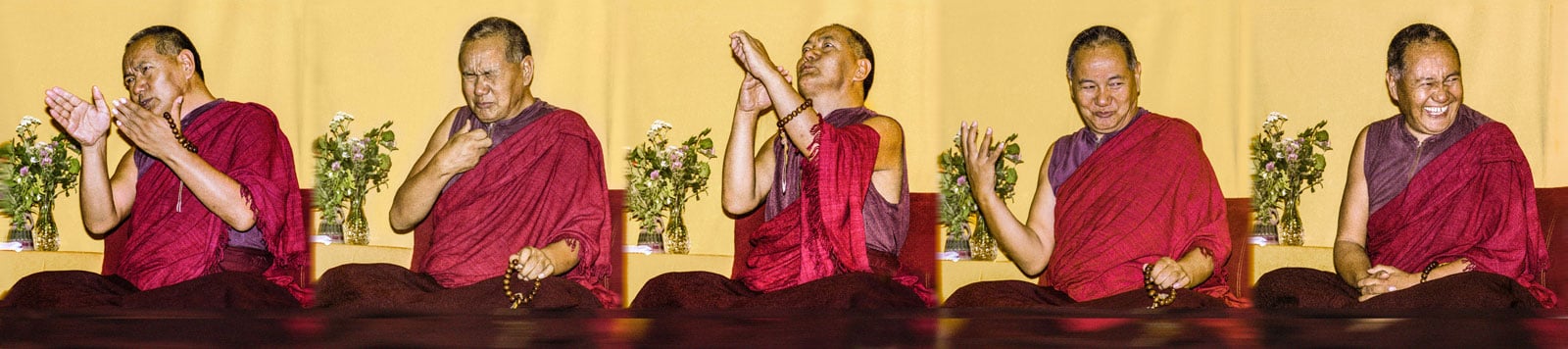
The great bodhisattva Khunu Lama Rinpoche gave this teaching to the monks and nuns of the International Mahayana Institute at Boudhanath, Nepal, 14 February 1975. Translated by Lama Zopa Rinpoche and edited by Nicholas Ribush.
This teaching was published in 2005 in the LYWA publication Teachings From Tibet. You can read more teachings from Khunu Lama Rinpoche and other great Tibetan Lamas on TeachingsFromTibet.com.

The ultimate purpose of listening to teachings is to receive enlightenment. Therefore, before listening to [or reading] this teaching on the Foundation of All Good Qualities [Tib: Yön tän zhir gyur ma], it is necessary to cultivate the pure thought of bodhicitta, the main cause of enlightenment.
We receive enlightenment only by practicing Dharma. Without practicing Dharma, there’s no way to receive enlightenment. Enlightenment can be received only through the practice of Dharma.
There are two types of Dharma, outer and inner. Inner Dharma means Buddhadharma; outer Dharma refers to the non-Buddhist religions, the religions followed by non-Buddhists. Of these, there are five divisions.1 By practicing outer Dharma, you can receive only temporary, samsaric pleasures but you cannot receive enlightenment. To become enlightened, you have to practice inner Dharma, Buddhadharma.
With respect to Buddhadharma, there are four schools of philosophical thought: Vaibhashika [che-tra-mra-wa], Sautrantika [do-de-pa], Cittamatra [sem-tsam] and Madhyamaka [u-ma-pa]. These four schools encompass the two main divisions of Buddhadharma, the Hinayana and the Mahayana. Vaibhashika and Sautrantika are Hinayana schools; Cittamatra and Madhyamaka are Mahayana. The teachings that we should practice are those of the Mahayana; in particular, those of the middle way, the Madhyamaka School, whose view is the best, most perfect and pure. But while the view of the Madhyamaka School is purer than that of the Cittamatra and is that which we should study, when it comes to extensive action, or skillful means, the teachings of the Cittamatra and the Madhyamaka are the same. The Madhyamaka, therefore, contains the best teachings on both profound view and extensive conduct.
Lama Tsongkhapa’s The Great Treatise on the Stages of the Path to Enlightenment (Lamrim Chenmo) elaborates in great detail the steps of the sutra, or Paramitayana, path, but when it comes to the Vajrayana, it states simply that we should enter this path; it doesn’t explain the graded path of tantra in detail, as it does the sutra path.
The short text by Lama Tsongkhapa that we’re going to talk about here, the Foundation of All Good Qualities, is rooted in the Madhyamaka teachings and it is therefore very important that you understand it.
Verse by verse commentary
The first verse reads:
The foundation of all good qualities is the kind and venerable guru;
Correct devotion to him is the root of the path.
By clearly seeing this and applying great effort,
Please bless me to rely upon him with great respect.
This verse, obviously, is about guru practice. All the good qualities of liberation, the boundless state [Tib: thar-pa], and enlightenment, the ultimate goal, depend upon the guru. Therefore, it is necessary to find a perfect guru who has all the qualities explained in the lamrim teachings. Our responsibility as disciples is to follow the guru’s instructions exactly, offer service, make prostrations and so forth. By following the perfect guru perfectly, we can receive enlightenment. If, instead, we follow a misleading guide, a false teacher, all we’ll receive is rebirth in one of the lower realms, such as the hells.
Why do we need a guru? Because we’re trying to reach enlightenment and don’t know what it is. The guru knows what enlightenment is. Therefore, we need to find and then follow a guru. Since the extremely kind and venerable guru is the foundation of all good qualities—the good qualities of liberation and enlightenment—the first thing we must do is to find a perfectly qualified guru. Then we must follow that guru correctly by making material offerings, offering respect and service and doing whatever else should be done. But the main thing, the most important thing, the essence of following the guru correctly, is to follow the guru’s instructions exactly.
This text, the Foundation of All Good Qualities, although short, explains the entire graduated path, including the six perfections, especially the perfection of wisdom, and the necessity of entering the Vajrayana path. The next verse, then, explains the difficulty of receiving a perfect human rebirth. It reads:
Understanding that the precious freedom of this rebirth is found only once,
Is greatly meaningful and difficult to find again,
Please bless me to generate the mind that unceasingly,
Day and night, takes its essence.
Since beginningless time, in numberless bodies, we have been wandering through the six samsaric realms, but this is the one time that we have received a perfect human rebirth. A rebirth such as this, which is free from the eight unfree states and possessed of the ten richnesses, will be extremely difficult to find again. We can see how rare it is by meditating in three ways: on cause, example and number. It’s hard enough to find an ordinary human rebirth let alone one with these eight freedoms and ten richnesses; the perfect human rebirth is much harder to find than a regular one.
This perfect human rebirth gives us the chance of continuing to be reborn in the realms of suffering or of attaining enlightenment; it offers every possibility. Therefore, it is highly significant. What we should use it for is attaining enlightenment—since we have received a perfect human rebirth just this once, we should use it to attain enlightenment. Therefore, the teaching says, “Please bless me to generate the mind that unceasingly, day and night, takes its essence.”
The next verse tells us that the perfect human rebirth is not only difficult to find but also decays very quickly, like a water bubble:
This life is as impermanent as a water bubble;
Remember how quickly it decays and death comes.
After death, just like a shadow follows the body,
The results of negative and positive karma ensue.
Death is certain, but when it will arrive is not. One thing that’s for sure is that we are not going to live for one hundred years. One hundred years from now, pretty much everybody alive today will be dead. It is very important to remember impermanence. The Kadampa geshes used to remember impermanence all the time in order to avoid seeking the comfort of the temporal life. They felt that if they didn’t bring it to mind in the morning they were in danger of wasting the entire afternoon, and if they didn’t bring it to mind in the afternoon they were in danger of wasting the whole night. By constantly keeping impermanence in mind, they were able to prevent the meaningless thought seeking only the comfort of this life from arising.
After death, our mind doesn’t come to a complete stop, like water drying up or a flame going out. There is continuity. Just as wherever the body goes, the shadow comes along with it, similarly, wherever our mind goes, our karma comes along too. You must have unshakably firm belief in this.
With respect to karma, there are the ten non-virtuous actions and the ten virtuous ones. We must avoid the former and practice the latter. Thus the teaching says,
Finding firm and definite conviction in this,
Please bless me always to be careful
To abandon even the slightest of negativities
And to accomplish only virtuous deeds.
In other words, “Please bless me always to be careful in the practice of avoiding the ten non-virtuous actions and observing the ten virtuous ones.”
The next verse tells us that no matter how much we enjoy samsaric pleasures, there’s no way to find satisfaction in them.
Seeking samsaric pleasures is the door to all suffering;
They are uncertain and cannot be relied upon.
Recognizing these shortcomings,
Please bless me to generate the strong wish for the bliss of liberation.
Whatever beautiful objects we see, we’re never satisfied; whatever pleasant sounds we hear, we’re never satisfied; and it’s the same with all other objects of the senses. No matter how much television we watch or movies we see, we’ll never be satisfied. This is how it is, and all samsaric pleasures are the door to samsaric suffering. No matter how many samsaric pleasures there are, they are of no value. All past great meditators and holy beings have recognized temporal pleasure as a shortcoming of samsara; as faulty, deceptive. They have never seen samsaric pleasures as valuable or good.
Led by this pure thought,
Mindfulness, alertness and great caution arise.
The root of the teachings is keeping the pratimoksha vows;
Please bless me to accomplish this essential practice.
With this next verse, we request blessings to succeed in the essential practice of keeping the vows of individual liberation. There are seven different levels of pratimoksha ordination, such as bhikshu and bhikshuni, and keeping the pratimoksha vows is root of the teaching and the main cause of liberation. Supported by the pure thought of wanting to receive nirvana, we should keep our precepts with great remembrance, conscientiousness and care.
We shouldn’t be like those practitioners who say that they’re focusing on tantric practice and therefore don’t need to concern themselves with sutra practices, like keeping the pratimoksha vows. We should observe whatever pratimoksha vows we have taken with great care. First it is necessary to generate the mind wanting to abandon samsara. Without renunciation of samsara, we cannot receive even Hinayana nirvana—the liberation of the Shravakayana and Pratyekabuddhayana.
Then, after generating the mind renouncing samsara, it is necessary to generate bodhicitta. Without bodhicitta we cannot receive enlightenment. Therefore, it is necessary to practice bodhicitta. The next verse reads:
Just as I have fallen into the sea of samsara,
So have all mother migratory beings.
Bless me to see this, train in supreme bodhicitta,
And bear the responsibility of freeing migratory beings.
Look at yourself. Since beginningless time, you have been suffering incredibly by wandering endlessly through the various realms of cyclic existence—mainly the hell, preta and animal realms—and just as you have been suffering in samsara since beginningless time, so too have all other samsaric sentient beings. Thinking in this way, cultivate bodhicitta, or, as the prayer says, “Please bless me to receive bodhicitta by understanding this.”
Clearly recognizing that I will not achieve enlightenment
By developing bodhicitta
Without practicing the three types of morality,
Please bless me to practice the bodhisattva vows with great energy.
In order to receive aspirational bodhicitta, the thought wishing to receive enlightenment for the sake of all sentient beings, and the engaged bodhicitta, actually following the path to enlightenment, it is necessary to practice the three aspects of the perfection of morality—the morality of abstaining from negativity, the morality of creating all virtue and the morality of working for sentient beings. Although this verse mentions specifically the three divisions of morality, it also refers to the practice of all six perfections.
However, the following verse refers more specifically to the last two perfections, concentration and wisdom.
By pacifying distractions to wrong objects
And correctly analyzing the meaning of reality,
Please bless me to generate quickly within my mind-stream
The unified path of calm abiding and special insight.
Here, Lama Tsongkhapa is saying that our minds are always distracted by objects of the senses; for example, attractive visual forms or interesting sounds. Our minds are always concentrated on those. Calm abiding, or mental quiescence [shamatha], is a kind of reversal of our normal attraction to sense objects, the opposite of distraction—it is the control of single-pointed concentration. Shama means peace; tha means one-pointedness. This is to be combined with penetrative insight. In Tibetan, the phrase yang-dag-par-jog-pa means concentrating on absolute nature. In this prayer, Lama Tsongkhapa asks for blessings to quickly achieve the path that unifies shamatha and vipashyana. When we achieve this path, we are close to enlightenment.
Up to this point, Lama Tsongkhapa has been talking about the general training of the mind in the Paramitayana path. Next, he talks about tantra:
Having become a pure vessel by training in the general path,
Please bless me to enter
The holy gateway of the fortunate ones—
The supreme vajra vehicle.
In other words, he’s saying here, “Please bless me to achieve the Vajrayana Path, which allows me to receive enlightenment in this lifetime.” If you follow the general, Paramitayana, path it can take you a long time to collect the necessary merit and reach enlightenment, as long as three countless great eons. Guru Shakyamuni Buddha, for example, had great energy but it still took him that long to receive enlightenment. If you follow the Vajrayana path, it’s much quicker. If you fully observe the fundamental practice of keeping the tantric vows and samayas, or pledges, purely, the practice of Vajrayana can lead you to enlightenment in one or perhaps sixteen lifetimes. It’s like the difference between going somewhere by airplane or train. The tantric path is like a plane; the Paramitayana path is like a train.
There are two types of realization, or siddhi, involved. There are the general realizations, of which there are eight—such as the attainment of the sword, the attainment of the eye medicine2 and so forth—and the sublime realization, which is enlightenment itself. The foundation for attaining these two realizations is perfect observation of the vows and pledges, as Lama Tsongkhapa makes clear in the next verse:
At that time, the basis of accomplishing the two attainments
Is keeping pure vows and samaya.
Having become firmly convinced of this,
Please bless me to protect these vows and pledges like my life.
He says, “Please bless me to observe the vows and pledges just as I take care of my life,” because he thinks that in order to receive the “uncreated,” or effortless, stage, it is more important to observe the vows and pledges, the foundation of all realizations, than to take care of the temporal life.
The next verse alludes to the four classes of tantra—the Kriya, Charya, Yoga and Maha-anuttara Tantras.3
Then, having realized the importance of the two stages,
The essence of the Vajrayana,
By practicing with great energy, never giving up the four sessions,
Please bless me to realize the teachings of the holy guru.
The main form of tantra that we should practice is Highest Yoga Tantra, which includes father tantras, such as Yamantaka, and mother tantras, such as Heruka and Kalachakra. This class of tantra also includes the graduated paths of generation (kye-rim) and completion (dzog-rim) stages. One tantric teaching likens these two stages to a flower and its smell. Without the flower, there’s no smell of the flower; similarly, without the generation stage, there’s no way to practice the completion stage.
There are different ways of dividing up the day into sessions, like four sessions of six hours each, two in the day and two in the night, or six sessions of four hours each, three in the day and three in the night.
The next verse reads:
Like that, may the gurus who show the noble path
And the spiritual friends who practice it have long lives.
Please bless me to pacify completely
All outer and inner hindrances.
Here we pray for blessings for our gurus who show us the noble path and our spiritual friends, who follow it correctly, to live long lives, and for ourselves to be able to pacify outer and inner hindrances. Outer hindrances are, for example, external enemies—other living beings who harm us and disturb our Dharma practice. Inner hindrances are such things as the sicknesses that afflict our body and negativities that afflict our mind. We ask for blessings to pacify all those hindrances.
The last verse is:
In all my lives, never separated from perfect gurus,
May I enjoy the magnificent Dharma.
By completing the qualities of the stages and paths,
May I quickly attain the state of Vajradhara.
We pray that in all future lives may we never be separated from perfect gurus, because the guru is the root of the path. Even though there’s benefit in simply meeting a guru, the actual purpose of doing so is to practice; therefore, we pray to enjoy the Dharma through having met a guru and to follow the guru correctly in order to realize the grounds and paths and thereby quickly achieve the enlightened state of Vajradhara.
That is a brief explanation of this prayer, The Foundation of All Good Qualities, which, although short, is a very precious teaching. It contains all the important, essential points of the path to enlightenment. I received this teaching from His Holiness the Dalai Lama in Sarnath.
*************
There are five great branches of knowledge: sound, logic, hygiene, handicrafts and inner knowledge. Outer knowledge has been well developed in the West. I’ve also heard about Western psychology, which is the study of the mind, but although I don’t know much about it, I’m sure it’s not like the inner knowledge of Buddhadharma.
Also, there are other religions, like Christianity, and they also have a kind of inner knowledge, but again, it’s nothing like Buddhadharma. All the many non-Buddhist religions have their qualities, but they’re not like Buddhadharma. Within Christianity you find Catholicism, Protestantism and so forth. They all have their own views, but they don’t talk about view like Buddhadharma does; they don’t talk about absolute nature, reality.
Non-Buddhist religions do have a kind of view. They believe in the self-existent I—but this is precisely what we need to abandon. According to Buddhadharma, the self-existent I is the wrong conception that we’re supposed to get rid of.
People in the West aren’t too concerned about future lives. However, I’m not just saying that Christianity is bad and Buddhism is good. If you study religion you’ll come to your own conclusion. Through your own experience you’ll prove to yourself that Buddhism is correct and other teachings are not; you’ll prove to yourself what’s right and what’s wrong.
Within Buddhadharma itself, there are the four types of different doctrine that I mentioned at the beginning: Vaibhashika, Sautrantika, Cittamatra and Madhyamaka. The view of the Sautrantikas negates that of the Vaibhashikas, the view of the Cittamatrins negates that of the Sautrantikas, and the view of the Madhyamikas negates that of the Cittamatrins. Thus, even within Buddhadharma, there are four doctrines whose views differ from each other. In other words, as long as a view is imperfect, it can always be negated, or contradicted, by one that is more correct.
Of the five great branches of knowledge, what you should study is the fifth—inner knowledge; Buddhadharma. It is very good, very pleasing, that you have come from the West to study Buddhadharma at Kopan Monastery. The teaching of the Buddha is the method whereby you can benefit all sentient beings. Therefore, you should study it well and then, like the shining sun, spread it in the West.
The Dharma that came from India to Tibet contains both sutra and tantra. If you really want to understand all these teachings, you have to become fluent in the Tibetan language, its vocabulary, grammar and so forth.
Guru Shakyamuni Buddha received enlightenment through reciting the mantra TADYATHA OM MUNÉ MUNÉ MAHAMUNAYÉ SOHA. Therefore, you too should recite it continuously. Say it twenty-one times with the TADYA THA at the beginning, then continue reciting without it, as many times as you can. Reciting this mantra once purifies 80,000 eons’ worth of negative karma. This is a very powerful mantra.
I don’t have anything material to offer you to take back to the West as gifts for your family and friends but there is one thing that I can give you—this mantra. This is the one thing I can give you to take back to people in the West. In other words, you should teach this mantra to others.
Therefore, staying at Kopan, you should follow the guru and complete your study of Dharma. Tibetan Buddhism contains great inner knowledge, the best inner knowledge. By living at Kopan, you should complete your study of Buddhadharma, inner knowledge. The more you study Dharma, the deeper it becomes; it gets more and more profound. The more you study other subjects, the lighter they become.
Lama Tsongkhapa wrote several lamrim texts, such as the Great Treatise on the Steps of the Path to Enlightenment [Lamrim Chenmo], the Middle-length Lamrim [Lamrim Dring], and the most abbreviated version, A Concise Exposition [Lamrim Dü-dön or Lamrim Nyam-gur], sometimes also called Lines of Experience. The subject matter contained in the Great Treatise is explained in the intermediate version and the subject matter contained in the intermediate version is explained in the most concise one, the Lamrim Dü-dön. All these teachings are condensed in Lama Tsongkhapa’s letter to his disciple, the Three Principal Aspects of the Path. The teaching I have explained today, the Foundation of All Good Qualities, is a short lamrim teaching in the form of a prayer.
Do you have any questions?
Q. When I study, especially emptiness, I think I understand something correctly and keep going in that direction but later on I see that my understanding was wrong and I wasted time following it. By going off on these tangents, I prevent myself from progressing more quickly in the right direction. How can I relate to the experiences I have in such a way that I don’t waste time exploring what turn out to be wrong conceptions?
Khunu Lama Rinpoche. First, I can see that you are all trying to do great, extensive Dharma work, and I will pray for you to be successful and benefit the teaching of the Buddha. With respect to your question, when you are studying or meditating on emptiness, it is possible for fear to arise or for you to realize that what you have always believed to be true is wrong. However, fundamentally, what your mind should be avoiding is the two extremes of self-existence and non-existence. Your pure view of emptiness should be devoid of these two extremes; it should be in the middle way. Then your view of emptiness is correct. Even the conception holding emptiness is empty.
Q. I have a question about relative truth. There are false relative truth and right relative truth. Is it possible for a person who has the wrong conception of the self-existent I to ever perceive right relative truth? There are two ways in which a person can view something: as something there or as something not there. For example, a person looking at tsampa can see it as free from dirt or as contaminated. There are two different ways of seeing it. As long as the person has the wrong conception of self-existence, does that prevent her from having the right relative view, from perceiving right relative truth?
Khunu Lama Rinpoche. What is the right relative truth of tsampa? When everybody looks at the tsampa, they see tsampa. Not only that, tsampa has to be viewed through intact senses; senses that are not defective. It is right relative truth if it exists as an object of normal senses. Also, when other people look at the tsampa, they see tsampa. That is what we recognize as right relative truth.
For example, when you’re in a moving train, the trees also seem to be moving. Sometimes you get this kind of wrong conception. Or when a conjurer transforms inanimate objects, like pieces of wood, so that they appear in the form of animals, or when you see a white conch shell as yellow, those are wrong relative truths because they are a projection of defective senses. Also, it’s proven that they’re wrong because they are not seen as that by other worldly beings, those who have not realized emptiness.
Finally, according to the Madhyamaka scriptures, the “I” that is believed to be self-existent by non-Buddhist philosophers is also a wrong relative truth.
Q. Please could you explain the difference between relative and absolute bodhicitta?
Khunu Lama Rinpoche. Absolute bodhicitta, the realization of fully seeing ultimate nature, as the Madhyamaka teachings explain, is achieved on the first of the ten bodhisattva grounds. Relative bodhicitta is explained in Shantideva’s Guide to the Bodhisattva Way of Life. There are two types of relative bodhicitta—aspirational and engaged. Aspirational bodhicitta is the wish to attain enlightenment for the sake of all sentient beings; engaged bodhicitta is actually following the path to enlightenment.
Even worldly people, those who have not attained the path of seeing, can achieve aspirational bodhicitta. As you know, there are five paths—the paths of accumulation, preparation, seeing, meditation and no more learning. Even those on the first of these five paths can achieve relative bodhicitta. The two types of relative bodhicitta are explained in Shantideva’s Guide, and absolute bodhicitta has been explained by Nagarjuna and also in certain tantras. Absolute bodhicitta is actually ultimate nature.
However, since bodhicitta is the seed of buddhahood, like the seed of a plant, it’s the main thing we need to develop in our mind. Bodhicitta is what we should strive our hardest to achieve. The Buddha himself said that all the buddhas come from bodhicitta.
Q. Many of us will soon be going back to the West. Since you mentioned that we should take the Dharma back with us, what’s the best way to present it?
Khunu Lama Rinpoche. You should try to teach the Dharma according to what suits the minds of those listening to you. If explaining absolute nature is appropriate, you can follow the brief explanation in Lama Tsongkhapa’s Three Principal Aspects or the more elaborate one in his Great Treatise, which has more than one hundred pages on emptiness. If you want to explain the method side of the teachings, you can do so according to Shantideva’s Guide, where he talks about the practice of the first five perfections of generosity, morality, patience, effort and concentration. You can also explain right view on the basis of [the ninth chapter of] the Guide, if it fits the minds of your listeners.4 In short, you should teach Dharma in the way that a doctor prescribes medicine. Even if the doctor has the perfect medicine for a patient’s illness, he can’t force the patient to take it. That’s an unskillful approach. The wise doctor treats patients according to their capacity. Dharma should be presented in the same way.
Q. Our minds are always discriminating things like, “I like him; I don’t like her,” and we’re usually so unconscious that we’re totally unaware that we’re doing this. Now I’m starting to realize that discriminating in this way causes suffering. Since developing equanimity is the first step to bodhicitta, how can we equalize our minds in our everyday situations to avoid discriminating between the people we like and those we don’t?
Khunu Lama Rinpoche. You should check in the following way. If there’s an outer object that you think is good, bad or ugly, try to see its absolute nature by analyzing every atom. Mentally reduce the object you see as good to atoms, take even the atoms apart, and analyzing it like this, try to see its emptiness. Again, analyze the object you see as ugly down to its atoms, analyze even the atoms, and, in this way, try to see its emptiness. When you do this, you’ll see there’s absolutely no difference between these two objects. In your relative view you discriminate them as different, but in emptiness, you don’t.
Q. How we can unite these two views—the relative with the absolute?
Khunu Lama Rinpoche. The mere appearance of an object is the relative view. That should be seen as illusory but at the same time unified with emptiness. The relative view should be one with emptiness. But that doesn’t mean that your view of an object that you believe to be truly existent is really true. This view and the view that sees the object as illusory and empty cannot become one. This is very difficult to realize. Therefore, it is important that you get as clear an intellectual understanding of it as possible. First, understand how things are dependent upon causes and conditions; you must understand the born and the unborn, in other words, dependent phenomena and emptiness respectively.
Q. Rinpoche, you said that we should teach people according to their level of mind. How can we discern this? Do we have enough wisdom to know if it is appropriate to teach Western people who are interested mantras, visualizations and so forth?
Khunu Lama Rinpoche. That is hard to answer specifically, but what you can teach is this. Visualize a white cloud in the space in front of you at the level of your forehead. On that is a large throne upon which is seated Guru Shakyamuni Buddha in his usual aspect of a monk adorned with robes, with his right hand over his knee touching the moon cushion and his left in the meditation mudra. He is surrounded on all sides by countless buddhas, bodhisattvas, such as the eight great bodhisattvas, and arhats.
Powerful light rays emanate from Guru Shakyamuni Buddha and the others and enter you and all other sentient beings, who appear in human form surrounding you, purifying all the negativities accumulated since beginningless time and bringing all the realizations of the graduated path to enlightenment. While visualizing this, recite Guru Shakyamuni Buddha’s mantra, TADYATHA OM MUNÉ MUNÉ MAHAMUNAYÉ SOHA or OM MUNÉ MUNÉ MAHAMUNA-YE SVAHA, as I mentioned before. No matter which of these two versions you recite, the visualization is the same.
Then make a strong decision in your mind that through this purification, you and all other sentient beings have become irreversible bodhisattvas, thus pleasing the infinite buddhas.
*************
From my side, I will pray for you never to be separated from the guru in all future lifetimes, to complete the path and attain enlightenment as quickly as possible. I will pray for you to accomplish the entire Dharma and to have long lives in order for this to happen. It is not sufficient for just me to have a long life, as you have requested. You, too, should try to live long. So, I will pray for that, but my prayers alone will not be enough; from your side, you also have to try.
*************
For a complete version of the root text, please go here.
1. See Hopkins, Jeffrey :Meditation on Emptiness, pp. 317–333, for details of the non-Buddhist systems. [Return to text]
2. See Khunu Lama Rinpoche's commentary to Lamp for the Path. [Return to text]
3. Action, Performance, Yoga and Highest Yoga Tantras. [Return to text]
4. See His Holiness the Dalai Lama’s Practicing Wisdom. Boston: Wisdom Publications, 2005. [Return to text]