
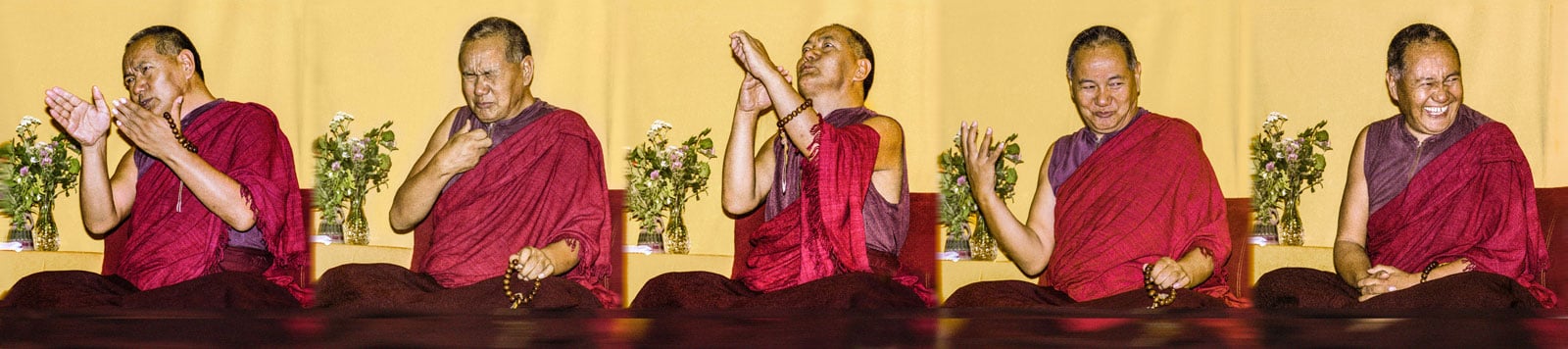
Commentary on Gyalwa Gyatso
A teaching given by His Holiness the Dalai Lama to a group of Westerners in his audience hall at Teckchen Choeling Palace on September 1, 1984 from 10-12 noon and 2-4 pm.
The teaching was requested by Lama Zopa Rinpoche in connection with the Chenrezig Gyalwa Gyatso initiation given in the temple on August 21-22, 1984. His Holiness spoke mainly in English and was assisted by Alex Berzin and Sharpa Rinpoche.

I do not have the actual lineage of the discourse on this teaching nor the lineage of the oral transmission of this but I shall give you a general introduction to this practice.
At the beginning it might be good to recite MANI, one hundred, I think that is better.
[Prayers, mandala offering, manis follow]
To distinguish ourselves from the followers of the distorted path we take refuge to distinguish ourselves from the lower motivations, from the Hinayana motivation, there is the development of bodhicitta. We shall repeat the verses of refuge and bodhicitta.
Sang gyä chö dang tshog kyi chog nam la
Jang chub bar du dag ni kyab su chi
Dag gi jin sog gyi pä sö nam kyi
Dro la phän chir sang gyä drub par shog
How many of you understand Tibetan? A little?
As there is not much time I shall not go into a very detailed explanation. I also feel that you can read details regarding visualization, you can understand this through reading. I am going to emphasize, try to explain, those points which are important not only in this practice but as a general practice, tantric practice, or basically Buddhist practice, then the Mahayana practice, within that Tantrayana practice, within that Maha-anuttara Yoga practice. I thought it might be better to explain these important points.
So, first of all, I think you all know that at the present moment the human population on this planet, as I usually say, consists of three categories: one that deliberately abandons all Dharma, that is the minority; then another category that believes in some kind of Dharma or religion; and then the majority, the third category, that just simply neglects any religion and is completely absorbed in money matters.
All members of these three categories have one thing in common, they all want happiness, want to overcome problems, suffering. The only difference is in the methods they follow in order to gain that object. We belong to the second category, to those who believe in Dharma or spirituality. Now you see, within the thing that we want, happiness, there are different levels. Although all people of the three categories want happiness, within that there are different levels of happiness. Generally, people feel that happiness will come from external things, from the outside, for example from good accommodation, wealth, fame, that if you have these then happiness will come. By now it has become quite clear that material progress, development alone cannot provide satisfaction to us, and another way to gain happiness is through our own mental training, mental process. All the different religions actually train our minds and try to give more satisfaction, happiness through mental progress or mental training.
Buddhism and some other Indian religions accept not only this one life but limitless lives, past lives as well as future lives until we achieve nirvana. You see, Dharma helps not only in this life but also in future ones; but any good thing, any quality which is related to this physical body is only for one lifetime; this physical body is of one lifetime, and when this life ends then no more traces are left of it. Any good this life ends then no more traces are left of it. Any good thing or quality which is related to the mind, specially the subtle mind, subtle mental quality, will go to the next lives and therefore it will give you some help in future lives. As you know, Buddhism as well as Jain and some sections of Samkhya philosophies do not accept a creator as one force which creates all phenomena. These philosophies believe that ultimately things depend entirely on the mind.
Now the question of self, soul. Within that category Buddhism does not accept a permanent soul, the permanent kind of dag. Generally all Buddhist schools of thought accept selflessness, dag me pa. Now in any case, since there is no creator, there is no other force which creates these things than one’s own mind and therefore mental training is the most important thing in order to achieve our goal, permanent happiness or sounder, or more satisfactory happiness. And how to train our mind? Basically there are two sides, the upaya side and the prajna side, the method side and wisdom side. Without wisdom, method alone cannot achieve satisfaction, might not succeed, and without a good motivation wisdom is limited. The combination of wisdom and method or motivation, those go together, is the foundation.
Now the motivation. One kind of motivation is mainly thinking of oneself, self-liberation, that is one thing. All Hinayana teachings are based on that motivation. Now the other motivation, not only thinking of oneself but that all sentient beings, just like oneself, want happiness, do not want suffering and therefore compare. Of course one’s own benefit is important, but compared to infinite sentient beings – they are more important than oneself. Therefore under those circumstances one should have more concern for the benefit of others than for one’s own. Compared to others one should ignore oneself completely. I used the word “compare” because not just neglect oneself, not that kind, in Mahayana teachings the interest in achieving enlightenment and also the interest in others – my English is degenerating, now very difficult – that motivation is the motivation of Mahayana teachings, the basic thing. That wisdom side, I think you all know that within Buddhism there are four different schools of thought, so there are different explanations, but generally speaking they seek wisdom, or main wisdom, is the wisdom which understands the ultimate nature or emptiness, voidness. For achieving self-liberation or achieving buddhahood, in both cases the main wisdom is the realization of shunyata, also the same wisdom goes towards achieving liberation or towards achieving omniscience. The same kind of wisdom, the same wisdom but one meant for self-liberation, one meant for buddhahood because of different motivations. It is the same with weapons, one target due to motivation, not the weapon itself.
Now in order to practice or train in the motivation and wisdom we need a teacher. Within one teaching the first teacher was Buddha. For example, this is the period of the fourth buddha, Buddha Shakyamuni with certain specific, different features. He himself proclaimed "I am enlightened." Some people criticized, they said "Oh, that is nonsense, he praising himself like that," and also Buddha Shakyamuni said, "If someone criticizes me he will go to hell," like that kind of thing, so you see people criticized. In any case, "buddha" means the person who now appears as a buddha. Now such people as Nagarjuna, or many others, actually in reality have already achieved buddhahood, in reality they are buddhas but they still appear as bodhisattvas. So a buddha’s own teachings first should come from that kind of buddha, so you see the ultimate teacher or the original teacher was the Buddha. Then the real protector is one’s own good motivation and wisdom or the combination of both, the path which combines method and wisdom, that is the ultimate protector, the ultimate refuge that is the Dharma.
In order to practice Dharma well we should have companions, Dharma companions, from them we can learn, get inspiration. I am quite sure of that even today. Buddha, or Nagarjuna, who lived approximately a thousand years ago, we never saw. The people to whom we can talk, with whom we can exchange views and experiences are the real source of inspiration, and they are the Sangha. Sangha need not necessarily be monks. In Mahayana teachings, whether layman or monk, Sangha is basically someone who has had certain experiences or has certain qualities, him we call Sangha. So now, Buddha, Dharma, Sangha. In order to train our mind in the right way or progressive way we need these three Refuges, Buddha, Dharma, Sangha.
Now the question of basic motivation, the motivation that we want to achieve buddhahood in order to serve or help all sentient beings, that we call bodhicitta.
On the basis of the combination of method or motivation and wisdom, first the unique union of method and wisdom, that kind of special combination is necessary because the goal or result, buddhahood, the Buddha’s body and mind, the two kayas, at that stage appear as two but in reality are not established as two different things. One substance appearing as two. The method which achieves that kind of result should be that kind of thing, appearing as two, method and wisdom, but in reality just one. In Sutrayana, the wisdom is held by motivation and motivation is held by wisdom. That according to Sutrayana is the union, the meaning of union. Now that is not sufficient, like water and milk mixed but although mixed if you make a precise analysis, there are still two things. That is the real view of Sutrayana. That is not sufficient, and therefore in Tantrayana there is the wisdom which understands shunyata. This is very difficult, I have no actual experience, so it is difficult to express but it seems like this.
In Sutrayana, when we practice the realization of shunyata, there is not much concern about the object of which to think, to investigate the ultimate nature. In terms of the object we have the selflessness of the person and the selflessness of all things. In Sutrayana it may be easier to understand it as the user and what is used. The user means self, the thing which is used by that self are phenomena. First, generally speaking, investigate the "user" or "I-self" because of the existing nature of the way that is conventionally established. Because it is something unique or different, it is easier to understand on investigation the realization of selflessness or realization of emptiness on the self than on phenomena or other things, like the five skandhas. Except for these kind of differences, generally there is not much importance placed on the object.
Now in Tantrayana the object becomes important. In Sutrayana though shunyata is there, because of the object it is in one case easier to understand than in the other, so the object does make a difference. On that basis now, in Tantrayana the object is not the ordinary object or, in other words, the object which actually exists, it is another object which does not exist in the ordinary sense but exists mentally, like visualizations of the mandala or the deities, which in the ordinary sense do not exist but because of our strong imagination at that moment come into existence.
Within form, there is the form which is within the Dharma source or the source of all things, just in the category of all general things, the meaning is ordinary color, shape etc. which the eye consciousness can grasp, can perceive. There is another kind of form which the eye consciousness cannot perceive, and within that category there are five different kinds of form. One of them mentioned is, I think, fine atoms. Within the five kinds of form there are two kinds which are actually created by the mind itself, due to strong imagination. They are kun tag pai zug and wang jor wai zug. I cannot translate these into English, totally imaginary forms, no, not imaginary, like a dream body, I think may be special dreams, may be, or ordinary, there I am still not very clear, certain forms which appear in dreams, I think that kind is kun tag pai zug. Then, due to samadhi, the concentration for depleting the elements, actual fire and water are produced, not from ordinary cause or source but it actually works as fire, that is wang jor wai zug.
Now the object, such as the visualization of a mandala or a deity’s body. It is very difficult at the beginning to actually create certain things that actually work or act as elements, but it becomes easier. At the beginning kun tag pai zug is possible. In any case, the visualization of a mandala, for example, is the special object, a unique creation of the mind. On that object the realization of shunyata is, due to the object, easier to understand. There are different explanations, but according to some explanations when we realize shunyata of the solid object, then at that moment the appearance of that object will diminish. Because of different objects, very subtle objects, the appearance of the object may not disappear during the realization of shunyata or emptiness on that object. Therefore now the wisdom which realizes the ultimate nature, the shunyata nature on the object of the deity which is a creation of our own mind, at that moment is one mind, one consciousness; since it realizes the ultimate nature it is wisdom. In the meantime, perceiving the deity’s form it becomes method. This moment, the real method, upaya, and wisdom combine within one mind, one mind itself acting as method and wisdom. This is the basis of Tantrayana teachings. Now within Tantrayana teachings, the Maha-anuttara Tantrayana, this combination of motivation or method and wisdom, that kind of union, is not sufficient, because that nature remains still on the grosser level of consciousness. This is not sufficient. What we need is the subtle consciousness in the nature of union of that kind. That is the perfect cause of the Buddha’s mind, because the grosser mind passes, is fleeting, temporary, I don’t know, and also do the three appearances. If you are not free from these three subtle appearances then you cannot eliminate the obstacles that prevent omniscience. It seems now, I am not very sure, that the appearance of true existence is somehow related with grosser consciousness. In order to eliminate that kind of obscuration it is not sufficient just to have bare direct perception of voidness but one needs to have this in the nature of the subtler consciousness. In Maha-anuttara Tantra Yoga there is a special technique or emphasis on the method to reduce the grosser consciousness. In order to create this unique combination of wisdom, which by nature is innermost subtle consciousness, the practice of control of breathing, all the yoga exercises, the practices which involve chakras, drops and inner airs, are necessary. This practice, the control of breathing and inner movements, drop movements or inner air can only be done through samadhi, mental power, it cannot be done by operation or something like that, the only way is mental power. Therefore our consciousness must be one-pointed, and not only that, there must also be a kind of special preparation for the practice of the next stage.
Now kye rim is involved, generation stage, development stage and the completing stage. First in the practice of kyerim all the basic preparations for the next stage are included and also while your are preparing the next stage, temporary accomplishments of activities related to peace, wrath and power, etc. Concerning the kind of preparation for the next stage I think there are some differences here according to Kalachakra. I think on this level there are some differences according to Nyingma tradition, I think mainly dzog chen tradition and within Sarma, the Kalachakra, Guhyasamaja and Heruka Tantric teachings. There are some differences in the way of emphasis. In some cases, e.g. dzog chen, emphasis is only on consciousness, the subtle consciousness, not on winds or inner energy. In Kalachakra it is also something like that, there is more emphasis on the consciousness itself and not on the winds. The wind practice is included there, but it is not actually emphasized because the dharmakaya and Rupakaya both are accomplished (drub pa) on the basis of the mind itself, both in dzog chen and Kalachakra. Now in Guhyasamaja and Heruka Tantrayana and many Maha-anuttara Tantrayanas two kayas (bodies) are accomplished on the basis of the combination of inner air and consciousness. All of them are the same in the practices to make manifest the extremely subtle clear light. The text which I am going to explain belongs to the Guhyasamaja group, at least I think so, but I am not sure. I think these deities and mandalas, the mandala itself, come not necessarily due to the mandalas but mainly due to the disposition of the practitioner. Therefore in the Heruka mandala, Heruka Tantrayana, one mandala is practiced in different ways. According to one practice, the Heruka Tantrayana is practiced in the same way as the Kalachakra teaches. The Hevajra is the same. The fact that there are different traditions of practice is not totally dependent on the fact that there are different tantras and different mandalas but due to different practitioners; then there can be different ways of practicing different specific mandalas.
Just a moment ago I said, I think this belongs to the Guhyasamaja group, that means it is possible to practice the Gyalwa Gyatso deity according to Kalachakra or dzog chen, due to the mental disposition of the practitioner. This generally belongs to the Guhyasamaja group. Within that we have Mother Tantra and Father Tantra. Since there is a Father Tantra and a Mother Tantra there must be a Son Tantra, without son we cannot speak of father and mother, can we?
Now you see, Guhyasamaja belongs to Father Tantra, Heruka to Mother Tantra, and some aspects of this belong also to Mother Tantra. Within that we have different methods. The Guhyasamaja method puts emphasis on subtle consciousness and subtle inner winds or inner energy. For this there is the practice of the three kayas: dharmakaya, sambhogakaya and nirmanakaya. On the buddha stage there are three kayas and therefore on the second stage, the dzog rim stage, we must produce the three kayas of the path, the three kayas of buddhahood, the three kayas of basis. What are the three kayas of basis? Deep sleep, without dream, that is the dharmakaya of basis, and a special dream body, that is the sambhogakaya of basis, then during the period of being awake, that is the nirmanakaya of basis. That means there are differences of subtle and grosser levels. Nagarjuna said the three kayas of basis transform into Buddha’s three kayas through he three kayas of the path. The dharmakaya of basis, deep sleep, has itself by nature some similarities with the nature of the dharmakaya, so utilize that similar nature. It takes on the ultimate source of dharmakaya so therefore, for that reason, Nagarjuna purposely called that stage of mind the dharmakaya of basis. Now the dream-body has actually departed from the rough physical body, is quite independent, that is the special dream-body. This body (His Holiness points to his body), but its subtle nature, without these solid things, is quite similar to Buddha’s sambhogakaya, and therefore Nagarjuna called it the sambhogakaya of basis. Likewise, that dream-body enters the rough physical body and awakens. That is the manifestation of sambhogakaya. A person like Shakyamuni Buddha, now this is called nirmanakaya. So there are similarities but more people can touch, can see, can talk to the nirmanakaya, so from that viewpoint it is grosser. In substance it is its own nature but somehow it appears grosser. Now the dharmakaya, the only one who can have direct bare perception of the dharmakaya is a Buddha. The main ones who can have direct bare perception of sambhogakaya are arya bodhisattvas, and those ordinary persons who have the karma to meet with it can see the nirmanakaya. Deep sleep, dream-body and rough body, it is like that. The actual transformation of the three bases into Buddha’s three kayas takes place in the second stage of practice, dzog rim. In deity yoga there must be a preparation for it.
There is the taking of death as the path for the dharmakaya, and the bardo as the path for the sambhogakaya and birth as the path for nirmanakaya. The main three kayas of the basis are death, intermediate state and rebirth. The other one which I mentioned is…Furthermore, in twenty-four hours, within a day, there are three kayas. The basis is death because when we are dying all the grosser consciousnesses cease to function and only the innermost subtle consciousness remains. That we call buddha nature, buddha seed, and that level of consciousness always remains. That we call primordial, and that consciousness will go to buddhahood, the other, grosser consciousness will not go. That we call the dharmakaya. Then, like the special dream-body, the intermediate state body is not a solid one, like sambhogakaya, and the grosser body that takes rebirth is the nirmanakaya. In the deity yoga of Maha-anuttara Yoga, these three practices must be done.
There was Maitri Zoki who was a very learned person and came from Eastern India. As a small boy he recited some MANI. He has a special relation with Avalokiteshvara. Later in his life he came to Tibet and remained for some time. His main Tibetan disciple was Trophu Lotzawa, about 800 years ago or two generations before Buton Rinchen Dub. He had invited this yogi to Tibet and he built … Jamchon Monastery. With his guidance Trophu Lotzawa built a big image of Maitreya Buddha. Now everything is destroyed, no one is there. He promised Trophu Lotzawa that as long as the Shakyamuni Buddha of the main cathedral in these remained, he would visit Tibet annually. He promised like that. I don’t know if he has been since 1959 or not. I don’t think so but maybe to bless the Chinese, maybe! Of course that is very necessary, isn’t it? We believe that this yogi is still in India, or somewhere else. Much later, this yogi actually saw certain lamas and received certain teachings. This is the story of Maitri. He received teachings or initiations from Avalokiteshvara himself and with his permission, his blessing he composed about a hundred different mandala initiations. Usually we call them Maitri gyatza. Now Thugje Chenpo Gyalwa Gyatso is one of the main deities since he himself achieved buddhahood through this practice. Within the Maitri gyatza, Gyalwa Gyatso is regarded as one of the most important deities, mandalas.
Now I follow the text.
I am not going to explain the preliminary praises and steps. In terms of practice, the main point is the person who is the basis. The person needs to have great faith, great renunciation, compassion, love, and particularly, bodhicitta, at least some experience of it. He also needs to have some sort of understanding of voidness. This is the basis to receive the initiation.
Such a person needs to be in a place which is pleasing and if one has a statue of Chenrezig Gyalwa Gyatso, one arranges that but if one does not have one, it does not make too much of a difference as the practice is mainly through the powers of the mind. You should then arrange offerings that are pleasing and, as it comes later in the text, an offering of tormas to the worldly ones and the ones beyond the worldly, you can set up biscuits, fruit etc. for torma. The torma being of the Anuttara Yoga class should have some meat and alcohol. The reason is that, in order to practice the completing stage practice, the body needs to be very health and strong. These things help to strengthen the body. This is explained from the point of view of necessity. These are called the substances of samaya, the close-bonded substances.
Generally there seems to be an increase of vegetarians among the Westerners. I heard recently in BBC that in England the number of vegetarians is increasing. That is very good. If there are no physical problems, then remain vegetarian, I think that is best. If there are problems, then you know that the general Mahayana Buddhist practice is to eat meat that is free of doubt, witness and information [nang sum dag pai sha] that the animal was not killed for you, that is free of those three recognitions – that is our usual excuse! – I think the main idea is if there is meat available, already there, then take it. While you are eating it you pray with strong motivation for that animal, that kind of practice. When someone who consumes that meat does some special mental practice and has some special motivation, some prayers, then as the animal is already killed there is some usefulness for that being there also.
Then you have the bell, the vajra and the damaru. There are two meanings to the damaru; one is being very clever, having a two-faced head, the other is the actual ritual object. Usually we regard people as having two faces who talk something at this side and something else at that side, that we usually call damaru. During the Cultural Revolution, the people of Lhasa regarded an old government official as a damaru person. During a criticism meeting, a damaru was put into a hand of that gentleman and he was led around the circumambulation path. The vajra, thunderbolt, symbolizes method, upaya, the bell symbolizes pure wisdom, and the damaru symbolizes union. I think one side of the damaru is the skull of a female, the other side the skull of a male, joined, combined, that symbolizes union. We believe that it arouses the inner heat. For that reason it should generally be held at the level of the navel but there are exceptions. Another meaning is that the sound of the damaru, trem phem, trem phem, trem phem, trem phem, arouses the dakinis. That is the explanation of the damaru.
The most important thing to have is the inner offering. In Maha-anuttara Tantrayana the main offering is the inner offering. The offerings are outer offering, inner offering, secret offering and thusness offering. The inner offering is the most important because its material comes from the bodies, five meats and five liquids, all the dirty things are there. The five kinds of meat and the five kinds of liquid, all these are dirty things. How can we distinguish between dirty and pure? This is mainly subjective, e.g. in tsog the Brahman, the dog and the outcasts are all the same, there is no difference between these three. In ancient India there were big differences between the Brahman, the highest, and the outcaste, and the dog of course. But this view is subjective and to a person who has developed a certain mental attitude and understanding there is no difference. The special meaning is that black and white exist only on the level of grosser consciousness. When one develops the innermost subtle consciousness then on that level there is no difference in these things. When a person deliberately utilizes that consciousness, transforms it into realizations for the path, then that stage we call to have control over the mind and the winds, utility of winds and consciousness. At the present stage, this body [His Holiness points to his body] seems solid and acts as a solid. Now we cannot control our inner five elements. Once we have reached the stage where we can fully control the inner five elements, then these external five elements cannot act as solids or as liquids. These differences remain as the subjective side at a certain stage. This does not mean that good and bad do not exist on the conventional level. Things are there, good and bad are there, Buddha, Dharma, Sangha, these things do exist. Buddha and suffering people and enlightened people are there, aren’t they? These are the main reasons why we consume these dirty things. The five meats and five liquids, the substances of the inner offering, are connected with the mind stream of living beings, and when a person consumes these things, his own five elements are affected and that helps to control our inner elements.
At the actual offering we first offer to the gurus, the root and lineage gurus, then to deities, then to all sentient beings and finally we take ourselves. The external, outer offering is simply an offering to the deities. The internal, inner offering is the greatest festival, not the other one, it is the most important element in the practice of Maha-anuttara Tantrayana. Whether you have the other substances or not – it is absolutely necessary to have an inner offering. You should have a pill which contains cultures of nectar-substances from previous pills and is blessed through meditation and recitation of mantras or something like that. These are preparations.
Now the seat. You need a very comfortable seat with a cushion, that is best, the Japanese style. That is very comfortable and very helpful.
Then you examine your own motivation. If your motivation is not pure then you should change it. If your mind is neutral, again you should change it and transform it into the strong motivation that "I am going to practice this sadhana for the benefit of others," not a plain recitation of the mantra but you must develop a strong feeling or even emotion. Then, if there is time, visualize at that moment all gurus, root gurus, lineage gurus or one guru who is the main guru. In reality your guru appears as a deity. In some cases from your main guru who appears as a deity in the center of your heart come all your gurus from whom you received teachings. Visualize and practice if you have time. Then practice relying on Guru Yoga, a spiritual master, train in deep respect and feeling of gratitude. Finally, all the gurus disappear in the heart of the deity, then that deity comes on top of your head (it might slip off if you are bald). Generate great faith and great joy and happiness and imagine that the liquids and nectars descend. Then the guru absorbs into yourself and then your own body disappears gradually. At that moment you should realize the nature of emptiness and concentrate on it. With this bliss your dearest guru absorbs into yourself and imagine yourself transformed or completely mixed with your deity or guru and with that kind of enjoyment or bliss try as much as you can to feel shunyata, emptiness, try to understand the meaning of emptiness. That wisdom or mind is the actual causal substance to work with, for later appearing deities, mandalas, everything including offerings comes from that source. Without this kind of realization, if you cannot generate at least a little bit in terms of fervent regard and imagination, what follows will not have any point.
Last year in Bodhgaya a question was put to me, very correct. One Buddhist monk I think from Ceylon made a comment on Tibetan tantric teachings. He said the visualization or the practice of the mandala is very useful and very attractive, and is good to pass the time with. Actually this kind of practice helps distraction and conception but it will never help to destroy ignorance. This is a very good point. This is not only a question of the present generation but also a question of the ancient Indian practitioners. Because the question arose, the answer was also there. Buddha Sangye Yeshe, the teacher Buddhajnana, mentioned that when there is no understanding of shunyata, the mere visualization of deity yoga can not help to destroy ignorance. The answer is that the visualization of the deity or mandala is not mere imagination but that wisdom, that consciousness actually fully understands the nature of the ultimate reality, shunyata. As I already explained, one consciousness acting as method and wisdom combined. How can we produce at this moment a strong feeling of understanding shunyata? Without losing the feeling that consciousness transforms into the form of a deity. Nothing is not something like that kind, try as much as you can to understand shunyata, that feeling, that wisdom itself now transforms, although now only in imagination, like some modern actor.
Just a few days ago I met an American actor (Richard Gere). Out of curiosity I asked him some questions. When an actor cries in a film or on television, tears come, in some cases actors really weep. When you perform, do you actually starve or fast for a few days, do you put chemicals in your eyes, or how do you perform? He said that first he familiarized himself with the story, the words, and then he actually experienced that thing, that situation, and because of that strong feeling he actually passed through that kind of moment, story. Similarly, this rough physical form actually disappears and the consciousness which has realized emptiness itself transforms into the deity of Gyalwa Gyatso. The appearance is the deity Gyalwa Gyatso, the reality is wisdom with strong motivation. Now at that moment the form of the deity as an object, as the basis and the realization of shunyata of that deity, now combine. That is the instantaneous arisal.
Then there is the blessing of vajra and bell, and remembering the meaning of it. One holds the vajra and bell of being mindful of this.
After that comes the blessing of the inner offering. Now here is one question. In order to bless the inner offering, the imagination of the emptiness and again in the same way the consciousness which understands shunyata of the substance, you put there the five meats and five liquids, with those things as the object, now understand shunyata of these things, then again the wisdom which understands shunyata of these things transforms into nectar. There is no connection with the other appearance. So, you can practice without these things, so why should you have these substances?
The actual offering is just a play with the appearance of the deep awareness that understands voidness. Here, I think, on the initial stage, just like us, now, until we control the inner five elements, the external five elements act very strongly, very forcefully. Therefore we have to rely on external things, matters, five elements. When we reach the stage of full control over the inner five elements, then nothing depends on the external five elements. So here at the initial stage we need the external substances. When we reach certain experiences, when we actually produce certain new things, then external substances are not necessary. I think this may be the answer. The actual procedure for the blessing of the inner offering is just as in the text, there is nothing special to remark on it.
After the blessing of the inner offering is the blessing of the preliminary outer offering. This is an outer offering made to the worldly protectors requesting the various types of action from them, and before you can offer it to them you have to bless it. So your mind understanding voidness is aimed at these objects as its basis and then out of that understanding of voidness you generate the pure appearance of the outer offering.
After that is the blessing of the preliminary torma. It is the same as the blessing of the inner offering above. The difference is that the basis at which one aims with the understanding of voidness for accomplishing the inner offering is something to drink and here the basis is something to eat.
Now follows the invitation of the guests for the torma. When you are inviting the guests, the directional protectors and the protectors of various fields and areas, you can have the white side, the black side and also the unspecified side, and within the white side of whom you are inviting there are those who are worldly and those who are transworldly, and among the transworldly ones there are those with learning still to be done and those with no more learning or training to be done. You draw forth these directional and field protectors and arrange them in the eight cardinal and intermediary directions and they dissolve into clear light, and from that they take on the aspect of a deity and specifically here the deity of the Great Compassionate Gyalwa Gyatso. Then reciting the mantra you make the offerings. Then you request their virtuous activities. Then you recite the hundred-syllable mantra and request patience for any mistakes. Then is the blessing of the offerings for the self-generated deity, then the meditation of Vajrasattva. If you have time you can do it here, if you have no time you can do the meditation at another place.
When you do the Vajrasattva meditation it is necessary to have the four forces complete in it: Taking refuge and reaffirming the bodhicitta, which is the force of the basis. When at the beginning of this you think in terms of the various negative actions and obstacles and karmic obscurations you have accumulated in the past, you generate great regret for these negative actions of the past and motivated by this regret you do the actual practice of using a remedial force which is here the opponent power of reciting the mantra. You do this to purify yourself of these negative potentials.
You can either generate yourself as Vajrasattva or generate Vajrasattva on your head and here you generate him on your head. The generation of the deity is exactly as it is described in the text. Recite the hundred-syllable mantra as often as you can. Here it says twenty-one times but in terms of the blessing of the four initiations you recite it twenty-eight times. You imagine purifying yourself of the obstacles of body, speech and mind individually and of body, speech and mind altogether in conjunction with receiving the four initiations. At the end when you recite the verse after the recitation of the mantra, held by the regret that you had before you give the opponent power of the promise to turn away from repeating these negative actions in the future.
How long does it take to recite 100,000 Vajrasattva mantras? Recently you did retreat here, how long did it take to recite 100,000 Vajrasattva mantras?
Answer: We have not finished yet.
And generally? [The answer was inaudible]
Then there is the making of offerings to the tree of merit. For meditation on the generation stage in general there is the basis to be purified which is death, bardo, and rebirth. The result of doing the purification is the attainment of the Three Bodies of the Buddha.
How is the purification done? There is the purification with thusness or voidness, which is making manifest the voidness which was not manifest before. Making manifest what was not manifest before accomplishes the purification. When you do a purification of various delusions or disturbing attitudes the purification is done in terms of applying opponent forces, e.g. you use a way of approach which is completely different from the thing which is to be abandoned. So if you want to abandon grasping for true existence then you use an understanding which is the complete opposite of the way of grasping at things as being inherently existent. That purifies it.
Then there is the purification of one’s mindstream and that is done in terms of slowly in stages ridding the mindstream of its various stains. But the way of purification here, of purifying the basis of which is death, bardo and rebirth, is a different one. It is done by meditating on the path which is similar to the basis being purified and by means of that accomplishing a result which is likewise similar to the basis being purified. Here, for instance, when we are talking about death for the basis of purification then by meditating on a path which is similar to the way that death comes ordinarily through its own forces, then one accomplishes the purification of that basis which is death. Here what is being purified is the type of death that comes about for beings of this world with the six elements. Because, if we can purify the kind of death, birth and bardo that occurs for human beings of the southern continent then it is possible to purify any other type of birth, etc. in other realms. Therefore, there is no fault of omission, of having left anything out. Not only is it analogous to death, bardo and rebirth which is the basis for purification but likewise the path is analogous to the way in which a supreme nirmanakaya is made manifest in the world. It is likewise analogous to the result. So it is necessary to meditate in terms of how death occurs to human beings of the southern continent having the six elements. Then in terms of achieving a rebirth with that type of basis it is necessary to accumulate the positive karma and virtues in order to achieve that rebirth. This practice here is analogous to that.
Having emanated lights from one’s heart which bring forth the mandala of Gyalwa Gyatso one makes offerings, etc. to it. Then there is the offering of the seven-limb puja. In some of the seven-limb prayers it either has the request not to pass into parinirvana or it is left out. When it is included then it is done in terms of the nirmanakaya and when it is left out it is done in terms of consideration of the sambhogakaya.
After this there is the taking of the tantric vows, etc. which is not actually taking the vows but reminding oneself of them as a practice of offering. After that comes the meditation on the four immeasurables. Then the field of merit dissolves into oneself. Now let us first go and have lunch. Having made the offerings to the field of merit we ourselves can go off and eat. We will meet again at two o’clock.
[Break]
This morning we completed the collection of merit and next comes the collection of insight. It is at this point that taking death as the path for the dharmakaya takes place. When human beings with bodies of the six elements on this southern continent die ordinarily, not due to a sudden happening or by some external chance, then one goes through the process of earth dissolving into water, etc. up to the clear light, altogether through eight stages. All of you know the general situation; there are the external signs and the internal signs. Here everybody imagines himself as the deity Gyalwa Gyatso with consort. You imagine that light goes out from the syllable HRIH at your heart and reaches all sentient beings. Those who are not yet ripened it ripens them and those who are already ripened it frees them and those who are freed it brings them to total completion of the path. And automatically as the light brings all sentient beings to an enlightened state then without acting as a cause it also changes the entire environment into that of a pure land. Then the environment dissolves into the sentient beings, and the sentient beings living within that environment dissolve into oneself. Earth dissolves into water and the meaning of earth dissolving into water is that the ability of the earth element fails, is no longer working and so the water element becomes more prominent. The internal appearance for this is that of a mirage. Oneself as Chenrezig, the consort dissolves into oneself and oneself as the deity dissolves from the top and the bottom. First the dissolution occurs from the bottom up (to the heart) and then from the top down so that you are left with the syllable HRIH. It is at that point that the water dissolves into fire, which means that the ability of the water element lessens or weakens and the fire element becomes more prominent and at the same time you have a smoke-like appearance. You visualize yourself as the HRIH in the U-chen form of the Tibetan letters, then a long "a" – sign at the bottom which makes it a long vowel and that "a" dissolves into the body of the syllable HRIH. It is at that time that fire dissolves into wind which means that the ability of the fire element weakens and the wind element becomes more prominent and you get the image of a whirling firebrand.
When you visualize the syllable HRIH you should be completely absorbed in this visualization of the HRIH. From the viewpoint of this syllable you are below it so that you can look up and down the upper and lower parts of the body. Before that you should have been holding the strong dignity and pride of identifying with, being the syllable HRIH and then you go through the dissolution process.
Now we have come to the point where the RA underneath the HRIH dissolves into the letter HA. At this point the wind dissolves into the consciousness, and at this time the breath ceases. Normally one would consider the person having died. This is the vision like a glow, a red glow in which before you had all sorts of sparks as from a firecracker and these have slowly faded so that you have a vague red glow. There are different ways of explaining this but this is perhaps the easiest one for understanding. Now the body of the letter HA dissolves into the line that is on top of it as its head. You imagine at this point that the consciousness together with the eighty conceptual thoughts and these together with the wind on which they all ride, all these together dissolve into white appearance consciousness. The appearance is like that of a clear sky in an autumn night in the beginning part of the month when the sky is full with the light of the full moon, so it has this generally pervasive and extensive white appearance. You should not think of the actual disc of the moon appearing but it is the light from that moon which is pervasive all over the sky.
The line on top of the letter HA dissolves into the "i" vowel indicator, the giku, on the top. It is at this point that the appearance consciousness dissolves into the increasing consciousness, the increasing consciousness has the appearance of red, like the sky being pervaded with rays of the light of the sun, that redness. Then the "i" vowel indicator on top dissolves into the two dots which had been on the side of the syllable HRIH. So you are left just with the two dots. At this point the increase consciousness with its winds dissolves into the near-attainment consciousness and this has the appearance of blackness like a pitch-dark night which has no moonlight nor any other light. The near-attainment consciousness has two parts; the conscious and the unconscious part, with mindfulness and without mindfulness. In this other part, if somehow you can still think, you can remember, then in the later part that power is no more, just something like a faint, a complete faint, no memory, you yourself cannot remember. Up to that moment, the other part moment, someone who is really well trained and got used to it through many years, there is the great possibility to remember, up to that moment. This is the procedure of dying. This is a kind of one lifetime. So far, such and such a stage has already come, now such and such things will still come, that kind of strong alertness, awareness, and try to understand shunyata, non-selfexistent nature. If you have some other facility, quality, at that time the level of consciousness, its own environment is very helpful to absorb into the ultimate nature.
First all the things of gross appearance have already disappeared and mind, consciousness itself becomes much subtler than our present consciousness, there is much less distraction. Then the consciousness becomes still deeper and then finally the near approximation consciousness together with its winds dissolve into clear light. That is called the clear light of death. This is the basis for the dharmakaya. One can also call it buddha nature. This is the creator in Mahayana Buddhism, especially in Mahayana-anuttara Tantrayana. At that point the two dots at the side of the syllable dissolve as well, so that at that time all different types of appearances have been absorbed and you have achieved the subtlest level of consciousness. The appearance that you have then is of a completely clear, empty sky at the time of false dawn, just before dawn breaks. If you have accustomed yourself to meditation then at that point you meditate on voidness. Having absorbed all the various extraneous appearances and being completely absorbed on voidness then you set the pride and dignity of actually being the resultant dharmakaya. This is the taking of death as the path to the dharmakaya. Since you are focusing single-pointedly on voidness this is the accumulation of insight or wisdom. Then, as I said before, in the state of voidness in which ordinary appearances are no longer there, staying within that state of realization of voidness the consciousness itself appears in the syllables YAM, RAM, etc., exactly as you have it in the text.
Then you get the emergence of the four elements, Mount Meru, etc., and then the mandala. First you have the generation of the four elements, the element mandalas and on top of that Mount Meru, then the Protection Wheel and then within the Protection Wheel, the Celestial Mansion. After you have generated the Celestial Mansion with the deities and their seats, then you take as the basis the identification and single-pointed concentration of yourself being the dharmakaya, so at this point you make that even clearer, stronger, remind yourself of it. Because at this period another visualization takes place, at this moment the dharmakaya-nature might be somewhat weakened and so you now make a special effort to feel that you are the dharmakaya. Now that dharmakaya transforms into HRIH with form. That letter appears as letter but in reality you imagine it as the sambhogakaya. You set the dignity of being the sambhogakaya. Setting the strong dignity and self-confidence of being the syllable HRIH, this transforms into a blue utpala flower with the syllable HRIH on top of it. Then on the four petals and in the four doorways likewise the four dakinis and the four wrathful Ones appear, coming out of their seed-syllables, and then the implements. Then, as it says in the text, the light radiates out and does the various purposes of benefiting sentient beings.
Then, if you have the time, you can imagine very carefully through the various stages that the light goes out and according to all the various dispositions and indications of the different beings it teaches them the various teachings which are suited to them, teaches them the various vehicles of humans and gods, vehicles of the shravakas, the pratyeka buddhas, the Mahayana vehicle and it tames those who have not been tamed. And ripens those who have not yet been ripened, it liberates those who have been ripened and it brings those to completion who have been liberated, and in this way it leads everybody step by step through the various realizations to the ultimate actualization of the state of Avalokiteshvara.
Then all of them dissolve into oneself as the insignia marked with the seed-syllable and this changes and transforms into Avalokiteshvara Gyalwa Gyatso with consort. Then one sets the dignity and self-confidence of being the nirmanakaya. Then you have the generation of the four goddesses and the four wrathful deities as in the text. This is the root-matter here, the three bodies, the path for the three bodies. Then comes the blessing of the three places with the three syllables, then the calling forth of the wisdom beings and they become inseparable with one. Then call forth the initiating deities, they give the initiation, and one is crowned with the head of one’s buddha family.
Up to here, out of the four types of purities which are in common with all classes of tantra we have had so far the visualization of one’s body as the deity and the visualization of the environment as the mandala. Now comes the pure enjoyment of offering objects, the offerings made to the self-generation. Here is the pure enjoyment of the offerings from the four purities and first is the enjoyment of the outer offering to oneself and then the inner offering. Although it does not say so explicitly here in the text, for the secret offering and the thusness offering you can put in the visualizations here for them. For the secret offering you are in union with the consort and you induce the four blisses and the four voidnesses. As for the thusness offering, within the state of having the appearance of voidness and bliss you likewise have the appearance of yourself as an illusory body complete with all the major and minor marks and being aware and mindful of this union is the subtlest and most profound level of the thusness offering. In terms of this there is the outer offering in connection with the vase initiation. Then there is the inner offering made in connection with the secret initiation, then the secret offering made in connection with the wisdom initiation, and then the thusness offering in connection with the word initiation. So this takes care of the pure enjoyment.
For the fourth purity, the pure actions, this was the visualization of lights going out from the seed-syllables and during the various actions for the benefit of others. So that is the pure action or the pure virtuous conduct.
We have already had the taking of death as path for the dharmakaya, taking the bardo as the path for the sambhogakaya and the taking of birth as the path for nirmanakaya, and now applying that in terms of purifying the basis and in terms of applying this to the resultant state this is like the coming forth of the nirmanakaya, and in terms of the coming of the nirmanakaya to the world is the making of offerings to it and likewise the offering of praises.
Next comes the offering of praises according to the verses in the text. Similar to the silent meditation of the Buddha is the next part of the subtle development stage, meditation. According to history, after Buddha Shakyamuni had demonstrated Enlightenment he sat for 49 days without talking, without teaching Dharma. Representing this is the sitting in single-pointed concentration. The achievement of shi nä or mental quiescence of the basis of the tantra methods comes in here. This is something that requires special attention. The person who really wants to gain samadhi should practice this stage. At this moment you check, you visualize yourself as the main deity, then you check all the four dakinis, then go further to the four guardians of the doors, then the archways of the mandala, then further to the lotus underneath the basis of the mandala, then go further out to the Protection Wheel, and below the mandalas of the four elements. Then you bring your focus back in, up to yourself and within you to the moon-disc and the HRIH in the center. Coming, again going, so in this way you review. Then try to make a very clear vision about the central deity, just stay, just leave on your mind without any wavering. Then it is exactly the same as is described in the lamrim in terms of applying the various opponents for metal dullness and mental agitation. One important thing is that your main consciousness or you yourself enter and remain in the central syllable HRIH. You imagine the outside of the deity’s body as something like a house. You feel yourself in the central HRIH. Sometimes we visualize in front of the deity which is in front of you either a consort or a dakini, sometimes you can think of deities around you but it is probably better to focus more on the syllable HRIH within. Try, try, try but stop before you get too tired, that is better. Then when the Buddha rose from his period of silence in single-pointed concentration he taught the Dharma and in accordance with this there is the recitation of the mantra.
First there is the blessing of the rosary. The instructions for the visualization during the mantra recitation are found here in the small letters of instructions. You should follow them. For visualizing from the center things go out or also the curved type of visualization of the mantra going through a ring-like process, curving around. You arrange the syllables of the mantra around the seed syllable. There is nothing special to say here. If you are doing the approaching retreat then you do 100,000 repetitions of the mantra. When we remain in a long retreat then there is the recitation of, say, two or three hours. What we are usually doing is, at the beginning we say a few hundred, two, three hundred mantras, then do the visualization for the recitation. Then think about shunyata, about impermanence, about the suffering nature, etc. Instead of thinking about other business think of something that helps your mind, otherwise the recitation period is the most relaxed period. All new ideas, new plans are coming, during the daytime you are going shopping etc., coming and going, then there is a special purpose when you stay and recite. This is the time to cut all the plans for the future. Avoid those mental distractions and think of the important points which shape your mind. Sometimes it is very useful to put the text in front of you and while reciting read, not very quickly but just to remind yourself of different points that you see in the text and then think about them. After about 1,000 mantras again think about the visualization of the recitation, just once or twice, then again think about lamrim, after another few hundred mantras again think about the visualization, like that, it will help to refresh yourself. When you just think about the visualization, thinking, thinking, then you will feel bored. Sometimes you should imagine yourself from the point of view of the syllable HRIH on the disc looking around you reading the syllables of the mantra. When you have done the mantra recitation you do the hundred-syllable mantra.
After the recitation of the mantra come offering and praise and then comes the offering of the torma to the transworldly deities. This is done exactly according to the text and there is nothing further to add. After that is the offering of the torma to the worldly deities and the request for their actions, then the request for their patience for any mistakes and then the request for them to leave. Then the offering of praise and thanksgiving, then again request for patience, then at the end is the final dissolution. Then patience, then at the end is the final dissolution. Then there is nothing further, it is exactly as it says in the text. After that you rise again in the form of the deity. There are the various actions that one does afterwards.
The things to be abandoned on the generation stage are ordinary pride and ordinary appearance. The way to abandon them is not the same as for abandoning delusions. You are taking as the thing that is to do the abandoning the pride and the clear appearance of oneself as the deity. By holding this for the length of the session, whether that is one or two hours or however long, during that time ordinary appearance and ordinary attraction to that appearance do not arise and in that manner it acts as the opponent. It is not in terms of appearance to the face of the eyes but in terms of the face of the mind or imagination. You actually do see the various physical things in front of you but to the face of your mind or imagination you just have the appearance of the deities around you. During the period in which you do not have the ordinary appearances etc. to the face of your imagination, but have instead the pure appearance of yourself as the deity and if you maintain this with stability and consistency then you use this as the basis for labeling yourself, the I.
For instance, if you are a monk, on the basis of the robes you label yourself as "I am a monk," on the basis of the continuity of having those robes, like that. Here having absorbed all the ordinary appearance of one’s ordinary aggregates, etc. on the face of one’s imagination or to the mind then what actually appears there to the mind is the pure appearance of oneself as the deity and so you use this as the basis similar to the example before to label your I or self. This is the way of setting the pride and dignity of oneself as the deity. Sometimes if you face a wall when meditating it will help to make things clearer. Sometimes have your eyes open, sometimes close them, but it is probably better to keep your eyes open. If you put great effort into trying to have this appearance to the face of your mind then you will not have too much disturbance from what appears to your eyes. If you meditate with your eyes closed that may be easier in the beginning but in the long run it may not be helpful. While the eyes are open and sixth mental consciousness appears to the consciousness, try try, try and when you get used to it the external disturbances become very weak. That is better. Then occasionally remember the nature of the deity and stay single-pointedly on this.
You alternate between training on the profound side and on the extensive side. In the training on the extensive side there is the clear appearance and the holding of the pride. If you can stay like this for a four-hour session, without having any disturbances, then your mind has started to take shape, your qualification is arriving well. Wherever your mind is focused the energy will collect there. This is called either inner air or energy. That is the key point in shaping certain physical conditions; that helps to control the inner energy and the inner drops. These help to cease the grosser consciousnesses. Through that way we eventually reach the second stage, dzog rim.
Now almost complete. In the periods between sessions there are the yogas of eating, washing, going to sleep and waking up. At that time you should try to recognize all appearances as being purely the deities. The body one sees as deity and whatever sound one hears one imagines as the sound of the mantra omniscient mind. So now this is complete
Any questions now? There is a little bit of time, are there any questions?
Question: Could His Holiness explain the meaning of the full mantra?
Answer: I don’t know the meaning very well. OM MANI PADME HUM – six letters, the meaning of that is quite vast. The main points are: OM represents A U M-three letters. These three letters symbolize on the basis our body, speech and mind and in the buddhahood stage the Buddha’s body, speech and mind. In other words, the impure three things are transformed into completely pure three things. What is the method to purify these three, impure body, speech and mind? That is the MANI PADME, these two words, MANI jewel, PADME lotus. The jewel symbolizes method or motivation; the lotus symbolizes wisdom. There are many different stages on the levels of meaning of the method and wisdom. We have the Sutrayana, the lower three Tantrayanas and higher Tantrayana and within that the first stage and second stage and within the second stage again there are two different levels. According to Maha-anuttara Yoga the highest jewel represents the illusory body, the lotus represents clear light. HUM, the sixth syllable, means inseparable, cannot be destroyed. What is inseparable? Two things: method and wisdom; these two things. Inseparable way, inseparable nature – practiced in that way. So –OM MANI PADME HUM. GHUMA GHUHYE the consort, the main consort; HARI NISA the four dakinis; RATZA HRIHYA the four Guardians of the Doors, SVAHA, established.
There are the five buddha families. In terms of the seed-syllable, there are five buddha families. Sometimes the seed-syllable is the initial of the name, sometimes they are the things which the deities purify, such as the seed-syllable here and that syllable there – this you have to ask Vajradhara. If you meditate on a seed-syllable, either a RAM or AH – it does work. Now for example, OM AH HUM, OM TAMSHI AH, or LAM MAM PAM TEM, TUM AM SIM KAM HUM, this kind, different seed-syllables, detailed explanations are very difficult to give but imagine certain letters in certain nerve centers, it does work, that is the main purpose.
Question: [Inaudible]… how to practice dzog rim?
Answer: According to this matter I have not seen any teachings on dzog rim. It seems once you complete the first stage of this deity then, I think, the second stage may be an addition from Heruka dzog rim, either Luipa dzog rim or Drilby dzog rim, I am not very sure. Most probably, I think, this is the alternative. For the time being, I think in dzog rim there is not much needed at this stage. Therefore in all different kinds of dzog rim, in different tantras, the one basic practice is tummo, heat. So tummo practice according to Naljorma good, according to Naro Choedrug tummo is basic practice.
Question: inaudible, but request for explanation of dakas and dakinis
Answer: Dakini is the one who goes in space, and so one could say that is the one who has the extra physical power to walk in space. The basic meaning is, may be, a form of angel or something of a separate form but with some inner quality, inner experience. The basic inner quality, the space means emptiness, shunyata, or sometimes the inner clear light. So the person, male or female, the person who experiences that stage we call khadro or khadroma, daka or dakini.
Question: What is daka and dakini energy?
Answer: Daka – male, dakini – female. One understands them as persons, as living beings, living sentient beings.
[Question is inaudibly continued]
Answer: Khadro and khadroma is Tibetan for the above. As I said before, khadro is the one who goes in space literally. In general when one speaks in terms of deities as being male and female, the male and the consort, god and goddesses, one is speaking in terms of method and wisdom. This does not mean as husband and wife, this symbolizes the method, one being, the union of method and wisdom, as I mentioned several times. Now in Maha-anuttara Tantrayana for male in certain cases and at a certain stage you may need female helper and for female in the same condition you may need male for helper. Not in the ordinary sense of sexual intercourse. With full preparation and full control of the nerve centers and inner airs, the sex organs act like instruments to stop or to minimize the grosser consciousnesses. As soon as the grosser consciousness stops the subtle consciousness becomes active. That is the point. Whenever you hear a discussion of male and female (daka and dakini) that is the meaning. mandala deities like Guhyasamaja, Kalachakra or Heruka all are in union with consort. That does not mean Guhyasamaja has a small kingdom, may not have nuclear power but some power as small kingdom, that kind of thing: main empire, queen, and some ministers, not that kind. All these are symbolisms for our five skandhas, five components, and four elements and five sense organs, then the nerves, bones etc., eight bodhisattvas, ten wrathful deities, that is symbolism of hands and this, and this (His Holiness points to all the relevant parts of His body), the ten physical parts of the body. The wrathful deities are the deities of action, something like that. So usually the parts of our physical body are very active. Feet, knees, elbows, shoulders, these are the most active parts of our body and are represented as the ten deities, eight deities including eyes, ears, nerves, bones, etc. For example, Guhyasamaja, four dakinis – four elements, another five dakinis that is sight, smell, taste, touch. The five Buddhas representing the five skandhas, so altogether thirty-two deities. All are the same being, all manifested as thirty-two deities. Now in one kind of Kalachakra there are more than 770 different deities or something like that, all these are the same, not independent, separate beings who all come together in a big mandala, a sort of house, not that kind, all are simply manifestations of parts of your physical body.
Question: [Inaudible] … about the generation stage, when we rise from meditation on emptiness, could His Holiness explain that?
Answer: In the second stage, actually the deep consciousness which fully realizes shunyata, that subtle consciousness itself transforms into a deity with form. For that we prepare in the first stage, only in imagination, in the face of imagination that consciousness itself transforms into a deity but in reality we cannot perform that. So at one stage just remember as much as you can shunyata, with all the force of mind concentrate on shunyata. Then as soon as you visualize, or imagine to start with, the hold on voidness loosens. So now you cannot act simultaneously, you have to see the conventional aspects of things, such as the HRIM or the utpalas or like that. But due to the previous strong conviction that things do not exist as they appear to me, that kind of strong conviction or strong understanding, due to that, even relative things, even mental fabrications appear, they appear like an illusion. In the Heruka sadhana this is referred to as meditation on voidness with appearance and without appearance. For some period of time you do the meditation on voidness with appearance, that is thinking of things in terms of being illusions. In the lamrim it speaks of the meditation period of being absorbed in voidness, and then the subsequent realization of all as illusion. Occasionally again try to understand the ultimate nature. Go like that, alternate. That is the practical part, I think. On the subtle generation stage the understanding of voidness will come stronger.
Question: Rinpoche, when you say you do not have the realization of the emptiness that you explained for the initiation what does that mean. I am wondering what that means to me as a practitioner. As you say that to us, what does it mean when Rinpoche says he has not the realization of emptiness but he will try to help us understand it by giving an explanation?
Answer: It is difficult, I try as best as I can, but the actual experience, I don’t know, my own qualifications I don’t know. There is some feeling about shunyata, and about bodhicitta, but that is all. Since I myself am not very sure, whether I really understand shunyata or not, so I mentioned it like that. With this robe I cannot tell lies. Any other questions?
Question: Is it very important to visualize in Tibetan letters?
Answer: No necessary. In Tibet, for example, there are people who visualize in the form of Lendza, the old Lendza script, some Indian letters. But generally people visualize in Tibetan letters. Now in your case, the Roman script, there is no problem. But it may cause problems when you have the dissolution of the various parts of the syllable HRIH. That may be a problem but I wonder if that is really so important. In certain sadhana practices, since the parts of the letter are not sufficient for the dissolution in eight stages, then the curve on top of the dot, the nada, is used. So if it is to be divided into three parts, you may divide a Roman letter into three parts, you may divide a Roman letter into three parts, you may make some divisions.
Any other questions?
Question: … about shi nä and visualization … [inaudible]
Answer: I think so because it will work simultaneously. Two things: first it will definitely help to achieve one-pointedness of mind and secondly because you absorb into that letter, that letter positioned on a special place, one of the key nerve centers, because of that there will be a stronger feeling and the grosser consciousness becomes less active. Say, for example, in front of you, just imagine that moment only this other part works, the dissolving part is not there, that different, that special feature is not there. Do you understand? I think you understand. In Maha-anuttara Yoga Tantra there are lights or letters in certain places, the nerve centers, here, here, here [His Holiness points to parts of his body] this is one of the main centers. Your concentration on it helps not only to achieve shi nä but it helps to reduce nam tog, conceptual thought. So I think it might be better as this sadhana belongs to the Maha-anuttara Yoga Tantra. In Kriya Tantra that kind of thing may not be necessary, that is a different thing.
Other questions? You? You?
Question: … concentration on heat … [inaudible]
Answer: For Vajrayogini concentrate at the navel. As I mentioned earlier, review, check all parts of the body and then absorb at one place, concentrate, not concentrate like seeing, like this, not that, you yourself enter it and remain like that. For that usually we have the feeling that the main consciousness is somewhere here, so you see just try to think that your main consciousness is somewhere here. Sometimes that is difficult, the chakra, veins, for that reason first we concentrate on the center, then the second place here, first in the form of light, concentrate, enter it, feel. Once you feel the light, then that light gradually lowers to here, like holding a bait in front of a child, go there, something like that, then go there, check or see the other chakras, there are thirty-two branches of chakras: thirty-two, like that. Somehow you can feel and more concentrate, grow a stronger feeling, the eye-consciousness, ear consciousness start to reduce. That you can feel. And here is one danger, it may hurt your eyes, in some cases I think. We practice these things very carefully.
Question: When we are sending lights out, are they coming from the heart? Does that mean blue light?
Answer: Here I think the main letter, the seed letter, is sometimes of white color, sometimes blue, sometimes of red color. Different colors are mentioned. There is no special reason for that. There is also the discussion of the colors of the inner airs, the five root inner airs. There are different airs, so different colors. Sometimes there is that involved too.
Now in the real practice the light comes from the center of the heart, not necessarily the beating heart, just the center. When all the activities are finished then dissolve it, that means the things I mentioned earlier. In Maha-anuttara Yoga Tantrayana the innermost clear light is the creator. Things must come from the creator and finally absorb into him. That is the symbolism. We think of samsara and nirvana as made by clear light. That means everything based on that kind of nature is superior. All these reflections, in this case now whatever we call samsara or nirvana finally goes to the individual. Society is a big thing but societies and communities are combinations of individuals, aren’t they? So you see nirvana finally or ultimately is related to one person, isn’t it? There is that person who has achieved nirvana, nirvana is there, so we can talk of nirvana, there is a stage of nirvana. There are beings who undergo sufferings due to sources of suffering, that is samsara. Because such beings exist, we call it samsara. We cannot say samsara is something like a country and people go there together, not that kind of thing. Ultimately it exists in one being, doesn’t it? nirvana and samsara. For that reason samsara and nirvana both are based on the clear light of that person, that being. As long as one is ignorant and cannot utilize it, clear light is samsara. Once one realizes clear light and utilizes it, transforms it into a path, wisdom, that is nirvana. From that point of view it is the creator, is the basis of both nirvana and samsara.
Now I think that is all. Finally, through this practice, we say, persons of the best level can achieve enlightenment in this lifetime, of the medium level achieve it through a succession of lifetimes. The most important thing is that we can use it and suppose we have to go through ordinary death, then at that moment this practice is the best method to utilize that opportunity, that occasion. That is the best form of powa, a self-powa. If one does not practice and ones dies, and some high lama is invited to do some puja, that is fifty/fifty. That is one possibility but no effect. While you are living everything is your own hand-practice. Try, use it. Then when the final days come, courage, confidence is there. So you see, no need to worry. That is one purpose. That is a one hundred percent guarantee to take another form of good life for the one who can practice these things continually, and you can make a genuine, good tulku, not the kind of reincarnation who gives no indication from his own side but forced to claim, that is not a real incarnation. Until that time happens be a good person, with peaceful manner and calm mind, and remain one of the best world citizens. That is good, useful for yourself and others, enjoy yourself, be happy no matter what happens around you. Mentally you always feel happy, calm if you have happiness and calmness your will, determination, hope will always be there. You remain a person with inner strength, that is good. Inner strength is very useful for yourself and also very useful to help others. There is no mistake of there being too many of that kind of person, even a hundred billion of them, but on the contrary, the other side, the very mischievous one, deceiving other people, bullying other people, of that kind of person even one is one too many.
One individual’s effect is limited but there is nothing wrong with making an effort and contribute to the human society, for the world. Good, thank you very much.
[Concluded with prayers]