
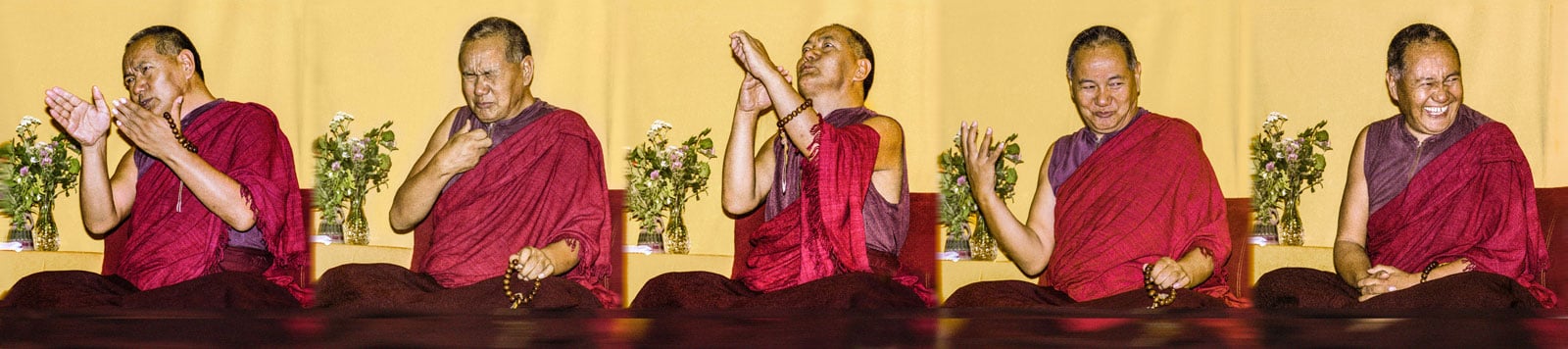
Atisha
A biography of the renowned Buddhist sage
|
|
|
Translated by Thubten Kelsang Rinpoche and Ngodrub
Paljor, with John Blofeld. First published by the Social
Science Association Press of Thailand, Bangkok, in 1974.
Reprinted by Mahayana Publications, Tushita Mahayana
Meditation Centre, New Delhi, 1983, 1984. ISBN 0 86171
015 0.
|
|
Contents
|
 |
Atisha and the Restoration of Buddhism in Tibet
Compiled by the Tibetan Teachers' Training College
Dharamsala, India
Lha Lama Yeshi Yod, (King) of Manjushri, (the western province
of Tibet), whose holy endeavors were unending, sent many learned
disciples off to India. After they had studied Sanskrit, they
were asked to translate a great many volumes of sutras and
tantras. Among their translators Renchen Sangpo became the
most preeminent. Lha Lama also sponsored the erection of the
Todinpel Monastery.
Previously Buddhism had been suppressed by King Langdarma,
so very few ordained monks were to be found in Tibet during
the seventy years that followed his reign. However, at that
time, thanks to the services rendered by the religious King
of Mnahri, monasteries for bhikshus were built. Nevertheless
there was conflict, because those who preferred the Vinaya
school opposed the followers of the Tantric school and vice
versa. Thus whereas almost all subscribed to this or that
doctrine in name, it was rare to find anyone who understood
even one set of teachings, let alone the entire practices
and doctrines of the Mahayana. It was a time when numbers
of Indians came to obtain gold from Tibet, and these people,
pretending to great knowledge of tantra, behaved truculently,
employed black arts, and cheated many Tibetans.
King Lha Lama was saddened on seeing those conditions. Therefore
he sent Gyatsundru Singhe and others to India in the hope
that they would be able to translate the scriptures, and,
in particular, invite a well-versed pandit who would be of
real benefit to the religion. Having given these commands,
he sent a large amount of gold with them. The disciples, after
a long period of investigation, found no one who could surpass
Atisha, but as they were not able to bring back the pandita,
they returned to Tibet and related the reasons to the King
of Mnahri.
Again Lha Lama, desiring to invite the pandita in order
to introduce unsullied doctrine, collected a large amount
of gold, and set forth in search of more. The King of Garlog,
knowing that Lha Lama was seeking gold so as to invite the
pandita, issued this command: "The ancestors of this
man did much for the spread of Buddhism in former times. Therefore,
unless he is made prisoner he will invite the pandita and
spread Buddhism again. So capture him and imprison him."
Accordingly, Lha Lama was captured and put in prison. Hearing
this news, Jangchub Yod 9 went with a hundred horsemen to
release his uncle but the Garlog King was able to put up a
powerful resistance; Jangchub Yod thought that since it would
cost many lives, it would be unwise to wage war against him.
Moreover, if there were likely to be some danger to Atisha's
life, it would not be possible to invite him. Therefore, thinking
to release his uncle by peaceful means, that is, by paying
ransom, he approached the King of Garlog, but the King exclaimed:
"Either you give up your intention to invite the pandita
and pay homage to me, or else you must bring me gold equivalent
in weight to the body of Lha Lama." Then Jangchub Yod
brought him a hundred gold coins as ransom, but the King refused
to accept them. The next time, he took with him gold equivalent
in weight to the body of Lha Lama, but again it was refused.
Then Jangchub Yod went up to the gate of Lha Lama's prison
and cried: "0, compassionate one, it would be futile
to wage war against the Garlog King, since the karma from
previous lives has fallen upon us. It is better for you to
die here for the sake of religion than to live under such
an evil man. With that thought in mind, I went to him with
gold equivalent in weight to your body, but still he refused.
I will come back to release you when I have collected gold
equivalent in weight to your head also. Until then, keep your
mind fixed on karma, pray to the Triple Gem, and make merit
by meditating on compassion."
On hearing this, his uncle smiled and said, "When you
were a dear little boy being fed with butter cakes, I never
thought you would be able to face such hardships. Your doing
so reveals that you will preserve the tradition of our ancestors,
even though I pass away. This is what you should understand.
Already I am doing as you have said. Even if I was not to
die at this time, I would have but ten years left. Therefore
it would be better to die now for the religion. Do not give
even one coin to the Garlog King. Take all the gold to India
to invite Atisha and deliver this message to the pandita,
'For you and the sake of our religion, I have sacrificed my
life to the Garlog King. My great longing is to spread Buddhism
in Tibet. Therefore, please fulfill this desire and I shall
pray for blessings to fall upon you in future lives.' This
is the message you must deliver to the pandits. Now leave
me here and devote yourself to the religion."
Then Jangchub Yod, in accordance with astrological observations
and predictions, said to Nagtso Lotsawa (the translator):
"You must go to India to invite Atisha and I will send
with you a large amount of gold and as many servants as are
needed. I wish you to tell Atisha how Langdarma suppressed
our religion, although the Buddha Dharma had been spread and
propagated by religious kings in former times. (Tell him how)
later my ancestors were able to re-establish the Buddha Dharma,
but still those who know how to practise it properly are rare
and the Buddha Dharma has been sullied by misconduct. (Recount
how) my uncle, not being able to bear these conditions, went
to seek gold to invite him, but was murdered by the Garlog
King. All these things you must tell to Atisha. Alas! My uncle
was so very gracious, why should he have met such trouble?
I dare not leave him behind and come with you. When I peeped
at him through a chink in the door, he was bound with ropes,
his voice was weak and his body thin as a bee's, yet still
he thought of nothing but Atisha, Tibetans and their need
for Buddhism. (Say to him) 'If such is the courage of us remote
Tibetans, how can you, the merciful one, the refuge (of the
helpless), abandon us?'" Giving these messages he sent
the Lotsawa Nagtso with his servants to India.
Many hindrances that beset Nagtso on his way to India were
overcome by various miracles performed by Avalokiteshvara,
and thus they arrived at Vikramala-shila. Here, they consulted
with Gyatsundru Singhe 10 about inviting Atisha, but sometimes
they had difficulty even in seeing Atisha face to face. Then
one day Gyatsundru Singhe took Nagtso secretly to Atisha's
chamber. Here they placed a piece of unwrought gold on a mandala
fifteen inches high and also presented other gold pieces to
the Lord, placing them on the top of the circle of offering.
After that Gyatsundru Singhe related what had transpired earlier
in Tibet, and then repeated the invitation, saying: "Again
a reverend one has come to invite you. Please, out of sympathy
for us Tibetans, do not refuse us as you did in that previous
year." Whereupon Atisha answered, "No doubt the
rulers of Tibet, the three religious kings and the great lamas,
were incarnations of the bodhisattvas. Otherwise they could
not have revived Buddhism after its destruction. It is unfitting
for me to disregard the order of the bodhisattvas and also
I feel ashamed that those people have lost much wealth and
many men for my sake. 0! I feel pity for Tibetans. However,
I am advanced in age, holding many keys (having many administrative
duties) and with many tasks that remain undone. Nevertheless,
I will consult the omens; in the meanwhile take back your
gold."
That same day, Atisha prayed to Avalokiteshvara and Tara,
inquiring how far the religion and sentient beings would be
benefited, how far the wish of the king could be fulfilled,
and whether there would be any danger to his own life. Having
prayed on these three matters, that very night he dreamt he
heard the words: "Go to where you will find a small Buddhist
temple and inquire of the yogini who comes there." Having
thus dreamt, in the morning he took a handful of flowers and
proceeded to a temple where he met a yogini, hair flowing
to the ground. To his inquiry, she replied, "There will
be benefit if you set forth for Tibet, especially with the
help of an upasaka." Still desiring to pray at Buddha
Gaya and make great offerings there, he approached the Abott
Jnana Shri Metri, by whom he was given a handful of cowries
to deliver to an old whitehaired woman who was living at Buddha
Gaya. When Atisha reached that city the old woman demanded:
"Give me the cowries that were sent to me." Atisha,
having paid homage mentally and questioned her in his mind,
got the same answers as he had received before (from the yogini).
But when he inquired about physical danger, she replied that
if Atisha did not set forth for Tibet, he would live to the
age of ninety-two years, whereas if he did set forth, he would
live to be only seventy-three. At this Atisha courageously
decided that he would not care about his health if his journey
would benefit Tibet.
Thereupon, many groups of monks and sponsors tried to dissuade
him from setting out for Tibet, declaring that, if he did
so, India, as the source of religions, would greatly deteriorate.
Seeing how things stood, Atisha resorted to very skilful means;
not mentioning his journey to Tibet, he went back and forth
many times, giving out that he was making huge merits at holy
places such as Buddha Gaya. Presently a phantom of Drom (one
of his future disciples) came in the form of a merchant and
without anyone knowing, he carried away his images of Manjushrivajra
and the buddhas, his set of holy writings, and other sacred
objects. Thus Atisha was able to proceed to Nepal. There at
the request of its king, Yashananda, and many devotees, he
stayed for one year, constructed the Tanbhehari Monastery,
and established a sangha.
Then Atisha and his disciples reached Nepali Tsong (on the
frontier of Tibet) where he met 300 horsemen who had been
sent by Jangchub Yod to welcome him. They were clad and adorned
all in white and the four great ministers, Lhayi Wangchuck,
Lhayi Lodo, Lhayi Sherup and Lhayi Sizin, were encircled by
sixteen horsemen who held lances with white flags, whereas
the rest of the retinue held small Buddhist flags and twenty
umbrellas. All of them, masters and servants, were playing
upon flutes and stringed instruments, reciting the Refuge
in the Triple Gem and praying: "May the doctrine of the
Buddha prosper in Tibet!"
While uttering these auspicious words, they remained mounted
and formed a circle. In the centre were placed Atisha and
his retinue, with the rest of the horsemen facing them, led
by the four great ministers. As in former times when the wise
ministers of Chogyal Thrison Dhesten had gone with songs on
their lips to receive the Abbot Bodhisatta, so did the ministers
come forward singing. This occasion is famous for the thousand
melodious and auspicious songs with which they invited Atisha.
Nagtso Lotsawa and thirty-five bhikshus encircled him. In
their midst stood Atisha, his whole body beautiful to see,
pleasing to gaze upon, worthy of worship by humans and gods.
Sitting astride his horse, Chanshe Tonmon, he uttered the
following words in Sanskrit wiith smiling countenance: "Ema
Ho Ati Anti Pala Ho." Uttering many Sanskrit benedictions,
he continued on his journey.
While circumambulating Gang Rinpoche 11 he heard the sound
of a ghanti (a white sandalwood gong), for the Sthaviras 12
and Yen Lekjun were observing upasojong 13 day. Atisha, on
coming face to face with the chief Sthavira, held consultation
with him. On the bank of Manasarova Lake, while he was making
holy water offerings, 14 Avalokiteshvara appeared, nagas 15
came to worship him and many wondrous events occurred. Then
when they were gradually approaching Gughe Tedhen, Nagtso
delivered a letter to Lha Lama Jangchub Yod which made the
great king cry joyfully: "Long indeed have I been praying
for his coming, daily with reverence and faith. Now I shall
meet with that Lord! In my dream yesterday there appeared
a great sun from the west and a full moon from the east. At
their approach, cloud, mist and dust vanished immediately.
Also I dreamt that groups of stars gathered in lines as though
it were midnight and bowed to sun and moon. Perhaps that moon
might be myself but I knew not who was that sun coming from
the west. However that may be, it was an auspicious dream."
Then Atisha stood in the centre of his retinue, surrounded
by five hundred horsemen, wearing a beautiful cap bright as
the sun. Whereas his thirty-four disciples and servants resembled
one another in bearing, conduct and costume, his own robe
was smooth, shining, of fine texture and sweet-smelling. Brilliant
was his splendor, upright his handsome figure and many were
his other marks of distinction. The whole gathering, as soon
as they beheld that noble man, were unable to take their eyes
from him and prayed spontaneously: "We seek your protection."
Furthermore they implored: "Pray look compassionately
upon us Tibetan people who have accumulated so many evil deeds!
Our Lha Lamas who have faced such difficulties for your sake
will be overjoyed and by no means grudge the loss of Tibetan
men and treasure. Though it was difficult indeed to persuade
you, it was truly worth our trouble. Now a good time has come."
These words were shouted by all the people with full faith.
Atisha also rejoiced extremely. Looking upon the Tibetan people,
he blessed them.
Anilha Chick Chobum, Lha Lama's aunt, on meeting Atisha,
folded her hands and exclaimed: "For you, pandita, I
lost my nephew who was as precious to me as a golden mountain,
but now I feel no sorrow or remorse, for I have given my nephew's
life in exchange for your coming, pandita. Truly the exchange
has been worthwhile. Now, I have you, pandita, to show to
Hasu in Nepal and Rinchen Songpo in Mnahri (western Tibet)
who set themselves up to be pre-eminent pandits." With
these words she laid down the mountain-like burden of sorrow
caused by Lha Lama's death. She then offered her turquoise
necklace and fifty gold coins to Atisha.
Then Atisha paid a visit to the Todin Golden Monastery and
was received by Jangchub Yod with a great procession. Lochen
Rinchen Sangpo also invited him to his own monastery. Here,
when he had listened to Atisha expound the madhyamika philosophy,
and particularly the Sambara abhisheka, as well as other sacred
matters and Dharma teachings, holy thoughts sprang up in the
Abbot's mind as well as wide comprehension of the teaching;
therefore he offered everything he had to Atisha. On being
asked by Atisha to accompany him as his interpreter, the Abbot
pointed to his head and begged Atisha to allow him to engage
in religious practice as he had grown old and grey. Atisha
in response to his plea, exhorted him.
"O Rinchen Sangpo! Since you righteously wish to practise
religion, let not your mind wander into evil." Rinchen
Sangpo, keeping these teachings in mind, sealed his meditation
house with iron nails, writing on the lintel of the door:
"If any mundane thoughts occur in this place, may the
protectors of the Dharma cut off my head!" Having done
so, he sat in contemplation for ten years and the mandala
of Sambara manifested itself before him.
One day Jangchub Yod, shedding tears, related fully to Atisha
how, although Buddhism had been introduced by his paternal
ancestors, yet it had since been reduced to ashes and scattered.
"Now it lies with you, O gracious Atisha, to bestow on
the rude and rough Tibetan converts the profound teachings
of the Dharma. O compassionate one! I pray you compose a treatise
setting forth the essential points of the Buddha's doctrine
in a manner very easy to practise for the benefit of the whole
Tibetan people." Atisha responded gladly by writing the
Bodhipathaprabha treatise (his famous Light on the Path of
Liberation).
Atisha then thought to move on to Tibet's central region,
but was restrained by a promise which, at the time of his
setting out from India, had been made to the Abbot of Vikramshila
Vihara. Should Nagtso Lotsawa not send Atisha back to India
after three years in Tibet, that promise would be broken.
Accordingly, Nagtso Lotsawa, in fulfilment of his bond, induced
Atisha to return to India for that reason. Atisha, at his
request, went back as far as Puran, at which place he occasionally
received a prophecy from Tara that, with the assistance of
an upasaka, he would bring much benefit to Buddhism. Moreover,
Tara prophesied that the upasaka would soon come. Atisha kept
constant watch for his coming and it was said he used to exclaim,
"My upasaka has still not come. Would Tara tell a lie?"
Then one day Dromtonpa, having been invited by a sponsor,
arrived at the dwelling while Atisha was out. Though Dromtonpa
was informed that Atisha would soon be back, he left, saying:
"I would sooner meet my guru earlier than later and I
have no time to wait." With these words, he went out
and presently met Atisha in a lane. Atisha handed him the
tsampa and butter he had begged from his sponsor as a share
for his upasaka that day. Dromtonpa ate the tsampa, but he
used the butter to offer a lamp which would last throughout
the night in front of Atisha's bed. Thereafter, he offered
a butter lamp in front of Atisha's bed for the rest of his
life. Dromtonpa was blessed by Atisha as his chief disciple
at the very moment of their meeting.
Then setting out from Puran, Atisha gradually journeyed
to Keydron. At that time, due to inspiration on the part of
Atisha and to good fortune on the part of the local Tibetans,
the way was blocked by a skirmish near the border of Nepal,
and Atisha stayed one year preaching the Dharma to several
converts at the shrine of Ranjun Pakpa Lhakhan. Today there
still exists in that place the monastery of Keydron Samten
Ling.
Dromtonpa Rinpoche eloquently persuaded Atisha to pay a
visit to central Tibet, saying there were many Buddha images,
holy writings, stupas, and thousands upon thousands of Buddhist
monks. When Atisha agreed to grant Dromtonpa's prayer, Drom
Rinpoche wrote specially to inform Kawa Sakya Wangchuk, although
at that time there were also (other great lamas such as) Nog
Lekpi Sherap and Khuton Tsondru Yuntran and so on. In his
letter, he wrote: "The great lamas of Tibet must reach
here before autumn to welcome Atisha." On receiving the
letter, Kawa Sakya informed all the great lamas of Tibet,
but before all were ready to set forth together, Khuton left
in advance, saying: "It is not necessary to include me
in your party." Though he created some anxiety, the rest
set forth immediately to invite Atisha. In the meantime, Atisha
preached the Dharma widely. The places where he preached are
now known as Grachokhor and Ladhap Chokhor. At that time Nagtso
could not invite Atisha back to India immediately and, recollecting
the promise he had made to the Abbot of Vikramashila, the
translator became worried. Seeing this, Atisha consoled him,
saying: "O Lotsawa, you should not be so distressed.
There is no offense if things are beyond our power to remedy."
On hearing the pandita's words, the translator rejoiced and
further prayed Atisha to visit central Tibet if there was
no offense involved. Then the great lamas of central Tibet
arrived to welcome Atisha. These great lamas wore elegant
san (shawls of Tibetan monks) and were dressed in setab (ceremonial
garments which abbots or monks usually wear on festive occasions
as a mark of rank). They rode good horses covered with woolen
blankets. Atisha, on seeing them coming, cried: "O upasaka,
what are these? Look at all those spirits approaching!"
So saying, he hid his head, wrapping it tightly in his robe.
So Dromtonpa told the newcomers that it was proper for the
great lamas of Tibet to come dressed in bhikshus' robes. When
they drew nigh, on Dromtonpa's advice, Atisha rose and returned
their prostrations. In due course, when Atisha was on the
way to Tsang, at Palpud Tan he met Lhodrak Marpa Lotsawa who
was about to leave for his last journey to India. Marpa studied
the Dharma with Atisha but, on being asked by the pandita
to accompany him as his interpreter, replied: "It is
absolutely necessary for me to go to India this time; however,
I can meet you afterwards."
Then gradually they approached Sakya, and Atisha, pointing
in that direction, prophesied that an incarnation of Manjushri
would appear there. At this place Drokme Lotsawa bowed himself
to the feet of Atisha as a disciple and venerated and served
him meritoriously. Then when Atisha was proceeding towards
Nartan, he foretold that at this place an incarnation of Arya
Sthivira would occur in the near future. Thereafter he visited
the shrine of Shalun Tel where he stayed in a rocky cave and
preached many sermons. On leaving this place, he passed Buddhist
Lent in Myantod, where he encountered three disciples, namely
Yolchos, Yoldranron and Yoltag Bab. Disciple Golo also came
and bowed at the feet of Atisha. Gonpapa, coming to the same
place, did likewise and presented offerings. After Buddhist
Lent, Atisha went to the central region by way of Ron. When
he reached Gonpa Jangtang (a grassy undulating plain in the
north of Tibet) he pointed towards the mountain of Lhasa and,
on inquiring what was to be found there, was told that it
contained the Temple of Lhasa (an appellation of the Jo Khan;
the chief temple there). Then he observed: "In the direction
of this temple there are three rainbows and many deva children
are paying their respects."
When Atisha came to Samye, he was served by Devaguru Bodhiraj
and there was a great congregation of Tibetans to whom Atisha
preached many sermons. In Samye, while he was in the temple
or circumambulating it, he performed numerous miracles which
inspired many people to attain single-hearted faith. Then
he was invited by Khuton to Yarlun where he stayed in the
Rarted quarter and preached often. However, as Khuton did
not conduct himself well, Dromtonpa and others fled with their
master, embarking in a boat belonging to Myanpo. Khuton, seeing
this, ran after them and cried: "Atisha, I beg you to
stay." But the master kept silent and threw his cap to
him as a keepsake that would bring blessings. Thereafter Atisha
stayed in the shrine of Won at Keru for one month and drew
a picture of himself on the wall there. Then he returned to
Samye and stayed in the Pakar Ling. There, on seeing many
holy writings from India, he felt boundless joy and cried:
"Oh, the spread of Buddhism in Tibet in former times
was even greater than in India! Seeing these holy writings,
it is just as if I were at Maha Bodhi!" So saying, Atisha
rejoiced in the monastery and holy places there.
Then nearly two hundred horsemen came from Banton to receive
him, and he and his attendants went to Godhar and stayed in
Gyapep for one month. Later, when Atisha was proceeding to
the Jo Khan at the invitation of Nog Lekpi Sherap, Avalokiteshvara
appeared in the form of a tall layman and declared: "Excellent!
the Maha Pandita has come and I pray he may win victory!"
Uttering these words, he hurried away. Although Atisha dismounted
and ran after him, he could not come up with him. On being
asked what he was doing, he replied: "Have you not seen
a tall layman?" "Yes, we did," they answered,
so Atisha said: "Well, that was my tutelary deity Mahakaruna
16 and, desiring to do him obeisance, I ran after him but
could not catch up with him. Oh, there is nothing more wonderful
than this Mahakaruna of the Jo Khan shrine of Lhasa! He is
the real Mahakaruna." Again on seeing the image of Shakyamuni,
he declared it to be a real embodiment of Shakyamuni. He thereupon
ordered a skilful sculptor from India to construct a similar
image. Presently he wondered whether there existed a history
of that monastery and of its dedication by King Tsonten Gampo,
whereupon a mad beggarwoman cried that she would display its
history to him. Recognizing her as a disguised yogini, Atisha
paid her homage in his mind and asked her to show it to him
by all means. "Well, it is written on the Bumpa pillar
at a height of two and a half fathoms, but it would be wise
not to disclose this to others," replied the yogini.
Atisha found it just as she had said and a guardian of the
temple treasures who was standing near by told them they could
copy as much as they could write on that day. Dromtonpa and
four disciples spent the day copying it, but there still remained
a little that could not be finished that day.
During Atisha's stay in Lhasa for one winter season, many
amazing signs occurred. He spent the summer that year in Yerpa
at the invitation of Nog Jangchub Jungne and performed many
deeds for the benefit of sentient beings. Thereafter he was
invited to Penpo by Kawa Sakya Wangchuk and stayed in Menpa
Jilpur, were he preached many sermons. Next he returned to
Yerpa, where he received an invitation from Bhaton and, travelling
back through Lhasa, came to Nartan. During all these days,
Drom Rinpoche investigated the essential stages of the liberation
path day and night continually.
After settling at the Lhari Ningpo Cul Monastery in Yerpa,
the guru and his disciples spent three years discussing and
examining the very essence of the stages of the liberation
path and then they made a summary of this teaching. In that
same place, Atisha gave instruction in the seven Kadam Lhacho
(seven wholesome teachings of Kadam) as well as sermons and
initiations pertaining to the sixteen tigle. Sanpu Noglekpi
Sherap offered a mandala to both Atisha and Dromtonpa, praying
them to compose a book to reveal the secret mysteries of both
the guru and his disciple. In response, Atisha wrote the Noble
Biography of Dromtonpa, whereas Dromtonpa wrote on the extremely
secret occult teachings of Atisha in a book called A Book
of Phantoms which in these days is known as the Kadam Lek
Bum. For many years this was transmitted privately (from lama
to pupil) and was not allowed to be preached in public. Later,
an emanation of Dromtonpa Rinpoche known as Drom Ku Mara clarified
the secret of this Dharma and spread it. Then in due course,
this doctrine was made public at the monastery of Nartan.
Since then it has spread in all directions.
|