
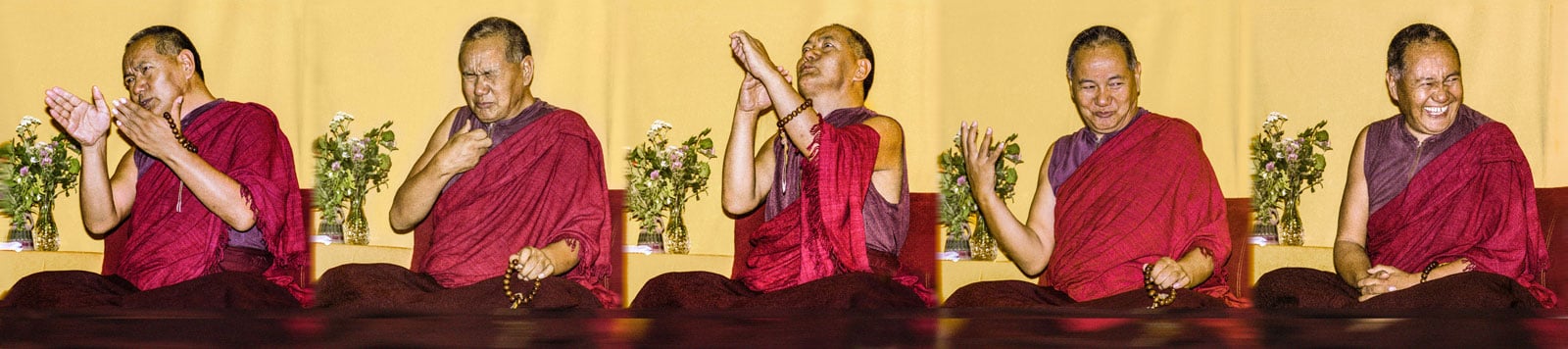
Interview on Emptiness
This material comes from Ven. Thubten Chödron’s interview with Lama Zopa Rinpoche at Sravasti Abbey January 29, 2005, and also incorporates clarification of a few points during an interview with Rinpoche in Wisconsin, July 2005. This document has not been checked by Rinpoche.

Thubten Chödron: I have a question about emptiness that comes from Geshe Sopa-la’s teaching last summer. A couple of things are confusing to me. One is: In the four point analysis we are supposed to search for the inherently existent I. However, in the syllogism—the I, for example, is not inherently existent because it’s a dependent arising—the I that is the subject of the syllogism is the conventional I, not the inherently existent one. So which I are we searching for? How are we to meditate on this?1
Lama Zopa Rinpoche: We ordinary beings who haven’t realized emptiness don’t see things as similar to illusions. We don’t realize that things are merely labeled by mind and exist by mere name. Generally speaking, we don’t see the mere appearance of the I2 until we become enlightened, because whenever our mind merely imputes something, the next second the negative imprint left on the mental continuum by previous ignorance projects true existence. In the first moment, the I is imputed; in the next it appears back to us as real, as truly existent, as not merely labeled by mind.
Until we achieve enlightenment we have this appearance of true existence. Except for the meditative equipoise on emptiness of an arya, all other consciousnesses of sentient beings have the appearance of true existence. During an arya’s meditative equipoise on emptiness things don’t appear truly existent. It is without the dualistic view (in two senses, first) not only is there no appearance of true existence, but there is no appearance of subject and object. This wisdom mind and its object are inseparable, like water put in water. The arya’s meditative equipoise on emptiness hasn’t completely eliminated the dualistic view from the person’s mindstream forever, but it has absorbed it temporarily. That is how the wisdom meditates on emptiness. It realizes emptiness directly, becoming inseparable from emptiness.
After arising from meditative equipoise on emptiness, everything appears truly existent again, even though the meditator no longer believes that this appearance is true. In this way, the meditator sees things as like an illusion in that they appear one way (truly existent) but exist in another (dependent, merely labeled). These post-meditation times are called subsequent attainment, or rjes-thob in Tibetan. So the appearance of true existence is there until we attain enlightenment. That’s why it is said that every consciousness of sentient beings except an arya’s meditative equipoise on emptiness is a hallucinating mind—everything that appears to it appears truly existent.
So whatever appears and whenever there is the thought “I,” aryas have the appearance of a truly existent I during the time of subsequent attainment. If this is the case for aryas, there is no question that ordinary bodhisattvas on the path of accumulation and the path of preparation, who have not realized emptiness directly,3 have a hallucinating mind. Everything that appears to them appears truly existent. Needless to say, whenever we common people, who haven’t realized emptiness, think “I,” we don’t think of a merely labeled I. Generally speaking, when we common people talk about I, it’s the real I, the I existing from its own side. During our conversations every day, we don’t talk about some other I; we’re always thinking and speaking about a truly existent I. That is how we see and think of things. Ordinarily people do not question that appearance. Nor are they aware that they assent to that appearance, grasping it as real and true.
So when we think “I” or point to I, naturally we think it’s truly existent. We don’t have any appearance other than that of true existence. Then we believe that appearance to be the way things actually exist. So when we say “I,” we’re automatically pointing to and thinking about a truly existent I because the merely labeled I is not appearing any more. But the I that appears to us is false; it doesn’t truly exist. When we meditate on emptiness, we drop an atom bomb on this truly existent I. The atom bomb is the reason of dependent arising—the I is not truly existent because it is a dependent arising. It’s not true. What appears true, what appears to exist from its own side, isn’t true. Thus it is empty of true existence.
But its being empty doesn’t mean the I doesn’t exist. The real I, the truly existent I, the I that exists by its own nature, the I that exists from its own side, is not true. It doesn’t exist. However, the conventional I, the I that exists by being merely labeled, the I that is a dependent arising, that I exists.
In the Heart Sutra, Avalokiteshvara says no form, no feeling, and so on. This is like throwing an atom bomb on the appearance of truly existent things. That appearance is not true. Those truly existent things that appear to us do not exist. Then what comes in our heart is that they’re empty. It’s not that they don’t exist. They exist, but they’re empty. Why? Because they’re dependent arisings. Because they are dependent arisings, they are empty of true existence; because they are dependent arisings, they exist (conventionally). Use the reason “It’s not true because it’s a dependent arising.” Do analytical meditation to search for the I, then do stabilizing meditation when you see its emptiness.
For us ordinary beings, whatever we contact, talk about, or think about—everything—appears truly existent and we believe in that appearance. We grasp things as truly existent. However, when you realize the emptiness of the I or any other phenomenon and train your mind in that realization, you see that this phenomenon is merely labeled by mind. Even though true existence still appears to you, you don’t assent to that appearance; you don’t believe that phenomena truly exist. You know they exist by being merely labeled by mind, even though they appear truly existent. You have discovered that they’re not true, that they exist in mere name.
Someone whose mind has realized emptiness in the meditation session sees things as like an illusion in the subsequent attainment time. He knows they exist by being merely labeled by mind. So even though that meditator has the realization that everything is a dependent arising and is merely labeled by mind dependent on the base, he still has the appearance of true existence. But now he points at that and say to himself, “This appearance isn’t true because it’s a dependent arising.” There is nothing contradictory in this—things are both empty and arise dependently.
Because this meditator has realized the emptiness of I, he has also realized that the I exists by mere name and is merely imputed by mind in dependence on the aggregates—this is the Prasangika view. The I is there. It exists, but you don’t grasp it as truly existent, even though it still appears to be. For example, let’s say you see a mirage and have the vision that water is there. But since you just came from that place, you know that only sand is there, so you don’t believe that it’s water. You think, “That water is not true. It doesn’t exist as it appears because there’s no water there. There’s the appearance of water—that appearance of water exists. But there is no water.” Many things are like that. Once when I was in Italy I saw a lady in a store but she turned out to be a mannequin. Then there was another figure that I thought was a mannequin but it was a lady. So this is similar: the appearance is false, it appears one way but exists in another.
Thubten Chödron: In the texts, it says that we don’t realize that things are merely labeled by mind until after we realize emptiness. So how can we use the reason that things are merely labeled by mind as a proof that things are empty if we can’t realize that they’re merely labeled by mind until after we’ve realized emptiness?
Rinpoche: It’s like this. There’s no contradiction. Being merely labeled by mind indicates how things come into existence. At this moment, this is not something you know through analytical meditation, not something you know by realizing emptiness.
Usually in the philosophical teachings, it says that whatever appears appears truly existent. That’s what normally happens due to the hallucinating mind. The only time true existence doesn’t appear to sentient beings is during the meditative equipoise on emptiness of an arya.
But in Pabongka’s text it says there is mere appearance of the object for a brief moment. Through analysis you can get the idea. For example, when you see a drum, analyze it at the same time. Be aware that your mind is labeling “drum” by seeing that base. Be aware at the same time as you’re labeling. Analyze: to be able to label drum you have to see a specific phenomenon. Even though the table is round like a drum, you won’t label “drum” on the base you label “table.” It has to be a specific base that performs the function of making sound and that has material to produce sound when hit. You have to see that base first. Then because of the function it performs—what it’s used for—the mind merely labels drum. Seeing that base—its shape, color, eThubten Chödron.—and knowing it has that function become the reason to label “drum.”
When you are aware and analyze at the same time as the labeling process is occurring—that is, you’re analyzing while you’re labeling drum—then, at that time, at the beginning there is a mere appearance.
If you’re aware of the brief instant the mind initially sees that base, the instant you’re starting to label drum, there is a mere appearance. When you’re aware the instant you begin to label drum, you’ll be aware that there’s no real drum existing from its own side. You’ll be aware that drum is merely imputed by seeing that base—that which performs the function of making sound when struck. At that moment, there’s just the mere appearance of a drum.
That awareness of the mere appearance of a drum lasts a very short second. It doesn’t last because you don’t continue that awareness or mindfulness and because you don’t yet have the realization that it exists in mere name, merely labeled by mind. And because the negative imprint left by the past ignorance is there, it projects a truly existent appearance on the drum and you see a real drum that exists from its own side. That’s the gag-cha, the object of negation.
I told Chöden Rinpoche that I agree with what Pabongka said. Why? For example, let’s say you have a child and you want to give it a name. While you’re thinking of the name—the minute you decide “George” or “Chödron,” for example—you don’t see George or Chödron right in that second while you’re labeling. If you’re aware that you’re labeling, at that instant you don’t immediately see George or Chödron as totally existent from their own side. So I agree with what Pabongka said—that this mere appearance is very short, just a brief moment. Here we’re talking about actual reality; that’s actually how things come into existence, merely labeled by mind.
However, since you don’t continue that awareness or you lack realization, in the next moment you see the object of negation that was projected by the imprint of ignorance. George or Chödron appear as if existing from their own side.
Except for the arya in meditative equipoise on emptiness, everything that appears to us sentient beings appears to be truly existent. At this time, the appearance of true existence is temporarily absorbed. Only emptiness appears; it doesn’t appear truly existent to this direct perceiver. This is what is usually said in the texts.
Also, it is normally said that as soon as you label something, it appears back to you as truly existent and you believe it exists in the way it appears to you. For example, suppose you are a parent with a new child and it’s time to give it a name. The thought “Döndrub” comes in your mind and you label “Döndrub.” Of course, the correct way would be for Döndrub to appear merely labeled by mind. However, due to the negative imprint or predisposition [Skt: vasana; Tib: bag-chag] left by past ignorance on your mind, the moment after you label the child “Döndrub,” Döndrub appears back to you as not merely labeled by mind but as existing from its own side.
But Pabongka says—and I think I agree with him—that doesn’t need to happen all the time. I think that sometimes if you’re analyzing and waThubten Chödronhing closely, there is a brief moment when the mere object appears without the appearance of true existence. Sometimes in the moment after the mind labels “Döndrub” there’s not the appearance of a real (i.e., inherently existent) Döndrub. Instead there is Döndrub but not real in the sense of existing from its own side. There’s the appearance of mere Döndrub, for a very short time. Then, due to the imprint of the ignorance that grasps at inherent existence, the mind goes into hallucination, believing that Döndrub exists from his own side, not merely labeled by mind.
This is a unique explanation. It’s not common and comes due to personal experience. I think I agree with what Pabongka said about this. I showed the text to Chöden Rinpoche and consulted him about it. I said I didn’t think that it would immediately appear truly existent. You need to waThubten Chödronh your perception when you’re labeling. You usually don’t notice because the mind is not aware. Probably mere Döndrub appears for a split second and then real Döndrub appears. There is an evolutionary process: mere Döndrub; then Döndrub existing from its own side—a real Döndrub appearing more and more, that appearance becoming stronger and stronger.
Check with your own experience, especially when you’re labeling something for the very first time. I think you will understand this if you examine your mind when it’s happening.
For something to exist there must not only be the mind conceiving it and the label but also a valid base. You can’t just make up a label and think that therefore the object exists and functions according to the label you gave it. For example, let’s say before they have a baby a couple decides to name it “Tashi.” At that time, there are no aggregates—no body and mind. Remember the lamrim story about the man who got excited and labeled a child he dreamed of having in the future “Dawa Dragpa”? It’s similar here, where the couple thinks of the name “Tashi.” At that time Tashi doesn’t exist. Why? Because there’s no base. Whether Tashi exists or not mainly depends on the existence of the aggregates, the existence of the base of the label. It depends on whether there is a valid base.4 In this case, since a valid base which could be labeled “Tashi” doesn’t yet exist, Tashi doesn’t exist at that time.
In another scenario, let’s say a baby is born—so the mental and physical aggregates are present—but the name “Tashi” hasn’t been given yet. So at that time, Tashi also doesn’t exist because the parents haven’t labeled “Tashi.” They could label “Peter.” They could label anything. So even though the aggregates are there at that time, Tashi doesn’t exist because the parents haven’t named the child. When does Tashi come into existence? It’s only when there is a valid base. When a valid base is present, then the mind sees that base and makes up the name “Tashi.” After making up the name and labeling it in dependence on the aggregates, then we believe Tashi is there.
Therefore, what Tashi is is nothing. Nothing. Tashi is nothing other than what is merely imputed by mind. That’s all. There’s not the slightest Tashi that exists other than what is merely labeled by mind.
The Tashi or the I appearing to you that you believe is something even slightly more than what is merely labeled by mind is a hallucination. That is the object of negation. Anything that is slightly more than what is merely labeled by mind doesn’t exist at all. It is the object of negation. Therefore what Tashi is in reality is extremely subtle. What Tashi really is is not what you’ve believed up to now. The Tashi you believed existed for so many years is a total hallucination. There’s no such thing. It doesn’t exist. The Tashi that does exist is what is merely labeled by mind. Nothing other than that. So what Tashi is is extremely fine, unbelievably subtle. The borderline of Tashi existing or not existing is extremely subtle. It’s not that Tashi doesn’t exist. Tashi exists but it’s like Tashi doesn’t exist. When you examine, you discover that it’s not that things don’t exist. They exist. There are the aggregates. Then the mind sees those aggregates and makes up the label “Tashi.” Tashi exists by being merely imputed. This is how all phenomena exist and function, including the hells, karma, all the sufferings of samsara, the path, and enlightenment—everything. All phenomena exist by being merely labeled, as in the example of Tashi.
The I is similar. What the I is is extremely subtle. The borderline between its existing and not existing is extremely subtle. Compared to how you previously believed things exist, it’s like it doesn’t exist. But it’s not totally non-existent. The I exists but how it exists is unbelievably subtle.
Because the conventional I is subtle, gaining the correct view is difficult. Thus before Lama Tsongkhapa there were many great meditators in Tibet who fell into the extreme of nihilism, thinking that nothing existed at all. It’s difficult to realize the view of the Middle View devoid of eternalism—grasping at true existence—and nihilism—believing that the I doesn’t exist at all. The Middle Way view is free from holding things to exist from their own side and holding that they don’t exist at all. As with the example of Tashi, things are empty of true existence—they do not exist without being merely labeled in dependence on a valid base—but they are not non-existent. They exist ever so subtly, almost as if they didn’t exist. But you can’t say they don’t exist. There’s a big difference between the I that exists by being merely labeled in dependence on a base and a rabbit’s horn. Similarly, there’s a big difference between this nominally, or conventionally, existent I and an inherently existent I.
While the I and all phenomena are empty of existing from their own side, at the same time the I and all phenomena exist. They exist in mere name, merely imputed by mind. The I is the unification of emptiness and dependent arising. It is empty of inherent existence and arises dependently. This point is unique to the Prasangika Madhyamikas. Svatantrika Madhyamikas can’t put these two together. When they think that something is merely labeled by mind they think it doesn’t exist and thus fall into nihilism. Although Svatantrikas don’t accept true existence (den-par drub-pa), they do believe that things exist inherently (rang-zhin gyi drub-pa), by their own characteristics (rang-gi tshän-nyi kyi drub-pa), from their own side (rang-ngös-nä drub-pa). It means there’s something on the aggregates, something on the base that can be found under analysis.
The term “true existence” has different meanings for the Svatantrikas and the Prasangikas. If you don’t understand that, then studying their tenets becomes very confusing. Although tenet systems may use the same word, they often give it different meanings, so being aware of this is very important in order to gain the correct understanding. For Svatantrika Madhyamikas, “true existence” means existing without being labeled by the force of appearing to a non-defective awareness. If something exists without being labeled by the force of appearing to a non-defective awareness, then according to the Svatantrikas it is truly, or ultimately, existent. For them, it has to appear to a valid mind and that valid mind has to label it for it to exist.
So for Svatantrikas something exists from the side of the object. While they say that things are labeled by mind, they don’t accept that they are merely labeled by mind. They don’t accept that things are merely labeled because they believe that the I, for example, is there on the aggregates. In other words, they believe you can find the I on the aggregates. If you believe that the I is on the aggregates, then it means the I is findable on the aggregates. For example, if there is a cow on the mountain you’ll be able to find a cow on the mountain. Since there is something in the aggregates that is the I, it should be findable under analysis. This is their philosophy. You can find the I on the aggregates, so while they think the I doesn’t exist truly, it does exist inherently; it exists from its own side.
This is the big difference between Prasangikas and Svatantrikas. Svatantrikas believe the correct view is that you can find the I on the aggregates. Therefore they say it exists from its own side; that it exists by its own nature. According to Prasangika philosophy this is totally wrong; what the Svatantrikas believe exists is in fact a total hallucination. Prasangikas believe this not just because their philosophy says so but because if you actually meditate and search for an inherently existent I, you can’t find it. In other words, this is not intellectual wrangling but what you actually discover when you analyze and investigate how things exist. Therefore, the Prasangika view is the ultimate view.
Not only can’t you find a truly existent I on the aggregates; you can’t find a merely labeled I on the aggregates either. Many people seem to say that the merely labeled I is on the aggregates but that there is no truly existent I. This is an interesting point. If the merely labeled I is on the aggregates, then where is it? This becomes a huge question. Where is it? For example, if we say there is a merely labeled table on this base—four legs and a flat top—then where is it? Is the merely labeled table on top or on the right side or on the left side? If we say a merely labeled table is on this base we should be able to find it. Where is it? It becomes very difficult to say exactly where.
Do you remember last summer when Geshe Sopa Rinpoche was teaching I asked where on the base the merely labeled table is? I think it would have to cover the whole base. The merely labeled table would have to cover the entire base, every atom of it, or it would have to exist on one side or the other. We can’t find it on one side or the other, in one part or another, so the merely labeled table must cover the entire base, every atom of it. Then it becomes very interesting. Then if you cut it in half you should have two merely labeled tables. But if we break a table into pieces we see only pieces, and there should be a merely labeled table on every piece. Take a little piece and it would be a merely labeled table because table exists on the whole object. So that is totally absurd! Many faults arise.
I find it much clearer to say that there’s not even a merely labeled table on the base. Geshe Sopa Rinpoche debated with me. At that time I think we were talking about the person, so I said a merely labeled person is in this room, on this seat, but it’s not on the aggregates. It’s much simpler, much easier, to say this. I don’t see any confusion in it. The person is on the bed but not on the aggregates. Why is the person on the bed? Because the aggregates are there. But the person is not on the aggregates, because if it were, it should be findable when we search for it.
If you don’t debate and just say, “The merely labeled I not merely labeled aggregates,” it seems OK. But if you analyze and debate, it becomes difficult to believe that.5
True, or inherent, existence is the gag-cha, the object of negation. It appears and we grasp it as true. That is, we believe the label exists on the base. Because of our deep habit of believing this, when phenomena appear to us, they appear to exist from the side of their base—from there on the base, appearing from there. But in fact, when you come in the room, you see this phenomenon with legs and a seat that you can sit on. Before seeing it, you don’t label “chair.” Why not? Because there’s no reason for your mind to label “chair.” There’s no reason at all. The label “chair” doesn’t come first. First you have to see the base. Your mind sees that and immediately brings up the label. Initially we learned the label from others; when we were children they introduced us to it, saying, “This is a chair.” So much of what we call education in childhood involves learning labels. Whether we study Dharma at a monastery or another subject at secular school, we’re learning labels. Whenever we have a conversation we’re talking about labels. Studying science or any other topic is the study of labels, learning labels that we weren’t previously aware of. This is the same when we learn Dharma and everything else.
First you see the base; the next moment your mind gives it a label. The same mind sees this base and then generates the label. The mind merely imputes the label “chair.” It makes up the label “chair” and then believes in that. In fact, nothing is going onto the object; there’s nothing concrete going there and sticking on the object. Rather, the mind imputes and then believes the object is that label. The difficulty and the wrong view begin just when the label has been imputed; we look and the object appears from there. There seems to be the object there, existing from its own side, not something that was merely labeled by mind, but something that is the object there on the base.
That is the object of negation. It appears as a real chair or person or table, not one that exists by being merely labeled. The reality is that your mind merely imputed “chair” just now by seeing the base. It’s the same with the table: in the next moment, it appears as a real table from the side of the base, not as something that became a table dependent upon your mind making up the label “table.”
Before seeing the base, you didn’t label “table” and no table was there. First you see the base—something with legs that you can put things on—then, upon seeing it, your mind imputes table. In less than a finger snap, your mind imputes table, generates the label “table” because as a child you were taught that name, “This is a table.” You know the label, so by seeing the base, your mind imputes the label table. Then you believe that. But the next moment, when you’re not aware, because of the imprint of past ignorance, the mind projects the hallucination of a real table.
For example, bile disease can make you see a white snow mountain as yellow; wind disease can make you see it as blue. If you look through colored glasses, a white snow mountain will appear to be the color of the glass. It’s a little bit like that. The imprint of ignorance makes us see the label on the base. What we see, in fact, is a labeled object as existing from the side of the base, as coming from the base. Precisely this is the object of negation; this is what doesn’t exist at all.
Anything appearing from there, from the side of the base (i.e., from its own side), anything coming from there is the object of negation. It’s a hallucination. Actually, the table is coming from your mind—your mind makes it up and believes it, but because you’re not aware of that, in the very next moment the table appears to exist from the side of the base. That’s the object of negation.
All objects of the senses—visual, auditory, olfactory, gustatory, and tangible—as well as the objects of the mental sense power—in sum, all phenomena that appear to the six senses, are the object of negation. They’re all hallucinations. The entire world, even the Dharma path, hell, god realm, positive and negative karma, and enlightenment, were made up by your own mind. Your mind projected the hallucination of things existing from their own side.
This hallucination of inherent existence is the foundation. Then, on top of that, you pay attention to certain attributes and label “wonderful,” “horrible,” or “nothing much.” When you think, “He’s awful” and get angry, you label the person an enemy. Not aware that you created the enemy, you believe there is a truly existent one out there and project all sorts of other notions on him. You justify your actions, thinking they are positive, when in fact you created the enemy. In fact, there’s no real enemy there. There’s not the slightest atom of an enemy existing; not even a tiny particle of true existence. Simply by hallucinating that an action is harmful or bad, anger arises and you label the person who did it “enemy.” You label “harmful” or “bad,” anger arises, and you’re your mind projects “enemy.” Even though that enemy appears real, there’s no enemy there.
It’s the same with an object of attachment. By reasoning that a person is intelligent or by projecting beauty on the body, then attachment arises and you project “friend,” but friend doesn’t exist because it’s built on the foundation of seeing a truly existent person, which does not exist. The special insight section of the Lamrim Chenmo describes this process. I think this is extremely important psychology. Through such analysis, we can see that anger and attachment are very gross superstitions. We understand the process by which ignorance causes us suffering.
First there is ignorance. From it, attachment and anger arise. Understanding this is very important; it is the best psychology. When we realize that what anger and attachment believe does not exist, our mind can be at peace.
The hallucinated appearance (nang-ba), the appearance of true existence, exists. But the truly existent table doesn’t exist. We have to identify the appearance of a truly existent table; it exists. If the appearance of true existence didn’t exist, then there wouldn’t be an object of negation. The object of negation is the object of that appearance.
For example, when you take drugs, you may have the appearance of many colors in the sky. That appearance is there. But are there many colors in the sky? No, there aren’t. What you want to realize is that there are no colors in the sky, because when you do, you will stop arguing with your friend about what shade they are, in which direction they are moving, and so forth. If there were no false appearances, then whatever appeared to our mind would be correct and true, which would mean that we would already be Buddha. [Is this what Rinpoche meant?]
One way to meditate is to start with your head. That’s one name that the mind made up. But when we search this object we can’t find a head on it. We see eyes, ears, hair, and so forth, but not a head. Head is merely imputed by mind in dependence on the base and then we believe in that. Then search for the eye and the ear. You can’t find them either. You cannot find ear in any part of the ear. By depending on this base, mind just made up this label merely imputed ear and believed in that. What appears as ear from the side of the base is the object of negation; it’s a hallucination.
Then if you mentally break the ear into pieces—lobe and so forth—these parts are also merely labeled. Then mentally break the parts of the ear into cells. These, too, are merely labeled. Then look at the atoms. They too don’t exist from their own side but are merely labeled. As we look at smaller and smaller parts of a thing all we see are more labels. Even atoms: why are there atoms? There’s no other reason other than because there are the parts of the atom. By depending on them as the base, your mind labels “atom.” These parts are merely imputed in dependence on other smaller parts. From the body, to the limbs, to the cells, to the atoms, there is just another label, another label, another label.
So the reality is that all these phenomena exist in mere name (tags-yöd-tsam); they exist by being merely labeled; they exist nominally; they exist in mere name. Everything is merely labeled by mind, everything exists in mere name. The I exists by merely being labeled. Consciousness also exists dependent upon its parts. We search this life’s consciousness, today’s consciousness, this hour’s consciousness, this minute’s consciousness, this second’s consciousness, this split-second’s consciousness—each one has so many parts. There’s another label, another label, another label. So every thing, even the mind, exists in mere name. All phenomena, starting from the I and going down to the atoms, parts of atoms, split-seconds—none of them exist from its own side. Therefore everything is totally empty. Totally empty.
That doesn’t mean they don’t exist. They exist, but they exist in mere name, merely labeled by mind. So the way they exist is the unity of emptiness and dependent arising.
It’s good to do this meditation when you’re walking, talking, or engaged in other activities. There so many piles of labels to investigate. All these exist in mere name, merely imputed by mind. The feet doing the function moving forward one after another is merely labeled “walking.” The mouth moving making communicable sounds is merely labeled as “talking.” Writing, teaching, working are similar. This is excellent mindfulness meditation to do when you’re walking, eating, writing, and so forth. While you write, be aware that writing exists in mere name; it’s merely imputed by mind. Therefore the action of writing is empty. When you’re conversing with someone, teaching, working, playing—these are good opportunities to do this mindfulness meditation.
Until now we believed that things exist in the way they appear to us—out there on the base, real from the side of the base. Our mind is habituated with seeing this as true and believing it is true. When you start to analyze, you find and discover that how things exist is actually unbelievably subtle. What the I or any other phenomenon is is unbelievably subtle. It’s not that they don’t exist, but they’re so subtle that it’s almost as if they didn’t exist.
When we get an inkling of this unbelievably subtle way that things exist, fear may arise in our mind because it has been habituated to believe that what appears real is real, that it exists from its own side. Our mind has been living with that concept our whole life, and not only this life but from beginningless rebirths. Our mind believes that if it exists, it has to be truly existent; it has to exist from its own side. That which exists in mere name, that which exists merely labeled by mind and is empty of existing from its own side—these phenomena we think don’t exist. What in fact exists is for the deluded mind what doesn’t exist. So what doesn’t exist—a real table, real chair, real me—we believe all these exist. On the basis of believing this, other delusions arise. In this way samsara comes about. Our whole life and from beginningless lives we have believed that everything inherently exists. So when we discover that everything we believe in is totally false, it is terrifying. Discovering that everything in which we have believed is a hallucination is shocking.6
Thubten Chödron: You spoke about labeling on a valid base. To me, that seems to be a Svatantrika viewpoint. It sounds as if “valid base” means there is something from the side of the object that merits its being given that particular label. Gen Lamrimpa brought that up in his book, Realizing Emptiness, and said that especially the first time we give a name to an object, if we say it’s labeled in dependence on a valid base, it sounds as if there is something inherently existent from the object that makes it worthy of that label. In that case, it would be inherently existent.
Rinpoche: What is labeled exists. It has a valid base. Otherwise, if a valid base weren’t required, then when you dreamed about getting a billion dollars or dreamed about getting married, having ten children, all the children growing up and some of them dying, all those things would exist. But when you wake up you see that none of this happened. It doesn’t exist. Why? The mere labeling was there, but those objects don’t exist because there were no valid bases for those labels.
You have to distinguish the two kinds of merely labeled: 1) the merely labeled where there’s no valid base, such as things in dream, and 2) the merely labeled that relates to a valid base, such as this table. Both are merely labeled, but one does not exist. The one that exists is the one that has a valid base.
The valid base is, of course, also merely imputed by mind. What’s called “valid base” is also merely imputed by mind. It also comes from the mind.
For example, the I is merely labeled by mind. The base in dependence upon which we label “I” is the aggregates, and each of the aggregates is, in turn, merely labeled by mind dependent upon the collection of its parts—the body is labeled in dependence on the collection of physical parts; the mind is labeled in dependence on different parts, such as the collection of moments of consciousness. It goes on and on, each part being merely labeled in dependence upon its parts. Even atoms and split seconds of consciousness exist by being merely labeled.
Everything that appears truly existent—even atoms that appear real from their own side—is totally non-existent. All of these are totally non-existent—from the I to the aggregates down to the atoms. All of these are totally empty. But while they are totally empty, they exist in mere name. They are the union of dependent arising and emptiness.
This meditation is very good: starting from the I, to the body, to the organs, the limbs and other parts of the body down to the atoms—everything that appears truly existent is a hallucination, is totally non-existent. From the I to the mind to the various types of consciousness to the split seconds of consciousness—everything that appears to be real from its own side is a hallucination and is thus totally non-existent. All of these are empty. Concentrate for as long as possible on the fact that everything is empty. This is an excellent meditation to do.
While they are empty, all of them exist in mere name; you don’t need to worry about that. They are empty and exist in mere name—this is the union of emptiness and dependent arising. While it’s empty, it exists; while it exists, it’s empty. Whether you are sitting or walking, do this meditation that everything is empty, from the I down to the atoms. Investigate one by one; they are all empty. While they are empty, they exist in mere name; they exist by being merely labeled. Contemplating in this way even while you’re walking is very good. You can do this meditation while sitting, walking, or whatever.
The following might depend on the individual person’s level of realization of emptiness, but normally when you think, for example, “The I is merely imputed in dependence on a valid base, the collection of the five aggregates,” at that time you don’t see the aggregates as merely imputed. Even when you say “I is merely imputed in relation to the aggregates, even without using the word “valid base,” the aggregates appear existing from their own side. But when you analyze the aggregates you see they are empty. Before, when you think, “The I is merely labeled dependent upon the aggregates” you may see the I is empty while the aggregates still appear to exist from their own side. But when you think, “The aggregates are merely labeled in relation to their parts,” then how the aggregates appear to you is different. They don’t appear truly existent; they don’t appear truly existent. When we meditate that something is empty or merely labeled, at that time its base appears truly existent. Until we achieve enlightenment, the base will appear truly existent in post-meditation time. But when you take what was the base and analyze it you see that it exists by being merely imputed in dependence on its base and thus is empty. On and on, nowhere do you find anything that is truly existent.
If you have realized emptiness of the aggregates, for example, when you come out of meditative equipoise on emptiness, in the time of subsequent attainment, there will still be the appearance of the aggregates existing form their own side. This doesn’t mean you hold them as true. Instead, you recognize that they are empty, that that appearance is false. You look at them as you would the water of a mirage. There is the appearance of water but you know there is no water there. Similarly, if you recognize you are dreaming, you have the appearance of many things but you know they are not real. It’s similar here; there’s the appearance of the aggregates existing from their own side but you realize that appearance is not true. It’s empty. But without realization that the aggregates are empty, the feeling of the aggregates existing from their own side is stronger. But the valid base of the I—the aggregates—also exists by name, by being merely imputed by mind.
Thubten Chödron: So something is not an inherently valid base. Its being a valid base is merely labeled.
Rinpoche: When you’re focusing on “I is merely labeled on the aggregates,” there appear to be truly existent aggregates but the next minute, when you see the aggregates are merely imputed on their bases, the aggregates don’t appear truly existent, though their bases may. There’s no problem with that. That’s an expression of our mind at the moment. It’s a hallucination; it doesn’t mean that things exist from their own side. The base isn’t truly existent.
Thubten Chödron: Regarding functioning things, if we meditate that they are dependent on causes and conditions—just that level of dependent arising—is that sufficient to realize emptiness? Or is it only one step and a deeper understanding of dependent arising is necessary?
Rinpoche: Meditating that things depend on causes and conditions helps to realize emptiness, but it’s not the most subtle dependent arising. It is gross dependent arising. You will understand that things are empty of being independent of causes and conditions and that helps to realize emptiness, but it is not subtle dependent arising.
The extremely subtle one is this: because there is a valid base, when the mind sees that valid base, it merely imputes, simply makes up the label this and that. What exists is just simply that, nothing else. There’s nothing more real there, nothing extra than what is merely imputed by mind by seeing that valid base. Whether a phenomenon exists depends upon whether there is a valid base for that or not. The reason it exists is because a valid base exists and the mind merely imputes this or that in dependence upon that base. This is subtle dependent arising according to the Prasangika system.
Thubten Chödron: So in order to realize emptiness, we have to realize a deeper level of dependent arising than things being dependent on causes and conditions. But I’ve heard it said that we can’t realize subtle dependent arising—that things depend on concept and label—until after we’ve realized emptiness. So meditating on which form of dependent arising gets us to understand emptiness? For example, we should meditate that the I is empty of inherent existence because it’s a dependent arising. But if we can’t realize that the I is a dependent arising in terms of its being dependent on name and concept until after realizing emptiness, how can we realize emptiness?
Rinpoche: It’s like this example. We talk about generation stage and completion stage. You can meditate and get the idea but it doesn’t mean you have the actual experience. So it’s similar. You may not have the actual realization of the Prasangika view of dependent arising but you get some idea. For example, you don’t have the actual experience of completion stage but by going through the words you have some idea of how to practice. That idea helps. By developing it, later on you actually have the experience. It’s similar.
Thubten Chödron: But if it’s only an idea and not the realization of subtle dependent arising, then how is that sufficient as a reason to enable you to realize emptiness?
Rinpoche: That is because dependent arising and true existence are totally opposite to each other. They are contradictory. So when you think about dependent arising even intellectually, it helps. Even though it’s just an intellectual understanding now, it helps you to see that phenomena are not true, that they are not truly existent.
In the Three Principal Aspects of the Path, Je Rinpoche said,
Without the wisdom realizing emptiness,
You cannot cut the root of existence.
Therefore, strive to realize dependent arising.
It’s important to realize emptiness; without that you can’t be free from samsara. In order to realize emptiness, you must put effort into realizing dependent arising.
Different lamas have different views about what “realize dependent arising” means in this context. Kyabje Denma Lochö Rinpoche emphasized that the meaning of “realize dependent arising” is to realize emptiness. In order to do this you must realize dependent arising according to the Prasangika view. This is subtle dependent arising—dependent on concept and label. Geshe Lamrimpa, who gave so many teachings in Tibet and passed away there, also said that “dependent arising” means emptiness, and that means subtle dependent arising.
But when I received the oral transmission of the text from Chöden Rinpoche in Mongolia, he said that here “dependent arising” meant dependent on causes and conditions, the gross dependent arising. Kyabje Trijang Rinpoche said that Pabongka explained it similarly. So that makes it easier: understanding gross dependent arising helps to realize emptiness. If you analyze in this way, even if you don’t realize it, having a correct intellectual understanding helps you to understand that it’s not independent. This, in turn, will lead you to realize the subtle view of Prasangika, how the sprout exists—that it is empty of inherent existence but exists by being merely labeled, dependent on name and concept.
First gain a correct intellectual understanding by listening. Then familiarize your mind in that; meditate on it until you actually experience it, until you have the realization and actually see things that way. Intellectual understanding is like a map. Somebody tells you, “Do this, you’ll see this.” But you have to actually go there to have the experience. You can have an intellectual idea of what Lhasa looks like, but when you actually go there, that’s experience. It’s similar here.
I think your question —the sprout is not truly existent because it is dependent arising—is connected with this. What level of dependent arising is meant in the syllogism? The sprout is the subject. You haven’t yet understood that it is not truly existent, so that is what is to be proven or understood. “Because it is dependent arising” is the reason to prove that it’s not truly existent. For the person hearing this, understanding the sprout is a dependent arising helps her realize that the sprout is not truly existent. This reasoning here and what is said in the Three Principal Aspects of the Path is the same. There is no means to realize emptiness other than by developing the view of the Prasangika school.
You can have an intellectual understanding of emptiness by using the reason of dependent arising, when dependent arising means relying on causes and conditions. This is the preliminary to the actual realization of subtle dependent arising. With the support of the collection of merit, strong guru devotion, imprints of the correct view put on your mind stream from hearing teachings and thinking about them in the past, this intellectual understanding will act as a cause to realize the extremely subtle dependent arising of the Prasangika view school. This is something to think about. This may be a way of harmonizing the two views above. Words and belief can create hell; they can lead to nirvana.
Thank you for your question.
Notes
1. This question is related to, but not the same as, the issue of identifying the object of negation presented in Dreyfus, Georges. The Sound of Two Hands Clapping. Berkeley; University of California Press, 2003, pp. 284–6.[return to text]
2. This is the conventional I, the I that exists.[return to text]
3. This is referring to the bodhisattvas on these first two paths who initially entered the bodhisattva vehicle.[return to text]
4. See Lamrimpa, Gen. Realizing Emptiness. Ithaca NY; Snow Lion, 1999, pp. 91–2.[return to text]
5. Notice that “the I is merely labeled in dependence on the aggregates” has a different meaning from “the I is merely labeled on the aggregates.” “In dependence on the aggregates” means there is a dependent relationship between the I and the aggregates; in relationship to the aggregates, the I was labeled. It doesn’t imply that the I is findable among the aggregates. However, saying “on the aggregates” implies that the person is there, somewhere on or in the aggregates; that the person is findable under analysis. Here Rinpoche is also showing the difference between ultimate existence (the object of negation) and conventional existence (how things exist). While a conventionally existent person is on the seat or in the room, an ultimately existent person is not on or in the aggregates. [return to text]
6. This is why refuge, devotion to our spiritual mentor, and the accumulation of positive potential (merit) are so essential. They enrich the mind and enable it to sustain this realization and transcend any fear that may arise.[return to text]