
E-letter No. 39: June 2006

Dear Friends,
Thank you for taking a look at our latest e-letter.

And a special Thank You...
...to those who responded to our request to recite as many long Amitayus mantras for our precious Lama Zopa Rinpoche’s long life and good health. Together the LYWA community recited almost 10,000—and some people decided to keep reciting this mantra indefinitely—and as a whole the FPMT organization recited more than a half million. Read an update here from the FPMT International Office.
Here’s what some reciters said:
• A delightful experience—thank you.
• This has been of great benefit to me so I'm glad that I decided to respond to your appeal. Thanks.
• I am very happy that I could participate in this, all that positive energy!
• I am continuing to recite this mantra whenever it comes into my head and thank you all for your introduction to it.
• I am grateful…for all the good work you do, the information you provide, and for giving me the opportunity to participate in these requests and the activities of the LYWA. Thank you.
• Thank you for thinking of doing this for the Lama. It has left me feeling very close to Lama Zopa Rinpoche.
For those who missed out on our request…I’m sure something else will be coming up before too long. In the meantime, it’s still good to recite the Amitayus mantra, the Sanghata Sutra and the Sutra of Golden Light.
Rinpoche in the News
And speaking of Lama Zopa Rinpoche, here’s something in the Sydney paper about Rinpoche's animal blessing ceremony on his recent trip to Australia; it's titled "Small paws on the path to Buddhist enlightenment".

This month's Podcast
Last month we let you know that we were beginning to post Lama Zopa Rinpoche's teachings from the 28th Kopan Course from 1995; we have since completed these postings on our website. Along with this we have posted the audio of one of the day's lectures from this course on our Online Recordings page, and it is also this month's podcast. It includes an oral transmissions of the Heart Sutra and the 35 Buddha's prayer.
New Teachings on our Website
We have recently added a letter from Rinpoche written in response to a question about practices which can be done for the rest of one's life. It is an extensive teaching covering a wide range of topics including keeping one's vows, attachment, tonglen and emptiness.
Rinpoche's Online Advice Book continues to grow, with nearly 350 advices posted. Our most recent round of updates were to the Lamrim Topics section, with many new advices on the topics of Guru Devotion, Preliminary Practices, Making Offerings, and more.
New Publications in the Works
We’re busily working on our next free publications. As I mentioned in the last e-letter, we were seeking $8,000 to reprint Lama Yeshe’s wonderful The Peaceful Stillness of the Silent Mind. We’re getting there but would still like to raise another $2,000, so if you’d like to donate to this, please do so soon. Thank you so much and of course, many thanks to those who have already contributed.
We were also seeking funds for a new Lama Yeshe book, Ego, Attachment and Liberation, and offered you an excerpt of these great teachings. The response to this appeal was wonderful, and again, we thank all contributors very much indeed.
And, we were recently commissioned by the Maitreya Project to prepare Lama Yeshe’s teachings on the Maitreya yoga method, which Lama gave in Holland in 1981, so look for this to be published along with the two books above under the title Universal Love: The Yoga Method of Divine Love Maitreya. We give you a taste of this below.
Thank you again for your kind interest and support. Please let us know if we can do anything for you.
Much love,
Nick Ribush
Director

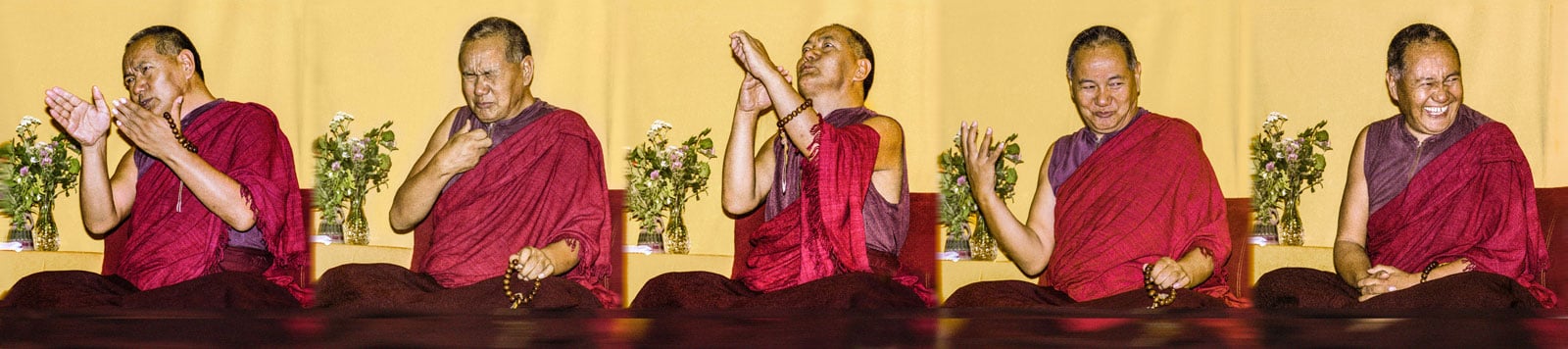
The Preliminaries
The preliminary meditations for the yoga method of Maitreya are taking refuge and bodhicitta, the four immeasurables and so forth.
So why are they here in this text? Why are they a part of this practice? The preliminaries are a kind of warning signal, like traffic lights, telling you to be careful. This shows the beauty of Tibetan Buddhism; it’s a kind of advertisement for Tibetan Buddhism. People nowadays are confused, both spiritually and in a worldly way as well. So we do need a comfortable, step-like path to enlightenment, a process by which we can grow gradually. In other words, a gradual system is very important in order to ensure that our spiritual growth is natural, organic, and that Dharma becomes us and we become Dharma.
The question may then arise, do you have to do the preliminaries when practicing this sadhana every day? They’re here in the text; do you have to do them? I’m going to say no, not necessarily. Then you ask, so why are they there? The answer is that since we have to develop gradually, they’re there to show us how to do that.
If you already have complete confidence in the supreme enlightened being and the wisdom of Dharma and you feel that the practitioners of meditation are your best friends in the world—if you have full confidence in those three—then that’s taking refuge. You don’t have to recite the refuge formula, “I take refuge in Buddha, I take refuge in Dharma, I take refuge in Sangha,” over and over. That can be simply cultural; that kind of taking refuge should be abandoned. Taking refuge is not simply words—there has to be something in your experience that leads you to feel that this is the way to act to escape from suffering and gain liberation and you feel very comfortable with that. That’s the essence of taking refuge.
The cultural way of taking refuge is going to the temple in the morning and mindlessly intoning the refuge formula. It’s good for some people and may be better than the Western way of taking refuge each morning in coffee and the bathroom. However, refuge should come intuitively; then you don’t need words.
The same goes for generation of the enlightened attitude of bodhicitta. Refuge and bodhicitta should both come intuitively, like a habit such as drinking coffee. When you’re habituated to drinking coffee you don’t need to make an effort; it’s intuitive. Similarly, when your mind is trained in refuge and bodhicitta, at a certain point you no longer need words. The same applies to the four immeasurables.
If you have eliminated from your mind strong feelings of attachment for your dear friend and hatred for your despised enemy and have equal feelings towards all, you don’t need to repeat the words. Repetition of the words is for those in whom the attitudes contained in the four immeasurables have not become intuitive. The words are needed to bring comprehension, but when you have developed comprehensive wisdom of the four immeasurables and they arise intuitively within you, you don’t need to meditate on them and you certainly don’t need the words.
Then the question might arise, if we have complete confidence in Buddha, Dharma and Sangha and are fully convinced that this is our path, have gained some success in meditation and in eliminating at least the gross mental problems, and feel love, compassion, bodhicitta and equanimity for all living beings, isn’t that enough? Isn’t love for all universal living beings and the universal thought that all sentient beings should reach the highest destination of enlightenment enough? What more do we need? Isn’t practice of the preliminaries, which brings these results, enough? Why do we then need to progress to the main body of the Maitreya yoga method?
That’s a good question, and in a way it’s true. Through practicing the preliminaries you can eliminate extreme desire and hatred and gain a clear and peaceful mind, but it’s not enough because the emotions we experience every day—hatred, jealousy, anxiety and so forth—are merely symptoms arising from our ego, and until that root of all suffering is eradicated our spiritual growth will be stunted.
My observation is that Western religions also contain the preliminaries; my scientific research into the Western world has opened my eyes. I think Western religions also value this kind of meditation. If you check the Bible with wisdom you’ll find it there. The difference in Buddhism, however, is that we also teach emptiness, and that’s what’s badly needed in the West. My feeling is that this is why the Buddha’s teachings are so useful for the Western mind. And this is why the actual meditation, the main body of the yoga method of Maitreya, begins with meditation on emptiness. Also, the tantric process of becoming one with a deity such as Maitreya is similarly non-existent in Western religion. Therefore I feel it’s so worthwhile that Buddhadharma has come to the Western world; the need is great.
Edited from the Lama Yeshe Wisdom Archive by Nicholas Ribush. To be published in Universal Love: The Yoga Method of Divine Love Maitreya, forthcoming from the Archive in 2006.