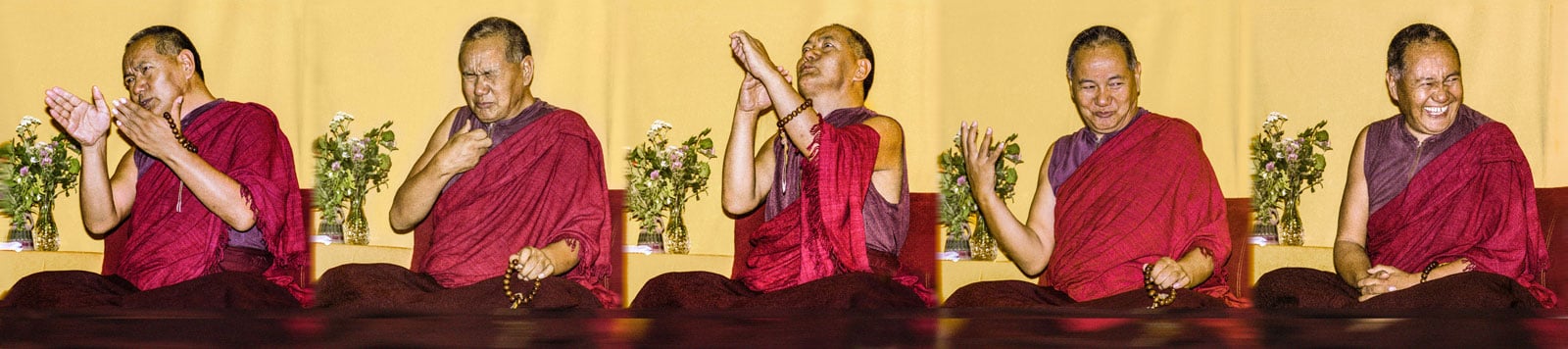
Lama Zopa Rinpoche and Lama Yeshe, Lake Arrowhead, 1975. Photo: Carol Royce-Wilder.
Dear Friends,
Welcome to our May e-letter and, as ever, thank you so much for your kind interest.
Our most recent offerings Our new books, Lama Zopa Rinpoche’s The Joy of Compassion and Geshe Jampa Tegchok’s The Kindness of Others have been very well received. If you are an LYWA member or benefactor you should receive your copies soon, if you haven't already. Also, they have been received at our international distribution outlets (FPMT Australia, Brisbane; Wisdom Books, London; and Dorje Chang Institute, Auckland) and should also be being dispatched from there. If you would like to receive copies, you can place an order through our website, or you can send us a request along with a donation to help cover the costs of postage ($5 in the US, $10 overseas) to our address below. Of course, you can always read them on line, or download a pdf file and print a copy of your own.
New in our Members' Area We have begun to post Lama Zopa Rinpoche's teachings from the 28th Kopan Meditation Course from December 1995 on our website. The first two lectures are up, as well as the entire pdf of the teachings. The rest will follow soon.
Amitayus recitations for Lama Zopa Rinpoche As we mentioned last month, all FPMT affiliates were asked to recite 100,000 Amitayus mantras to dispel obstacles to Lama Zopa Rinpoche’s health. Thank you so much to all those who accepted to recite this mantra. Please let me know at the end of May the total number of mantras you’ve been able to manage. There are still a few days to go, so if anybody else would like to join in, you'll find the mantra here along with a link to an audio recording of how to pronounce it. Again, please let me know at the end of May how many mantras you have recited.
Sanghata Sutra Many of us have had great experiences reciting this wonderful sutra. The official site can be found at www.sanghatasutra.net and also the FPMT is offering free copies of the book through their Foundation Store. I strongly encourage you to recite this sutra from time to time. Thank you so much.
Card from Lama Zopa Rinpoche.
Another special mantra One of Lama Zopa Rinpoche’s students sent us a copy of a card that Rinpoche had sent to her, on which he had written the mantra OM PHASHA BHARA HE YE SVAHA, just the sight of which he said leaves powerful imprints and purifies 100,000 eons of negative karma, so we thought we’d share it with you here.
The Peaceful Stillness of the Silent Mindreprint We’re still short of the $8,000 we need to reprint this wonderful Lama Yeshe book, so please do try to help us to the best of your ability. Thank you so much.
New Lama Yeshe book We’re also working on a brand new Lama Yeshe book, Ego, Attachment and Liberation, a five-day meditation course taught and led by Lama in 1975. We expect this to be available in three months or so but offer you a brief excerpt below.
Once again, thank you so much for your interest in and support of the Lama Yeshe Wisdom Archive. Together we can enlighten all sentient beings!
Much love,
Nick Ribush Director
Lama Yeshe teaching at Yucca Valley California, 1977. Photo: Carol Royce-Wilder. The Two Departments of Ego and Attachment
In a way, you people are intellectually very strong. That’s good, because Buddhism is also very strong. It’s like a knife in your ego—when you meditate, your ego comes out. Therefore, many people feel that Lama’s approach to the mind is not a simple thing. I agree; it can be quite difficult. I make you work hard, don’t I? But when you work, when you deal with your own problems and recognize the way your ego reacts, it’s worthwhile; really worthwhile.
I don’t have to do it this way. I could easily present Buddhism to you very diplomatically; I could explain it with very sweet words. We could run this five-day course like a nightclub with a lot of nice words, dancing and fun. That’s possible, but it’s not the point. You’ve come here for the meditation, not the floor show. In fact, you’ve come here precisely because you know all there is to know about the fun you find in nightclubs.
Also, I don’t want to joke around with you. We’re all sick of the joking trip. For countless lives and from the time you were born until now all you’ve done is play games and joke around. What, then, is the point of coming to this retreat to joke around once more, this time with Lama? It’s a waste of your time and mine. Therefore, it’s most worthwhile that you work. This is your course, not mine. If you feel, “This is my meditation course; I’m working; I’m alert, not sleeping,” that’s really worthwhile.
What makes your being here highly meaningful is if, through knowing the nature of the external nightclub, which only exhausts, conflicts and agitates you, you’re here seeking the inner nightclub of everlasting joy. That’s the perfect motivation for coming to this course. Instead of ignoring what your ego is up to in your mind, you’re here trying to familiarize yourself with your mental attitude, with what’s going on in your internal world. Here, you can learn how to examine your own psychological activity. In other words, you are studying to become your own psychologist, your own lama.
Not only are you people mentally strong, you are also skeptical. That’s good; Lord Buddha’s teaching is skeptical too. This meeting of skeptics is excellent. Do you understand what I mean by skeptical? I mean you don’t easily believe or accept anything; you check and experiment to see if something works or not. If it doesn’t, you keep checking, checking, checking, using your brain, your wisdom. In that way, you grow. This is all part of the path of inner freedom, liberation and enlightenment. Just believing emotionally, without understanding, what someone teaches you has nothing to do with any religion, even though you might pretend, “I’m a such and such.” It’s just a label and still an ego trip.
Ego, attachment and impermanence
The two departments of ego and attachment work together in your mind, and as long as they do, whatever sense pleasure you enjoy, wherever you go, whatever friends you have, nothing lasts. Your ego makes a wrong projection on an object and your attachment follows without hesitation and gets completely stuck on, or tied to, that object. This splits and severely agitates your mind.
I’m sure you can philosophize intellectually that things are impermanent, but if you check more deeply into how your ego interprets objects, what it projects onto them, you will find that it’s expecting them to last, perceiving them as permanent.
When two people get married, their egos’ interpretation is that they should be together forever, in life and even after death. This is so exaggerated. It’s impossible for people to make that decision. It’s not up to them; it’s up to karma. Uncontrollably, karmic energy makes the decision whether one partner lives and the other dies. When one finally does, the other misses him or her so badly and suffers enormously.
All that worry and weeping, missing and memory comes from the two mental departments of ego and attachment. Not understanding the impermanent nature of phenomena and expecting to live happily ever after as interpreted by ego and attachment brings the reaction of misery. That is a karmic result, or effect. If you understand impermanent nature, there’s no upset, miserable reaction. You accept death as a natural thing. In fact, you expect it to happen. With understanding, there’s no worry. You know separation is natural.
Therefore, instead of blindly following the grasping and attachment that result from the way your ego interprets things, it’s better to renounce. Perhaps you think that when I tell you to renounce I mean that you should get rid of all your possessions, but true renunciation isn’t physical, it’s mental. It doesn’t refer to what things are worth monetarily but to how your mind values them. Your mind makes things seem very important because it does not see their reality and grossly overestimates their nature.
When you know that phenomena are changeable, transitory and impermanent by nature, you expect things to disappear. Of course, everybody knows this intellectually, but when you meditate on the sensations of your body and mind you experience their automatically changing nature. That’s not intellectual philosophy but your own personal experience. Other objects, such as your family and friends, material possessions or whatever else may be your biggest object of attachment, are the same in nature. Everything is transitory, momentary; nothing lasts. We cling to these things because we think they are helpful, but try to ascertain whether they really help or harm your mind. Perhaps instead of inducing they disturb your peace of mind. You check up.
Of course, it depends on your own mind. Generally, the greater the number of objects of attachment around you, the more your mind is split, agitated and disordered. That’s natural; you check up. As long as the association of those two departments occupies the mind, who can be happy? Even the richest man on earth will be miserable if these two departments occupy his mind. Therefore, don’t grasp too much at the future, imagining, “If only I had this, that and the other, I’d be happy. Oh, how I wish I had those things in my life.” It’s not true.
You can never be sure. To your ego’s interpretation, a friend, a husband or wife or whatever can only be of help. Your ego grasps, “My life would be so much better if only I had somebody.” But think of a couple that stays together for, say, ten years, through countless ups and downs. Even after all that time, there’s still much attachment. Then the husband dies and for the next ten years the wife is miserable. She suffers greatly and can’t get him out of her mind. So what was actually worthwhile? She has spent ten years spent building, building, building attachment, her ego pretending to be happy, happy, happy, and then, when her great object of attachment disappears, she gets another ten years of misery and worry. For the first ten years she thought, “My husband helps my life,” but did he really help? Perhaps all he helped do was make her miserable for the next ten.
For the first ten years, when they were pretending to be happy, the husband and wife were happy maybe half the time and unhappy the rest. Then, when the husband died, the wife got another ten years of misery. Do you understand what I’m saying? I’m not talking about outer reality; I’m talking about the psychological aspect—the way the two departments of ego and attachment function in your mind. That’s what makes life difficult.
Renunciation
You have to realize how absolutely unrealistic and silly these two departments are. Then you can see how silly you are to follow that association. It’s a psychological thing, not a matter of saying, “I have attachment to this object; I’d better get rid of it.” That’s not what I mean by renunciation. It’s not matter but the mind. Therefore, don’t feel threatened that when I say “renounce,” you’re going to lose all your possessions. You must realize that Lord Buddha’s renunciation is psychological.
In his Mahayana teachings, Lord Buddha himself said, “If you have dedicated your body, speech and mind to the happiness of other sentient beings and have no attachment to your possessions, even if you’re a monk, you can own a thousand houses.” If you are free of attachment, you have no feeling that anything really belongs to you. But remember, this is psychological. After this meditation course, don’t go home and throw all your furniture into the street: “Lama said I have too much attachment. I’d better get rid of all my stuff.” If you don’t understand what I’m talking about, it can be dangerous. Therefore, try as much as you can to understand the psychological aspect of your mental attitude—how these two departments occupy your mind.
If you gain this understanding, even if you are surrounded by family and friends, you won’t grasp at them too much. It’s natural. If I cling too strongly to a flower, it will crush and lose its beauty. Similarly, if a husband clings too tightly and squeezes his wife, she’ll freak out and won’t be able to stand it. Because of his great attachment—perhaps he’s so jealous he won’t even let her walk down the street alone—she’ll no longer see him as attractive. A husband or wife who is natural, relaxed, free and less clinging appears more beautiful to his or her spouse.
Therefore, be natural. If you love your husband or your wife, instead of grasping and squeezing with attachment, try to better understand the up and down nature of each other’s mind and on that basis, help and support each other. That will bring a beautiful warm feeling into your relationship, which, in turn, will last longer.
Superstition
From the time we were born up until now, with totally unrealistic craving, grasping and attachment, we have dedicated the energy of our body, speech and mind to the pursuit of material possessions and sense pleasures. We have no idea of the reaction these conceptions bring into our minds. We see only the façade; our limited minds cannot see below the surface. Attachment and ego are narrow, limited minds. They don’t see the entirety, only part.
Perhaps even now, someone is sitting here thinking, “I’m stuck here listening to this silly lama while perhaps back home somebody is stealing my wife” or “Maybe my boss is planning to fire me.” Our minds create such worries. All this comes from attachment. We have so many fears; so many fantasies. Perhaps your fantasy becomes so real that when you get back home you beat your wife: “I’m sure you cheated on me.” We are so unrealistic; we fantasize and worry, “Perhaps this will happen; maybe I’ll lose that.” All this expectation and superstition is very strong, causes us much mental suffering and remains in our minds for long periods of time.
If somebody beats you up, you get really upset, but a beating lasts such a short period of time. The worrying mind completely controls you for days, weeks, months, years and lifetime after lifetime. Even now you are under its command. You think you are free, but you’re not.
Therefore, you have to determine, “Dharma wisdom is the only solution to my problems; the only vehicle that can carry me to everlasting happiness. Only Dharma can truly save me from danger. Any minute, I could lose my mind and go mad. It’s possible. The cause for this to happen has already been created. Dharma wisdom, understanding the nature of the mind, is my only protection. It can be with me all the time.” You cannot rely on material things.
For example, when husband and wife are apart, they worry about each other and feel agitated and insecure. Dharma wisdom, however, is always with you and makes you happy. Material things, the things you think your life depends on, are unreliable. Sometimes they’re there, sometimes they’re not. Also, psychologically, material possessions can become your worst enemy. When you’re dying and you have to leave them, you feel miserable. The more you have, the worse you feel. Check up right now. You can see that your mind is drawn towards whatever your attachment has labeled as good. Check up in meditation. Therefore, at the time of death, when you know that you are losing forever everything that you possess, all these things simply serve to make you more agitated. That worried mind itself almost kills you. Your elements are already completely out of balance; the mental shock of losing all your possessions delivers the final blow.
FromEgo, Attachment and Liberation, a five-day course taught by Lama Yeshe in Dromana, Victoria, Australia, 1975. Edited by Nicholas Ribush.