
E-letter No. 46: February 2007

Dear LYWA Supporters and Friends,
Thank you, as ever, for receiving and reading our monthly e-letter. We appreciate your interest and attention. Please share it with as many others as you can.
I'd really like to thank all those who responded to our request in the last e-letter for people to recite the Akashagarbha mantra and write out the Sanghata Sutra to remove hindrances to the sale of our friend's property, much of the proceeds of which will be used to further the Dharma, including the work of the LYWA. So far it has not sold but there is serious interest, so thank you again and please keep it up!
What People Are Saying...

We often get positive feedback about our free books and we’re extremely grateful for it. However, our new book, Lama Yeshe’s Ego, Attachment and Liberation, has prompted even more than usual.
Our old friend Stephen Batchelor said:
Thanks for sending the latest offering by Lama Yeshe. It really captures well the spirit and style of his teaching and you’ve done a great job of preserving his voice while at the same time expressing it in good English prose — no mean feat. I found myself very touched by the sincerity, kindness and intelligence that animate your text. It’s a wonderful gift to make these teachings available for free.
A couple of other long-time Dharma students offered:
This book has made me more excited than I have been about anything in years. Thank you for putting the meditation course into book form. As I was reading the book and doing the meditations, I started thinking that I would love to teach this book at a center. What do you think? I'm always trying to think of ways to make my ego less or more in control and this book certainly gives useful methods. It is also done in such a gentle way. I started making notes as I did the meditations so I would have them for when I start teaching this.
Ego, Attachment and Liberation is one of the finest spiritual works I have read. It is informative for both new and old students. From my side, it provided some insights into the practical study of everyday life for my emptiness practice. I have a small study group…perhaps you could send me a few more copies?
A prisoner wrote:
I have just finished reading Lama Yeshe’s book Ego, Attachment and Liberation and I found it to be a most amazing book. In it I found the answers to many questions, about both Buddhism and life as well. The meditation techniques contained within were excellent too.
Thank you all so much! If you, dear reader, have not received this book or would like more copies, please let us know.
New On Our Website
And speaking of Lama's newest title, this month's podcast is the first chapter from Ego, Attachment and Liberation. As always, you can listen to this recording—and all of the recordings we've released—on our Online Recordings page.
We have added to our Members' Area the series of lectures given by Lama Zopa Rinpoche at the 14th Kopan Meditation Course in 1981. It includes an extensive commentary of the "Patience" chapter of Shantideva's Bodhisattvacaryavatara (A Guide to the Bodhisattva Way of Life), as well as a wonderful question-and-answer session with Lama Yeshe. Also, we have now made available for public access Rinpoche's lectures from the 11th Kopan Meditation Course in 1978; you can access this through Rinpoche's Teachings page.
This month's updates to Rinpoche's Online Advice Book include additions to the Daily Practices advice page and the Purification Practices advice page, which has advice on the Vajrasattva practice, nyung nä, and tonglen. There are now over 400 advices posted!
Member Discount for DVDs

Now that we are putting out DVDs of some of Lama Yeshe’s teachings we have been asked if LYWA members get these free as part of their membership deal. Unfortunately, we cannot afford to do that and always made clear that it was just new books that would be sent out free.
However, we really do appreciate the kindness of our members and have decided we can afford to offer our new DVDs to members at half price; see the special item we've set up in the DVD section of our online store for our newest Lama Yeshe DVD, Offering Tsog to Heruka Vajrasattva. Another great reason to become a member…we have lots more Lama Yeshe DVDs planned!
For more information on the Archive's Membership program, please go here.
Lamas in Cyberspace
And even though our beautiful Lama Yeshe has not been with us for more than two decades, he still has his own MySpace page! Check it out.
Not to be outdone, Lama Zopa Rinpoche is on YouTube! Our friends in Australia have put up a series of images of Rinpoche in Brisbane at the new Karuna Hospice Service stupa last year. Check that out as well.
Refinished Photos of Lama Yeshe

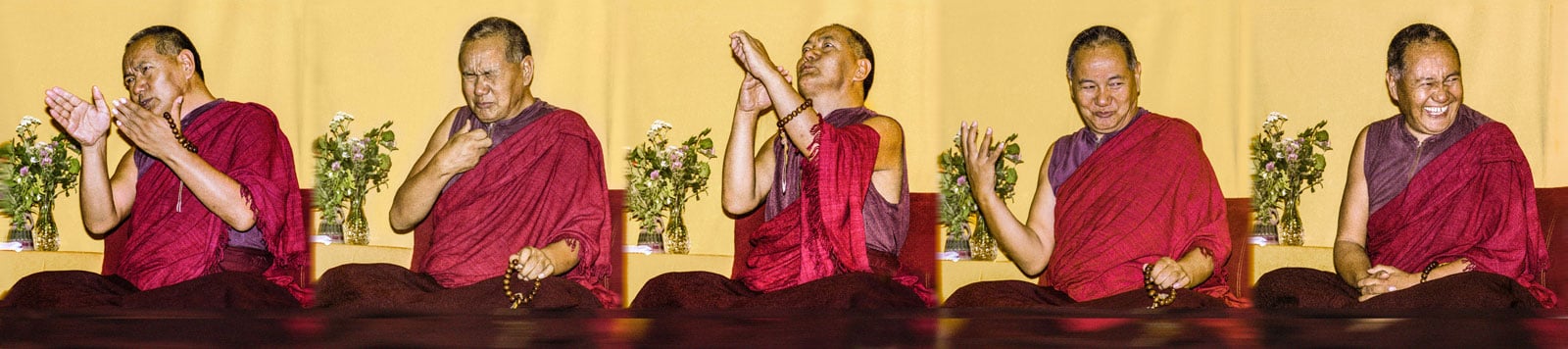
In the past few months we've been working with photo restoration specialist to enhance the quality of a number of Lama Yeshe photos, like the one you see here. The results have truly been outstanding.
In the next couple of weeks, we are going to make these photos available for purchase; the quality is suitable for framing for your Center's gompa, or for your altar at home. We'll be sending out a special e-letter mailing with more details soon.
On Being A Vegetarian
I was really blown away to see HH the Seventeenth Karmapa make a strong statement against the eating of meat. Although compassion is the heart of Tibetan Buddhism it has always puzzled me why so many Tibetan monks eat meat. As I’ve confessed before, it took me over thirty years of being a Buddhist to realize how abhorrent the exploitation of animals that surrounds us really is, but better late than never, and now I cannot understand why it took me so long. The website of the new FPMT center, Liberation for Our Brother and Sister Animals, contains much video and other evidence of the horrors of the animal realm and the humans who abuse them. See for yourself.
With that, I thank you once again for your kindness and leave you with another great teaching by Lama Yeshe that you would not have seen before.
Much love
Nick Ribush
Director
Introduction to Tantra

I’d like here to give just a brief introduction to tantra.
The first thing to understand is that Buddhism has broad and far-reaching array of teachings for human development. However, before we can begin actualizing the tantric path we need to understand the sutra path of human development, the three principal aspects of the path—renunciation, bodhicitta and universal reality, shunyata—which is the main prerequisite for entering tantra.
With respect to renunciation, we first need to understand the dissatisfactions and complications of our own daily life that result from ego conflict and that worldly wealth and pleasure are not the answer to the human search for satisfaction. Therefore renunciation means avoiding the extreme of grasping at worldly pleasure and beginning to recognize that the source of everlasting satisfaction can be discovered within oneself.
In order to develop bodhicitta, we also need to realize that the problem of human ego conflict is not just our own but a universal problem and therefore feel sympathy for all living beings. His Holiness the Dalai Lama often talks about universal responsibility because if we’re too obsessed with our own problems, for our mind they become bigger than the entire universe. So the way to rid ourselves of the self-cherishing thought, which is the biggest obstacle to our developing bodhicitta, is to change our attitude to one of dedication towards all living beings in the universe. Sutrayana explains that self-cherishing is symptomatic of all human problems: when we seek pleasure motivated by self-cherishing, we mislead ourselves; what we get is increased misery. All problems, from those between a married couple to international conflicts, are all because of the self-cherishing thought.
To totally get rid of self-cherishing we have to sever its root—dualistic concepts—which brings us to the third principal aspect of the path, the wisdom realizing emptiness, or shunyata.
Dualistic concepts have to be understood by analyzing the ego conflicts in our own everyday life. Dual phenomena exist relatively but non-duality implies psychological contradiction or comparison.
Say our neighbor buys a car. We look at it and think, “I should get a car, too.” Then he gets a boat and we think, “I should have a boat as well.” Then he gets a second car and we think, “Why shouldn’t I get another car?” This is what I mean by contradiction; our restless mind is never satisfied with what we have.
That’s why when we seek good ideas in our materialistic environment we have to pay for them. This is because of the build up of duality, samsara and restlessness. Therefore the result is conflict: between parent and child, husband and wife, even food and stomach. Buddhism can explode such dualistic superstition and the function of meditation is to extinguish the restless dualistic mind.
So, if we have gained realizations such as those of the three principal aspects of the Sutrayana path, why do we need to actualize tantra? Philosophically, Tantrayana is the vehicle by which humans can attain liberation most quickly but how quickly depends upon the individual practitioner. It takes much skill to utilize the powerful, sensitive tantric methods and techniques effectively.
One big difference between sutra and tantra is that Sutrayana emphasizes the faults of worldly pleasure whereas Tantrayana says that worldly pleasure can be the source of liberation. The Tibetan term for this concept is dö-yön-lam-khyer, which means, essentially, taking desire as the path to enlightenment. This indicates that the practice of tantra is very suitable to the materialistic life of the modern world, which is totally dedicated to the pursuit of pleasure, because all these modern objects of pleasure can be used to develop the path to liberation. This is an extremely practical approach to spiritual practice because we encounter these objects every day. So rather than telling to renounce pizza and mozzarella, tantra teaches us how to eat them in a positive way.
Italians have been eating pizza and mozzarella for centuries without knowing how; Tibetan monks have never eaten pizza or mozzarella but know how to do so!
Since every day we’re immersed in a materialistic environment and under the control of sense gravitation attachment, we can’t escape this situation; we’re born into it. Therefore it’s absolutely essential that we develop the skills to deal with this situation instead of being overwhelmed by it and find a realistic way of transforming our situation into the path to liberation or, at least, into a subdued and tranquil life. If we can learn to do that then it’s fine for us to enjoy our material life as much as possible.
It’s like certain poisonous plants will kill you if you eat them directly but with skill you can manipulate their negative energy and convert it to medicine. These days many people blame society and the environment for life’s ills but they’re wrong; it shows they don’t understand inner nature. From the Buddhist point of view, those who always blame external factors for their problems will never ever be able to solve them until they demolish such concepts.
According to tantric philosophy, as long as you harbor the misconceptions that make you interpret both yourself and the environment negatively and incorrectly there’s no way you’ll find true happiness. And tantra also contains the methods whereby you can purify yourself of negative projections of yourself and the environment.
Practically speaking, human beings are responsible for their own body, speech and mind, to not give and to purify negative projections and to recognize the pure nature of their body, speech and mind. Therefore the practice of tantra involves transformation of body, speech and mind.

The way to transform your own self-pity imagination of your body is to transform that energy into a deity, such as Avalokiteshvara. You can check right now through your own experience how your own ego projects, interprets or imagines your own body, how your self-pity imagination identifies yourself. So that’s why you have to change your unrealistic self-image into a higher, realistic one.
What I mean by unrealistic is my imagining I’m a manifestation of Mao Tse Tung or Hitler, or even a handsome Italian man. That’s unrealistic imagination.
So we have to identify ourselves physically in a healthy reasonable way. Also we have to recognize that as human beings we have a conscious, or psychic, body as well as a physical one.
Also, normally we all interpret ourselves as hopeless and bad and feel deservedly guilty. We can tally our bad motivations and evil actions like counting mantras: “I did this, I did that, I did the other, I did this, I did that, I did the other…” infinitely. “Therefore I’m bad, therefore I’m hopeless, therefore I’m guilty….”
So the emphasis of tantra is that the essential you is clean clear. You have buddha nature and it’s that with which you should identify yourself in a transcendental way; you should identify yourself as a fully developed being with completely developed knowledge and completely developed compassion. I truly believe that all human beings have love and wisdom; it’s simply a matter of recognizing and developing them.
Therefore you have to understand that emanating yourself as a buddha or a deity purifies your self-pity imagination. That’s why instead of counting off our negative qualities we count mantras instead. The energy of mantra involves nothing mundane—food, clothing or anything else. It’s a sound that automatically brings your mind into a transcendental experience or single-pointedness. That’s the function of mantra. It’s like fire; it incinerates your negative, impure mundane concepts.
You’re going to receive the initiation of Avalokiteshvara. There are many levels of initiation. Realistically speaking, what you receive depends upon your level of mind and how well you communicate with the guru giving the initiation.
As the word implies, initiation means an initial experience through the meeting of two minds and the energy activated by the initiation has to be maintained through continual practice.
Especially at this time you are going to receive the initiation of Avalokiteshvara from Avalokiteshvara himself. His Holiness the Dalai Lama is an emanation of Avalokiteshvara, who is a manifestation of all the buddhas’ universal compassion, so you’re very fortunate to receive this initiation from the real Avalokiteshvara himself.
Now, you should not interpret Avalokiteshvara as something that exists only as an external object. In fact, when you develop your own compassion to the level of universal compassion, you become Avalokiteshvara. My experience has been that Westerners communicate with this deity very well; much better than they do with other deities; sometimes they have problems communicating with deities that aren’t related to some kind of archetypal image. Avalokiteshvara has something to do with you. Buddha itself means something to do with you. So it’s important to connect our present limited compassion to the achievement of universal compassion.
So our receiving this initiation and becoming Avalokiteshvara is a kind of insurance to bring true peace to the world. Also, don’t ask, “Am I going to receive a perfect initiation or not?” As I said, it depends upon your level of mind and how well you communicate with His Holiness the Dalai Lama’s realizations.
Philosophically speaking, Buddhism has a clean clear structure that determines whether or not you have actually received an initiation that you have attended, but personally, I truly believe that, irrespective of what the structure says you get, you definitely receive something to subdue your mind and develop your limited compassion. From the practical point of view, that’s enough for us.
I mean just to be in His Holiness’s presence gives you tremendous imprints. We all seek compassion; we’re dying for compassion, for someone to love us, for someone to have compassion for us. We’re dying for peace and happiness in the world.
And it’s so rare for there to be such a holy example of compassion in the world. That’s exactly what we need; we’re not liberated beings—we need to see a powerful visual example of fully developed compassion because we’re so oriented by our sense consciousnesses and don’t have the power to understand psychically or telepathically another being’s realizations and knowledge.
With His Holiness we see somebody who was the leader of a country that was occupied by another and rather than abandon his principles of non-violence he just left and has maintained a position of peace ever since. We can see this visually. Meanwhile, we observe how violent and impure the rest of the world has become in this twentieth century. Therefore we need the support of the kind of physical example His Holiness offers us.
I think that’s enough talk from me. We have time for a few questions, if you have any.
Q. I’d like to actualize the Buddhist path deeply within my heart and would like to know if there’s a fundamental difference between the monastic way of life and practicing as a layman?
Lama. The life of a monk or nun is very different from that of a layperson. However, some lay people’s renunciation is much better than that of some monastics’. Renunciation is a state of mind rather than not doing this or that. The thing is that some people are more suited to the monastic way of life, others to lay life, so Buddhism offers both paths in order to meet the needs of the greatest number of people. We have methods for the liberation of laypeople and methods for the liberation of monks and nuns; there’s no shortage of methods in Buddhism.
Q. I came to the Institute to live and study here. Can I not take the initiation and still do that?
Lama. Yes, of course. The nature of Buddhism is that you check out which teachings are for you and which are not and practice accordingly. Lord Buddha himself said you don’t have to accept everything he said. He taught according to different practitioners’ various interests and aptitudes and it’s up to the individual to choose which teachings to practice and which, at least for the time being, to leave aside.
Q. I’ve been interested in Buddhism for a long time but I find it difficult to penetrate the teachings deeply because I don’t have anybody to ask. Occasionally I can ask a geshe some questions through a translator but as time goes by I find new questions and problems that are rather extensive and I don’t know who to speak to about them.
Lama. It’s good that as you think about the teachings more questions arise. Buddhism is a path of research into the universal reality of your own mind, and when you examine this reality and where it comes from, countless questions come into your mind and this process begins to shake your previously-held concepts. However, from the practical point of view, you have to answer your own questions through meditation. I truly believe that you can’t get satisfactory answers from anybody else. Perhaps I’m ignorant—of course I’m ignorant!—but in my experience I’ve had to fertilize my own mind, be constructive and take personal responsibility, and that’s the way I’ve found answers to my own questions.
So my experience also applies to you—unless you’re merely seeking intellectual, verbal answers. But who wants those? If you have a philosophical question, we can give you philosophical Tibetan answers, but they probably won’t fit your way of thinking. There are cultural differences in Western and Tibetan philosophical thought. Anyway, if your questions are strictly philosophical and you’re seeking simply intellectual answers, then you can probably find some philosopher to reply, but if you’re looking for something deeper you shouldn’t expect an external teacher to be able to give you all the answers. That’s not the Buddhist attitude.
Q. Thank you, but I am seeking deeper answers than the merely intellectual.
Lama. Then it’s best that you find the answer within yourself through meditation rather than expecting some Italian monk or other teacher to tell you. Through a combination of analytical meditation and single-pointed concentration you’ll get answers; the best answers.
Lama Yeshe gave this teaching at Istituto Lama Tzong Khapa, Pomaia, Italy, on 18 October, 1982, prior to a Gyälwa Gyatso initiation conferred by His Holiness the Dalai Lama the next day. Edited from the Lama Yeshe Wisdom Archive by Nicholas Ribush.