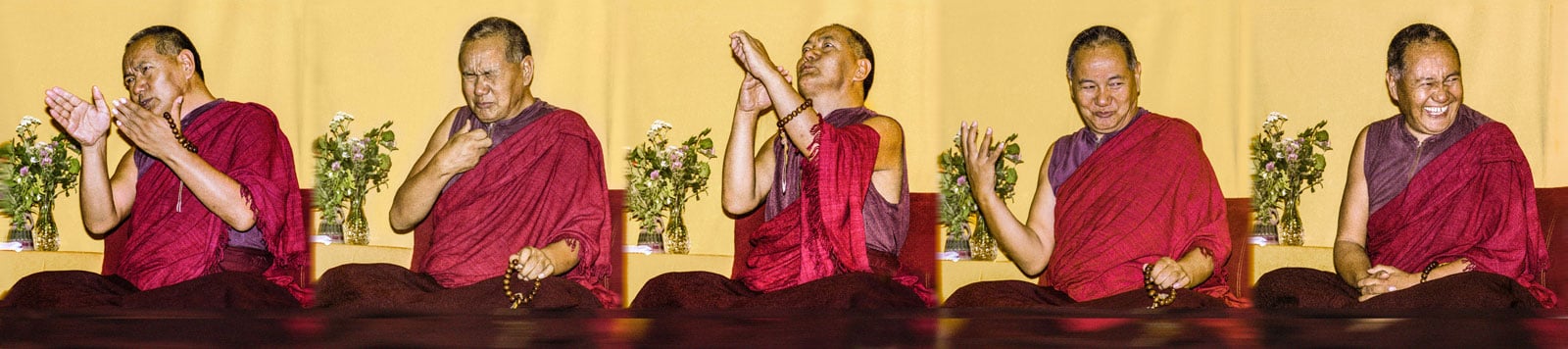
Lama Zopa Rinpoche and Lama Yeshe, Lake Arrowhead, 1975. Photo: Carol Royce-Wilder.
Dear Friends,
Thank you so much for reading our monthly e-letter. Please pass it on to interested friends or to your Dharma center mailing list. Also, please feel free to reprint any of the teachings we put out here in your newsletters or on your websites (but please acknowledge the source).
Nicholas Ribush with baby Maitreyi, November 2007.
We are pleased to announce that our colleague Sonal and her husband Deva welcomed their daughter Maitreyi on November 10th! Here you see her with proud uncle Nick.
Books in the Works We’re busy with a number of projects here. Lama Yeshe’s Universal Love: The Yoga Method of Buddha Maitreya is well into the design process and Lama Zopa Rinpoche’s How Things Exist: Teachings on Emptiness, has just gone off to our book designer. The latter will be, as usual, a free book but the former will be for sale. As I mentioned in the September e-letter, we were commissioned to do this book by the Maitreya Project, but will be sending it free to LYWA members and offering it at a discount on our website.
We are also preparing to reprint Lama Zopa Rinpoche’s Making Life Meaningful. All three books will be available in February 2008.
New Audio on our Website This month we have posted the 7th chapter from Lama Yeshe's book Ego, Attachment and Liberation which is titled "Developing Equilibrium." You can read along with the unedited transcript.
We have also posted Lama Zopa Rinpoche's recent teachings from New York City, a commentary and partial oral transmission of the Golden Light Sutra. As we mentioned before, the FPMT website has a dedicated Golden Light Sutra page with translations and links to all kinds of information related to the sutra.
Supporting the Dharma It is only through the kindness of our supporters that we can do this work, so once again we express our gratitude to all those who have made financial contributions to the Archive and, as the end of the year draws near, ask you to remember us in your charitable giving. You can easily make donations via our website. Thank you so much.
Our friends at Shambhala Sun Foundation (publishers of Shambhala Sun and Buddhadharma magazines) are hosting their first-ever online auction - November 21 through December 12. They have assembled a wonderful selection of unique auction items—including original art, photographs, gift certificates from contemplative publishers, meditation supplies, and retreat opportunities. All proceeds from this online auction will help to print Shambhala Sun and Buddhadharma on environmentally responsible paper, and to establish youth internships training the next generation of editors and designers to publish the dharma. Your auction bids will support the Shambhala Sun Foundation's mission.
By the time you receive this, the Thanksgiving holiday will have come and gone. I hope you had a peaceful time, but please spare a thought and a prayer for the twenty-five million turkeys that were slaughtered for the occasion.
Thank you again for your kind interest and support. And we leave you with an excerpt from Universal Love.
Much love,
Nick Ribush Director
Lama Yeshe at Vajrapani Institute, California, 1983. Photo: Carol Royce-Wilder.
Meditation
Why does Buddhism put so much emphasis on meditation? It’s because our mind is so gross and our memory so poor that we forget things easily and cannot recall our countless lives’ experiences. The purpose of meditation, therefore, is to increase, or develop, our memory, or mindfulness, of reality.
Our distracted, fragmented thoughts, which we experience continuously every day, are countless. Nonsense repeatedly cycles through our mind, again, again, again, again…. It’s like in the pictures of the wheel of life, whose hub shows a pig, a chicken and a snake going round and round endlessly. Like that, our pig, chicken and snake mentalities continuously reverberate in our consciousness, reducing our memory to almost nothing.
The meditation techniques that stop these three mentalities are very important. Without stopping these deluded minds we can’t see the concepts of ego that we spontaneously experience in everyday life. They’re very subtle, so without eliminating these gross minds it’s impossible to see our ego’s activity. That’s why we meditate on the energy of our own conscious experience. By quieting and eliminating our gross mentalities we create the space we need to see the concepts of ego, to recognize the entity interpreted by ego, which is non-existent.
Normally, religious people miss the point—we circle around it but don’t make much progress because we keep missing it. What is the point? The point is to become revolutionaries and totally destroy our entire concepts of ego. This is a much more revolutionary ideal than any of the theories propounded by Marx-Lenin, Hitler or Mao.
The concepts of ego project an independent, self-existent I totally unrelated to physical matter, time, space, cause, effect or anything else, existing somewhere, untouchable. Our ego holds on to the self-existent I and never lets it go.
Based on the results of his own practice, Lama Tsongkhapa said that by contemplating our conscious experience we can cut our superstitious, dualistic thoughts and thereby discover our ego projections and realize shunyata in a flash. Like throwing a switch, the moment we discover exactly what the false conception is, at that instant we discover non-duality.
The most difficult thing to recognize is the entity held by our ego, and the only way to do this is to meditate. According to Lama Tsongkhapa there’s no way to do it intellectually. To prove this, he quoted Nagarjuna: “The person is not of the nature of earth, water, fire, air, space or even consciousness. The person exists only as a conventional designation.” Lama Tsongkhapa totally agreed with Nagarjuna: all phenomena exist only in name. So we should just leave things as they are—superficial names projected by superstition—and not try to find some real, self-existent entity beyond that.
Some people think that first we have to study shunyata in order to understand it and then meditate. That’s wrong. To realize shunyata, first we have to meditate.
The thing is that the gross symptoms of ego, the three poisonous mentalities I just mentioned, disturb, irritate and shake the mind, so without subduing them to a certain extent—and there are various levels to which they can be subdued—there’s no way to see the unconscious levels of ego that hold the notion of an independent self-existent I. It’s impossible. And that’s the point. Therefore our approach has to be through meditation—the experience of contemplating the energy of mental clarity automatically eliminates those mentalities.
Otherwise, it’s like Lama Tsongkhapa said—our enemy’s hiding out in the jungle but we’re looking for him in town. That’s us—we practitioners are always busy doing something religious but never get anywhere because we miss the point and look for our ego in completely the wrong place.
Therefore it’s very important to stop our “that-this” superstitious thoughts and we’re capable of doing so. By simply remaining mindfully aware of the experience of our own energy without getting involved either subjectively or objectively in that-this thinking, focusing our mind and letting go, we’ll no longer have a problem with distraction.
It’s similar to our present situation. We’re here in this peaceful Dharma center knowing that there are disasters and bloodshed happening all over the world but not getting emotionally disturbed. It’s like that.
When I say “let go” I mean to focus on the clarity of mind and just remain there without expectation or emotional conversation. As I mentioned before, when the full moon shines it doesn’t have any expectation or thoughts such as “I’m illuminating the Earth.” It doesn’t think anything; it just illuminates. The fewer dualistic thoughts you have, the greater the peace, tranquility, satisfaction and bliss you experience—and satisfaction and bliss are antidotes to dissatisfaction, depression, aggression, distraction and all other emotional disturbances.
When we meditate on an object with continuous, focused attention, our sense perception no longer functions. In other words, we go beyond sense perception. Sense perception has a bad reputation in Buddhism because it’s the door to delusion and superstition. Whatever our senses perceive is always an optical illusion; the nature of sense perception is such that it produces more ego and superstition.
Therefore meditators deem the sense world unimportant. Since whatever appears to their sense perception is illusory, they no longer trust or use it much, but Maitreya also emphasizes in his writings that the mind the meditator uses is the sixth, or mental, consciousness, which is not sense perception or sense consciousness.
When a fighter pilot first sees an enemy plane it might be a long way off but as that self-existent plane gets closer and closer he sees it more and more clearly and at a certain point can shoot it down. The moment it disappears he experiences a kind of emptiness, shunyata. Similarly, when our clear wisdom first tries to find our ego, it’s not very obvious; it’s hiding. But as our concentration deepens our ego finds it increasingly difficult to remain out of sight and eventually it appears right there in front of us. As soon as we recognize it we should destroy it, and the moment it disappears we experience shunyata. The nuclear missile we use to shoot down our self-existent I is mindfulness, the wisdom of intensive awareness, and we don’t need dualistic thought to pull the trigger; the moment our ego appears, we shoot it down.
When we reach the point of experiencing the non-dual I in this way, we should just let go and focus on our mind with clear comprehension. Also, the “non” in non-dual shouldn’t make us feel lonely: “I feel so empty, I have no dear friend.” To experience non-duality is to experience the universe. We should feel, “I am the reality of all universal phenomena,” or “The reality of all universal phenomena is me.”
But again, these are not conceptual thoughts. What I’m talking about is pure experience, what we call the enlightened, or dharmakaya, experience and, in a way, we can say it’s the experience of the omnipresent love and wisdom of Maitreya.
However, the dharmakaya experience is invisible, and in order to communicate with sentient beings we have to emanate in a visible form.
Lama Yeshe gave this teaching at Maitreya Institute, Holland, September 1981. Excerpted from Universal Love: The Yoga Method of Buddha Maitreya, edited by Nicholas Ribush, forthcoming from the Lama Yeshe Wisdom Archive, February 2008.