
E-letter No. 32: November 2005

Dear Everybody,
Hi…we hope you are well. Thank you for reading the Lama Yeshe Wisdom Archive monthly e-letter. Please pass it on and encourage others to sign up for it. This is perhaps our best way of sharing our news and teachings with the world.
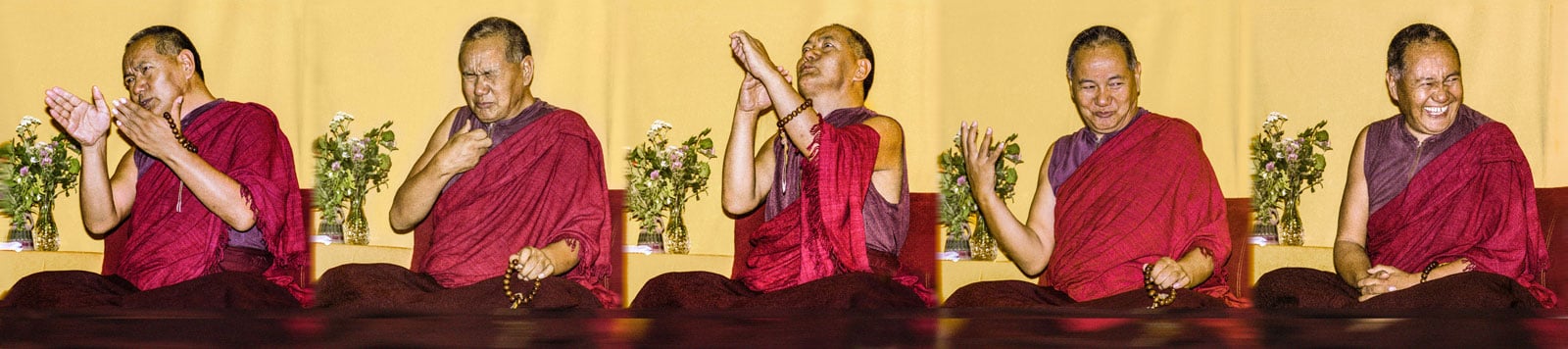
We have been working hard to establish our Photo Archive, scanning hundreds of slides and pictures over the past few months. We've posted a wonderful selection of these recent additions to the Archive, like the one shown here of Lama Yeshe in Reno, Nevada in 1977; take a look at the rest. We can see from our website statistics that the Photo Gallery is one of the most popular areas that people visit on our site, so we know that many of you will enjoy these additions—there's more to come! And, speaking of statistics, October 2005 saw the greatest number of visitors to our site: more than 13,000 people visited the Archive website last month.

Inspired by this, we continue to add new material on our website. This month, we've added a series of teachings from Ribur Rinpoche titled How to Generate Bodhicitta. We've also added many new advices to Lama Zopa Rinpoche's online Advice Book, including the addition of three new sections! One of these new sections includes many advices for Sangha, Dharma center directors and others who work for Dharma centers. Browse through the menus, or use our advanced search page to search the Advice Book section for the phrase "Nov. 2005". We now have over 225 of Rinpoche's advices posted to the online book!
Last month we told you about our new podcasts. We hope that some of you are listening. We started with four of Lama Yeshe's talks, the ones featured in the book Essence of Tibetan Buddhism. To find out more about our podcasts, see our podcasts page. This month's podcast is from the Mahamudra Retreat with Lama Zopa Rinpoche in April 2004.
All of the teachings found in our new free book Teachings from Tibet are now available to read individually on the web, including two that had never before been posted on our website: Zong Rinpoche's How to Start Practicing Dharma and Geshe Dhargyey's In Search of the Self. Browse the table of contents page to access all the other teachings, too, and find links on these pages to more teachings by these same great lamas.
We’ve been busily sending out Teachings from Tibet to our benefactors all over the world. Thank you all for your very positive feedback on this title. However, we’re not resting on our laurels. We have three more books in the pipeline: Lama Zopa Rinpoche’s The Joy of Compassion, a selection of four teachings on compassion from his longer (700-page) work, Teachings from the Vajrasattva Retreat; a wonderful teaching by Khensur Rinpoche Geshe Jampa Tegchok on the Seven-Point Mind Training; and a reprint of Lama Yeshe’s Essence of Tibetan Buddhism.
As ever, we’re able to bring you all these books free of charge largely through the kindness of the people who sponsored their preparation and printing. So, please rejoice in these benefactors’ merit and dedicate it to the enlightenment of all sentient beings. However, we depend equally on the contributions of all our supporters, not just those who sponsor specific books, and welcome all donations, great and small. And remember, anybody who offers $20 or more will receive completely free of charge any new books we publish in the twelve months following their donation. Thank you all so much.
That said, we do have a number of books by Lama Yeshe and Lama Zopa Rinpoche that we would like to publish in 2006 and are actively seeking sponsors for these, so if you would like to fully ($5,000–10,000) or partially (minimum $1,000) sponsor a book, please get in touch for more information.
And, of course, every month we bring you a new, previously-unpublished teaching by Lama Yeshe or Lama Zopa Rinpoche. This time we continue where we left off last time, with Lama Yeshe teaching on po-wa, the transference of consciousness.
Thank you again, and much love,
Much love
Nick Ribush
Director
Transference of Consciousness at the Time of Death (continued)

[In our previous e-letter, Lama Yeshe concluded with “Anyway, when you detect the signs and reach the point where you know that death is certain, at that time you employ the techniques for transferring your consciousness.” We pick up from there...]
But why do that? Death is coming and your consciousness will transfer naturally, so why employ these techniques?
It’s because when we die it’s usually from some kind of serious disease and at the time of death are unable to cope, so the practice of transference of consciousness allows us to handle our death constructively, before illness renders us incapable. That’s the time we should use it. However, if we don’t have a proper understanding of the signs of impending death and know clearly when to use the techniques of transference of consciousness we’ll be in danger of using them too early and simply killing ourselves.
So how do we practice transference of consciousness? Basically it’s a matter of putting our concentration and energy in the right channel to stop it going the wrong way. The teachings on this subject contain all the detailed technical information.
What’s the wrong way? There are many doors through which our consciousness can exit the body—eyes, ears, nose, mouth, navel, lower orifices and so forth—and the teachings explain which realm we’re born into according to which door our consciousness takes.
To be born in a pure land, our consciousness has to leave through the crown of our head; therefore we have to learn how to open this door and bring our consciousness to it. This is the point of practicing transference of consciousness. Since we can consciously, deliberately, mindfully separate our mind from our body, we should take this opportunity to make sure that we’re reborn in the best possible way, make sure that from now on we go from happiness to happiness, from happy life to happy life.
One important thing is this. You might be a good person and live your entire life with loving kindness, but if something goes wrong when you die, if you can’t cope and get angry, you basically destroy the whole thing because you’re reborn under the influence of that final negative mind.
Therefore we call transference of consciousness a super-method. Even somebody like Hitler, who was incredibly evil, killed numberless human beings and created terrible karma, can use this method, die with a clean-clear mind and say goodbye to all his or her negativities.
Death is a kind of final destination, our last chance to make our mind clean-clear; if we can be conscious at the time of death this is insurance to make our next life perfect.
Of course, before they can practice transference of consciousness, Himalayan yogis prepare. They rehearse the techniques and also make sure that they’re completely free of attachment to even an atom of matter. That’s the most important issue at the time of death—to not grasp at a single thing. The grasping mind is the greatest interference to a peaceful death, the greatest cause of fear. Grasping at anything at the time of death is the source of confusion and ensures a bad rebirth.
Some people don’t like to hear about rebirth but whether you call what happens after death rebirth or something else, most people feel that something happens after death, and that’s good enough. If you feel from your heart or at least intellectually that there’s something after death, that’s good enough to be open to these teachings.
The Tibetan tradition is to give all your possessions away before you die so that you can die without thinking that anything belongs to you. That’s fantastic. When I was a young, inexperienced monk, seeing old monks dying perfectly in this way was a great help to me; it gave me a lot of confidence. Of course, we can understand these things intellectually, but to see actual people give their things away and die without attachment makes you feel, “I can do this, too.” That’s very important.
Then, we also have explanations of how to transfer our consciousness to a pure land. However, I hope you understand what a pure land is.
From the Buddhist point of view, there’s not some pure place out there waiting for you. Pure means it’s a reflection of your own pure thought, your own pure, clean-clear mind. That’s what we call a pure land. Any manifest environment, good or bad, comes from the mind; nothing exists externally “out there.”
Normally we like to project nice, pleasant appearances but somehow, without control, negative appearances arise. So it’s important that we know how to project only happy, positive appearances. But when I say to project good, positive things I don’t mean in our usual exaggerated way. We can project positively in a realistic way.
If we want to see other people in a certain way—good or bad—that’s the way they appear. It somehow depends on the mental decision we make. Our view of another person as good or bad actually comes from our own mind, not the external object, the other person.
Therefore we have a choice as to what we see, and whether it’s positive or negative, we can make our view more so. We have that ability. And since we can choose, we should choose the positive.
Normally energy escapes from our various bodily orifices, but there are various meditation techniques we can employ to conserve it. Since our life depends on the movement of our breath, we can increase our life span by bringing the energy of our breath inside and keeping it there.
How many breaths are there in a life? Buddhism has an estimate of that number. I’m sure the West does too. Anyway, you can examine the pattern of your breath to see if it’s stronger from the right nostril or the left. If you are aware, signs such as these can indicate what’s happening with your life, and there are techniques you can employ to change the rhythm of your breath and thereby affect your life.
Also, transference of consciousness does not depend only upon our powers of concentration. When we train in its techniques we also use the energy of the movement of our breath and our heart and navel chakras, or psychic energy centers. By focusing on these points we have different experiences and can gain different realizations.
To be continued in the next e-letter.
Lama Yeshe gave this teaching at St. John’s Church, London, 18 September 1982. It was excerpted and edited from the Lama Yeshe Wisdom Archive by Nicholas Ribush. Listen to this teaching at recordings.LamaYeshe.com. We are in the process of producing a DVD of this teaching.