
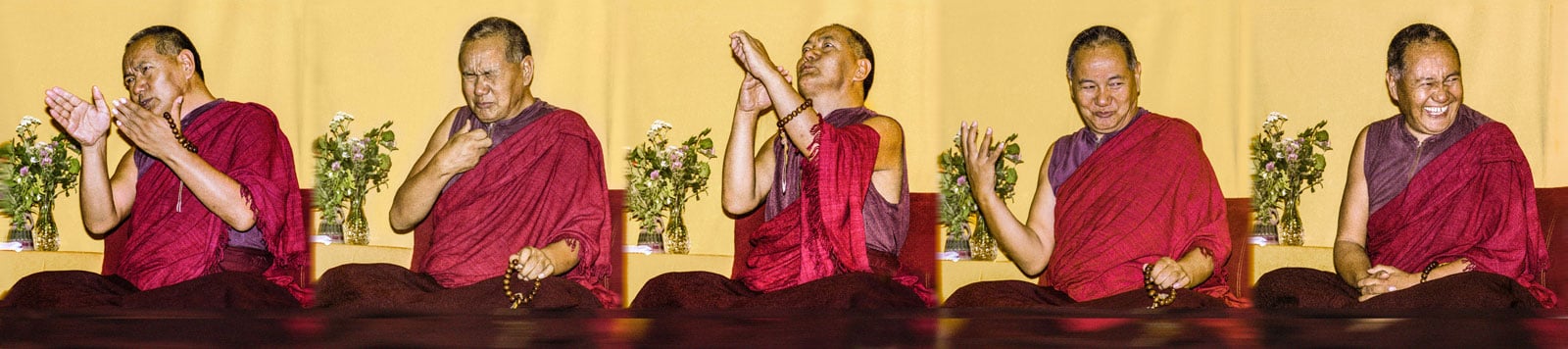
How to Start Practicing Dharma
His Holiness Zong Rinpoche (1905-84) was born in Kham, Tibet, studied at Ganden Monastery, gained renown as a learned geshe and great debater and served as abbot for nine years. He fled to India in 1959 and later served as principal of the Institute for Higher Tibetan Studies in Sarnath.
Rinpoche gave this introductory teaching on the first day of a two-week course on Mahayana thought transformation at Camp Kennolyn, Soquel, California, 20 May 1978 during his first trip to the West. It was translated by Lama Zopa Rinpoche, and appears in the 2005 LYWA publication Teachings From Tibet. You can read more teachings from Zong Rinpoche on TeachingsFromTibet.com.

Practicing Dharma is a personal choice
Generally speaking, it’s up to you as an individual whether or not you practice Dharma. It’s not something you can be forced to do—unless it’s the law of the land, in which case everybody has to do it. But even then, it’s not really practicing Dharma because adhering to the law of the land is done just for this life.
If you live just for this life, you don’t benefit your future lives, whereas if you practice Dharma, you bring happiness to not only all your future lives but your present life as well.
However, you have to find and practice the right Dharma; if you practice the wrong Dharma, no matter how much you practice it, you waste your whole life.
I don’t need to explain why you need to practice Dharma; I think you understand that. Various religions have appeared on this Earth but Guru Shakyamuni Buddha’s Dharma offers happiness and benefit at the beginning, in the middle and at the end. Its cause is virtue, it results in virtue, it creates virtue all the time and, therefore, brings continual benefit.
Originally, Buddhadharma spread widely throughout India and later went to Tibet. These days, because of unfavorable conditions, the Dharma is again spreading in India and even beyond. I use the word “unfavorable” because the conditions I’m referring to are the ones that destroyed Buddhism in Tibet. However, since these same conditions have helped Dharma spread to other countries, from that point of view perhaps they’re not so unfavorable.
What should you do when you encounter Dharma? First you should listen, then try to understand the meaning and, finally, meditate. If you practice in that way, you can attain enlightenment.
There are two reasons for listening to [or reading] teachings: one is simply to gain intellectual understanding, the other is to know how to practice. If you practice Dharma, it will get rid of disturbing negative thoughts and transform your mind; change it for the better. This brings you happiness in this and future lives.
If you listen to [or read] the Dharma to gain an intellectual understanding but don’t put the teachings you hear into practice, you don’t benefit your mind that much. However, since what you’re listening to is Buddhadharma, there is some benefit—hearing the teachings leaves imprints on your consciousness; it plants seeds in your mind. Then, in a future life, you’ll more easily be able to understand and realize the Dharma.
Therefore, if you are listening to [or reading] the teachings in order to understand and meditate on them, that’s excellent, but even if you’re simply trying to gain an intellectual understanding, that, too, creates extensive merit and is a cause for rejoicing. Whatever your motivation for thinking about the Dharma, you should feel, “How greatly fortunate I am.”
Since we have met the Dharma in these degenerate times, it’s extremely important that we do not waste this opportunity. Once you’ve begun to practice, it’s essential that you not only continue to do so but that you also complete your practice. First try to understand the teachings; then try to make what you’ve understood as beneficial as possible for other sentient beings.
In order to develop Dharma in your mind, you must find a perfectly qualified guru. These days, there are a number of learned monks, geshes and lamas outside of Tibet, far more than there are in Tibet itself. In Tibet there’s no longer any freedom in either the material life or Dharma practice; what used to be has been completely destroyed.
His Holiness the Dalai Lama has taken upon himself the great responsibility of trying to guide the Tibetan people in exile both materially and spiritually. If he is not successful in gaining independence for Tibet, the teachings will really be in danger of getting lost, because many of the highly realized lamas are now quite elderly and will soon pass away.1 If His Holiness is successful, the Dharma may again spread throughout Tibet, which will also be of great benefit to the rest of the world. The redevelopment and preservation of the Dharma in Tibet is of enormous importance, so please pray that all of His Holiness’s holy wishes will be fulfilled.
That which we call Dharma is medicine to treat the mind, to change it from its unsubdued, pre-Dharma state to a better one. From beginningless time our mind has been stained, foggy, polluted and disturbed by the three poisons of ignorance, attachment and anger because we have either not understood or practiced the teachings. Dharma is medicine to change that kind of mind for the better.
Reincarnation
Buddhism isn’t the only religion that teaches rebirth. In ancient India, for example, there were many non-Buddhist faiths that believed in reincarnation.2 But one of these religions—the Charvakas (Hedonists)3, whose view was particularly limited—denied the existence of rebirth because they believed that only things that you can see with your eye exist. That was their logic: if you can see it, it exists; if you can’t it doesn’t. Even ordinary people would agree that this is an extremely limited, ignorant view. There are many things that you can’t see—like the back of your head, things buried underground or what other people are thinking—but they still exist.
There are many reasons proving the existence of past and future lives, but if you haven’t studied the extensive texts that go into those reasons, it’s difficult for me to explain them and for you to understand.
However, since you are already interested in the practice of Dharma, it’s not imperative that I try to explain the existence of reincarnation to you. Anyway, the number of existent phenomena that we can’t see is vastly greater than the number of things we can; there’s basically no comparison. The things that we don’t see or realize are countless; our present knowledge is almost zero. Just that shows how little we know.
What you need to know to practice Dharma
Probably the best thing you can do to practice Dharma is to follow the teachings on the three scopes of the graduated path to enlightenment: the paths for those of least, intermediate and greatest potential, or capability. By practicing the teachings, you can generate the three principal aspects of the path—renunciation of samsara, bodhicitta and the right view of emptiness—which qualifies you to follow the graduated path of secret mantra, or the Vajrayana.
However, the main thing you should do is to train your mind in bodhicitta, because without this, there’s not the slightest possibility of attaining the blissful state of enlightenment; you absolutely must engage in the great practices of the Mahayana thought transformation. Without training in bodhicitta, you’re not even permitted to listen to teachings on tantra, let alone put them into practice. And when you do enter the path of tantra, you should keep your practice secret; that’s why the tantric teachings are also called secret mantra.
Not only can the teachings of secret mantra not be explained to those whose minds are unripe and unreceptive, even the teachings of the great Mahayana thought transformation should not be revealed to those whose minds are not ready. You can’t just go out into the middle of town and give them to any passer-by. In fact, they should be given only to students who sincerely ask their teacher for them.
If you want to attain enlightenment, you need to practice tantra, and to do that, you need to train your mind in bodhicitta. In order to train in bodhicitta, you need to practice the great Mahayana thought transformation, and to do that, you need to receive teachings on it. Therefore, you should sincerely request your teacher for teachings on the stages of the path, especially those on thought transformation. Then, even if your mind has not become bodhicitta, if it’s close to bodhicitta, you can receive initiations and teachings on secret mantra, which is extremely beneficial; this leaves a great impression on your mind.
Before you receive teachings on the great Mahayana thought transformation, you need to study the preliminary teachings on the graduated path to enlightenment.
The purpose of Dharma is to subdue your mind, to correct the actions of your daily life so that they become beneficial. So, Dharma teachings are a mirror that clearly reflects the actions of your body, speech and mind so that you can judge whether they are beneficial—the cause of happiness—or harmful—the cause of suffering.
Since beginningless previous lives, we have been under the control of disturbing negative thoughts, which have forced us to constantly create, without choice, harmful actions, negative karma, the cause of suffering. As a result, since beginningless time, we have been experiencing the various sufferings of samsara and, even in this life, we continue to do so. From the time of our birth, we’ve not had one day free of problems.
In other words, we’re sick; we’re patients. We’re suffering from the disease of the disturbing negative thoughts, which cause us to create mistaken actions, which bring the result of suffering. What can cure this illness? What can alleviate our suffering? What treatment do we need? It’s Dharma. Dharma is the only medicine that can help.
Now, the thing about medicine is that it has to be taken. The patient who has the right medicine but doesn’t take it doesn’t get cured. Similarly, if we don’t practice the Dharma teachings we receive, we can’t put an end to the problems of our daily life or escape from suffering.
Before receiving teachings on the great Mahayana thought transformation, we need to accomplish the preliminary practices. These are the right foundation for the meditations on bodhicitta. These initial teachings include those on the perfect human rebirth—what it is, how meaningful it is and how difficult it will be to receive again; impermanence and death; refuge in Buddha, Dharma and Sangha; karma; and the shortcomings of cyclic existence. You should begin your practice by studying and then putting into practice the teachings on the perfect human rebirth.
Notes
1. Note that this teaching was given in 1978. [Return to text]
2. See Hopkins, Jeffrey: Meditation on Emptiness, p.317 ff. for a discussion of non-Buddhist systems. [Return to text]
3. Zong Rinpoche refers to them by one of their other names, Yang-pän-pa [Skt: Ayata]. See Meditation on Emptiness pp.327–30 for a discussion of this system. [Return to text]