
| This teaching was given in Dharamsala in 1976, translated by Losang Gyaltsen and prepared by Michael Hellbach and Glenn H. Mullin. It was first published in 1977 in From Tushita. A slightly edited version of this teaching is included in Glenn Mullin’s 1998 book Living in the Face of Death (Ithaca, NY: Snow Lion Publications). The version presented here has been lightly edited by Nicholas Ribush from the original. |
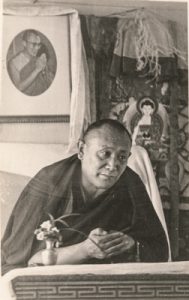
The tradition of death meditation taught here originated with Buddha Shakyamuni and was practiced by such renowned meditators as the bodhisattva Shantideva, the early Kadampa geshes, Milarepa’s disciple Gampopa, the incomparable yogi Lama Je Tsongkhapa, the Dalai Lamas and many other renowned masters. Eventually it came down to Pabongka Rinpoche, one of the greatest teachers alive at the turn of this [20th] century. Pabongka gave it to Kyabje Trijang Dorje Chang, the Junior Tutor of His Holiness the Dalai Lama. It was from this perfect guru, Kyabje Trijang Dorje Chang, that I heard it.
I myself trained under some twenty gurus, each of whom was without a doubt a fully enlightened buddha. However, from the viewpoint of my personal karmic disposition, the kindest of them all was Kyabje Trijang Dorje Chang. The excellence of this master cannot be described. The manner in which he teaches and the subtle skills he adopts to generate a true experience of Dharma in the disciple are so profound that it is almost impossible for even the dullest of listeners to remain unaffected. It is indeed sad that this fully realized being now assumes the form of an old man who can so rarely teach [Kyabje Rinpoche passed away in 1981]. Merely sitting in his presence gives one control over one’s mind. Besides caring for his disciples spiritually, he also does so physically. Many times during the course of my training I was without food day after day, my clothes but tattered rags; it was Kyabje Trijang Dorje Chang who saved me.
There are many people who study and talk about Dharma, but never really practice it. Their Dharma is only words. This is because they have not spent sufficient time meditating on death.
The disadvantages of not meditating on death
The disadvantages of not meditating on death are numberless but can be summarized under the following six headings:
- If you do not meditate on death you will not be mindful of your Dharma practice. All of your time will be lost in mundane pursuits. One of the early Kadampa geshes said, “If you do not meditate on death upon waking in the morning, your entire morning will be wasted; if you do not meditate on death at noon, your entire afternoon will be wasted; and if you do not meditate on death in the evening, your entire night will be wasted.” In this way most people waste their entire life.
- Although you may practice some Dharma your main practice will be procrastination. Many Tibetans told their gurus that they would soon do retreat but, having meditated insufficiently on death, put it off year after year and died before managing to do so.
- Your practice will become impure. It will become mixed with worldly ambitions, such as the eight worldly dharmas. Many practitioners fix their eyes more on becoming scholars or celebrities than on attaining spiritual realization. Jowoje (Atisha) was once asked, “If someone wishes for the happiness of this life alone, what shall he gain?” Jowoje answered, “Just what he wishes for!” “And what shall he gain in future lives?” the disciple asked. “Rebirth in the hell, hungry ghost or animal realms,” was the reply. It is said that in order to practice perfectly, this life must be abandoned. What does that mean? Not that you must abandon your present lifestyle, home, possessions or position, but that you must give up the eight worldly dharmas: wishing to experience wealth, fame, praise or happiness and to avoid poverty, notoriety, slander or discomfort. To differentiate between a true spiritual practitioner and a non-practitioner is simple. A practitioner is one who has abandoned the eight worldly dharmas; a non-practitioner is one who is controlled by them. Geshe Potowa once asked Lama Dromtönpa, “What is the line between Dharma and non-Dharma?” Lama Drom replied, “That which contradicts the beliefs of samsaric people is Dharma; that which does not, is non-Dharma.”
- Your practice will lack stamina. Although you take up a practice, at the first setback you’ll give it up. A small thorn bush grew outside the cave of Kadampa Geshe Karag Gomchung. Every time he entered or went from the cave its thorns would rip his flesh but that bush remained there until he died because this great meditator practiced with such intensity that he never wanted to waste the few moments necessary to cut it down. Geshe Karag Gomchung had realized the fruits of meditating on death.
- You will continue to create negative karma. Without continual awareness of death, attachment to the things of this life persists. Friends and relatives are held as more worthy of love than are strangers and beings who bring you discomfort. This emotional imbalance gives rise to an endless string of mental distortions, which in turn results in the generation of infinite negative karmas. In this way, you lose the happiness of this life and that of all future lives as well.
- You will die in a state of regret. It is certain that death will come. If you do not live in mindfulness of it, it will come as a surprise. At that crucial moment you will realize that all the materialistically oriented attitudes that you have cultivated all your life are of no value and that your wealth, family and power are similarly useless. When death comes, nothing but spiritual realization is of value but, having neglected to practice death awareness, you have neglected to practice Dharma and now stand empty-handed, regret filling your mind. In his Guide to the Bodhisattva’s Way of Life, Shantideva writes:
When grasped by death’s agents,
What value are friends,
What value are relatives?
At that moment, the only protection
Is the force of goodness,
But to that I never attended.Kadampa Geshe Kamaba once remarked that we should fear death now while there’s still time to act and at the time of death be fearless. Worldly beings are the opposite. While strong and healthy they never give death a thought, but when death comes they clutch at their breasts in terror. Most practitioners never really begin to practice but procrastinate day after day. Then, lying on their deathbed, they pray for just a few more days of life, but it’s too late: they are now between the jaws of the Lord of Death and the time for practice is but a memory—like a piece of meat that we held in our hands but did not eat, dropped, and is now in the belly of a dog and cannot be brought back. Although regret is pointless, regret arises.
The advantages of meditating on death
The advantages of meditating on death are also numberless but again can be summarized under six headings.
- Your life will become purposeful. In the Sutra of Buddha’s Passing Away (Mahaparinirvana Sutra), it is said: “Of all footprints, that of the elephant is the largest; of all mindfulness meditations, that on death is supreme.” If you practice the death meditation properly, your mind will yearn to seek a deeper understanding of life. You can see this in the biographies of the saints. Buddha himself was turned away from attraction to mundane existence by seeing first a sick man, then an old man and lastly a corpse. The yogi Milarepa was inspired to renounce black magic and search for a more purposeful path by witnessing his magic teacher’s reaction to the death of a patron.
- Mindfulness of death is an extremely powerful opponent to delusion. The strongest opponent to delusion is realization of emptiness but awareness of death is a close second. If you recollect death whenever attachment or aversion arise in your mind, that delusion is instantly destroyed, just as the blow of an iron hammer crushes a stone. The yogis and mahasiddhas of ancient India ate their food out of bowls made from human skulls and blew trumpets made from human thighbones. Similarly, monks painted human skulls on the doors of their toilets. This was not done to scare people but to maintain awareness of death. Even nowadays almost every temple hangs a painting of the Lord of Death holding the whole of conditioned existence in his mouth beside its main entrance; not as a decoration, but to instill the thought of death in all who visit. In tantric practice, we visualize cemeteries filled with corpses and so forth surrounding the mystic mandala.
- Meditation on death is important in the beginning of your practice because it inspires you to practice and practice well.
- Meditation on death is important in the middle of your practice because it inspires you to exert yourself both intensely and with purity.
- Meditation on death is important at the end of your practice because it causes you to perfect and complete your practice. Thus, meditation on death causes you to begin, continue and accomplish your practice. Some people, soon after contacting Dharma, develop a very heavy sense of renunciation and enter into retreat, but after some months their enthusiasm has waned and they yearn to return home. However, they feel forced to stay and complete their proposed retreat because they fear being ridiculed were they to break their practice. They end up cursing their renunciation, which they consider to have been nothing but a source of trouble for them.
- You will die happily and without regret. By maintaining awareness of death while alive, your life will spontaneously incline towards virtue and Dharma practice. Death will not come as a surprise and will bring neither fear nor regret. It is said that the best practitioner dies in a state of bliss, the mediocre practitioner dies happily, and even a poor practitioner has neither regret nor dread at the time of death. We should aim at least to be like the most inferior of these. Milarepa declared, “Terrified of death, I fled to the mountains, where I realized the ultimate nature of the mind. Now I’m no longer afraid.” If we practice as intensely as Milarepa did, there’s no reason why we should not attain an equal level of realization. We have the same kind of body and mental capacity as he did, and the various methods that he applied have come down to us in a pure, unbroken stream through the various lineage gurus. In a way, our opportunity to become enlightened is even greater than his, because a number of oral transmissions not available to Milarepa are now available to us
These, then, are the disadvantages of not meditating on death and the advantages of meditating on it.
How to meditate on death
How should you meditate on death? There are two main ways.
A. The first is the nine-part death meditation (the three roots, the nine reasons and the three determinations). This is the method taught in the sutras and is referred to in both Gampopa’s Jewel Ornament of Liberation and Lama Tsongkhapa’s Great Treatise on the Stages of the Path to Enlightenment.
B. The second is a technique wherein you visualize yourself undergoing the process of death. This is a tantric method and is found in every Highest Yoga Tantra system in the phase of mandala meditation known as taking the three kayas as the path.
A. The nine-part death meditation
The three roots to be meditated on are:
1. The inevitability of death.
2. The uncertainty of the time of death.
3. At the time of death, nothing but your spiritual realization is of value.
The nine reasons and the three determinations are divided equally between the three roots as follows:
1. The inevitability of death
Although death plans to attack, most people live pretending that it does not exist. It is not difficult to prove logically that any given person will die. Taking yourself as an example, you will certainly die, because death is inevitable. How do we know that it’s inevitable? By meditating upon these three reasons:
(a) To date, death has come to all humans. Without mentioning ordinary beings, even the great, realized beings—the arhats, bodhisattvas and buddhas—have died. So why should we expect to survive? Buddha Shakyamuni himself passed away so as to demonstrate impermanence to his disciples. Who do you know that is even a century old? In the face of these facts, it is hard to believe that we alone shall be immortal.
(b) Day by day life ebbs, with no chance of increase. A human’s lifespan can be likened to a pond, the inflowing stream to which has been cut off: moment-by-moment its waters diminish; or to a monk with only 1,000 rupees to his name and no further income: if he spends ten rupees a day, he will eventually be penniless. Shantideva wrote, “Remaining neither day nor night, life is constantly slipping away and never getting any longer. Why should death not come to me?” The length of your life has been decreasing since the moment of your conception. When 100 sheep are taken to the slaughterhouse to be killed by evening, the killing of each one brings the death of the last sheep closer. It is the same with our lifespan: as the minutes are consumed, the hours pass; as the hours are consumed, the days pass; as the days are consumed, the months pass; and as the months are consumed, the years pass. With the consumption of our years, death rapidly approaches.
(c) Although alive, we find little time to practice Dharma. Our lifespan can probably be divided as follows: twenty years are spent sleeping, twenty years working, ten years playing, five years eating and so on. We spend perhaps four or five years in practice. These are the parts that constitute the composite phenomenon that is the life of the average person. As the Buddha pointed out, anything that is composite is doomed to fall apart; that which is a collection of parts exists in dependence on those parts, which sooner or later must disintegrate.
If you meditate intensively upon this first root and its three reasons, you can, within seven days, realize the inevitability of death. From this realization will arise the first of the three determinations: the determination to practice Dharma.
2. The uncertainty of the time of death
This, the second root, is more difficult to realize fully. Many people live with the understanding that eventually they must die but few truly believe that they could be dead a minute from now. To generate this awareness, meditate on the following three reasons:
(a) The lifespan of humans on this planet is not fixed. Thousands of years ago, the lifespan of humans was measured in centuries; now it is less than a hundred years; soon it will last only a decade. Human lifespan is especially unstable in this degenerate phase of the eon. You may think that you have a long time to live because you are still young, but look at the aged carrying their dead children to the cemetery. You may think that you will live long because you have sufficient wealth to buy good food and medicines, but look at the old beggars and the millionaires who died young. You may think that you will live long because you are healthy, but this is also not a sound idea; many people die healthy while many sick ones live on, year after year.
(b) Many forces oppose life and few support it. The evil spirits that can terminate a human life number more than 80,000; the 424 diseases hover around us like a fog. These spirits and diseases wait for us like a cat outside a rat hole. Furthermore, the four elements that constitute the physical base of our being—earth, water, fire and air—are like four snakes in a single vessel, the stronger continually trying to overcome the weaker. When these elements are in harmony, we enjoy health, but when they fall into discord, our life is endangered. Moreover, that which we use to sustain life can easily become a cause of death: houses collapse, killing the inhabitants; foods turn to poison; medicines used improperly can cause death; the various means of transportation, intended to aid human existence, often result in death. In his Precious Garland, Nagarjuna wrote, “O King, life is like a butter lamp in a windstorm.” Whether the lamp is full, half-full or almost empty is of little consequence; it can be extinguished at any moment. Similarly, your age is no indication of how close you are to death.
(c) The human body is extremely fragile. We may say, “Granted, there are many opponents to life but I am powerful enough to endure them all,” but this is just wishful thinking. The human body is destroyed as easily as a dewdrop is knocked off the tip of a blade of grass. As Nagarjuna said in his Friendly Letter, “If the entire world will be destroyed at this eon’s end, what to say of the bodies of humans?” Kunga Rinpoche once said, “If you think you will first complete your worldly duties and then practice Dharma, bear in mind that the death of today may come before the practice of tomorrow.”
By meditating diligently on this second root and its three reasons, there will arise the second of the three determinations: the determination to practice Dharma immediately.
3. At the time of death, nothing but your spiritual realization is of value
To become convinced of this third root, meditate on the following three reasons:
(a) Wealth, possessions, fame or social power are of no value. At the time of your death you may have a hundred bricks of gold in your house but not a single one will be of benefit. A beggar must leave behind even his walking stick. A king may have a million subjects and a thousand queens but not one will be able to accompany him to the next life. As Buddha said, “Although you may have enough food and clothing to last a hundred years, when you die you go on alone, naked and unfed.”
(b) Family, friends and relatives are of no value. You are born alone and must die alone. When you are dying, all your loved ones may press down on your body trying to prevent death from taking you away but it will be of no avail; nor will a single one accompany you. The mahasiddha Maitripa said, “My friend, dying is like passing alone through a dangerous valley filled with robbers. Not one of your queens, sons, daughters or subjects will come with you then. Therefore, prepare yourself well.” In his Guide to the Bodhisattva’s Way of Life, Shantideva wrote, “Leaving all behind, I must depart alone. Alas, not knowing this, I committed all kinds of evil for the sake of family and friends, but who among them will help me face the Lord of Death?”
(c) Even your body will be of no value. Though you have had your body since leaving your mother’s womb and have clothed it to save it from the sufferings of heat and cold and fed it to spare it the pangs of hunger, at death it must be abandoned. The stream of consciousness goes on alone.
By meditating intensively on this third root and its three reasons, the third of the three determinations will arise: the determination to practice Dharma purely, unmixed with materialistic tendencies.
Shantideva wrote, “At the time of death, only goodness is of value but to that I did not attend!” If you know that you are moving to a country where the only valid currency is gold, you would be wise to convert all your old currency while you still have the opportunity. At the time of death, the only valid currency is spiritual realization, so you should practice Dharma intensely to gain that currency while you still have the chance.
How exactly do you conduct this nine-part death meditation?
Sitting in the correct posture, begin by glancing over the six disadvantages of not remembering death and the six advantages of remembering it. Having spent five or ten minutes on this, glance through each of the three roots with its corresponding reasons and determinations. Then take your mind back to the first reason of the first root, and hold it there for twenty to thirty minutes, entering into formal meditation on that point. The first day, do formal meditation on the first of the nine reasons; the second day, on the second reason and so forth, gradually working your way through the entire meditation.
To conclude each session, glance through the remainder of the points, dwell for a short time on the three determinations, and at the very end, recite a short dedication prayer such as the following:
By the power of this practice,
May I quickly achieve perfect buddhahood,
And thus may each and every sentient being
Come to realize wisdom’s eternal happiness.
B. Visualizing yourself undergoing the death process
There are both exoteric and esoteric ways of practicing this technique.
The exoteric way
Visualize yourself lying on your bed, dying. Your parents and friends surround you, lamenting. The radiance of your countenance has faded and your nostrils droop. Your lips dry and slime begins to form on your teeth. All grace has gone from your form and your body looks quite ugly. Your body heat drops, your breathing becomes heavy and you exhale more than you inhale. You remember all the negative karma you created during your life and are filled with regret. You look to all sides for help but there’s none to be found. Do this as convincingly as you can and see how you feel. Do attachment or fear arise? By meditating in this way you can discover which delusions will disturb you at death and work on abandoning them even from today.
The esoteric way
The esoteric technique of meditation on the death process is much more complex. To do it in full detail requires tantric initiation. This method is performed in all Highest Yoga Tantra systems in the phase of the practice known as taking the three kayas as the path. Only a limited portion of this teaching can be imparted openly; the explanations concerning the mandala, the five buddha families and the clear light must be omitted.
This meditation deals with the dissolution of the twenty-five course substances, an important topic in tantric practice. What are the twenty-five coarse substances?
1. The five psychophysical constituents (skandhas): form, feeling, recognition, volitional formations and consciousness.
2. The five imperfect wisdoms: the mirror-like wisdom, the wisdom of equality, the discriminating wisdom, the accomplishing wisdom and the wisdom of the nature of phenomena. These wisdoms are called “imperfect” because they are mentioned in reference to someone who has not attained buddhahood.
3. The four elements: earth, water, fire and wind.
4. The six sources: the eye, ear, nose, tongue, body and mind senses.
5. The five objects: colors and shapes, sounds, odors, tastes and tangibles.
When death comes naturally, it comes as a process of gradual disintegration. The first stage of this process is the simultaneous disintegration of (i) the psychophysical constituent of form, (ii) the imperfect mirror-like wisdom, (iii) the earth element, (iv) the eye sense and (v) colors and shapes. An outer sign manifests as a result of the disintegration of each of these five attributes, respectively as follows: (i) the body withers and loses vitality, (ii) the eyes blur, (iii) one can no longer move the limbs, (iv) blinking ceases, and (v) the radiance of the body fades. These are outer signs and can therefore be witnessed by others. With the disintegration of these five attributes, the dying person experiences an inner sign, which can be seen by that person alone: a mirage-like vision filling all space.
The second stage is the disintegration of (i) the psychophysical constituent of feeling, (ii) the imperfect wisdom of equality, (iii) the water element, (iv) the ear sense and (v) sounds. Again, there is an outer sign accompanying the disintegration of each of these five attributes. The outer signs are: (i) one loses discrimination as to whether physical sensations are pleasant, unpleasant or indifferent, (ii) one is no longer mindful of the feelings accompanying the mental consciousness, (iii) the lips dry, perspiration stops and blood and semen coagulate, (iv) inner and outer sounds can no longer be heard and (v) even the subtle humming in the ears ceases. The dying person experiences the inner sign of a smoke-like vision filling all space.
The third stage is the disintegration of (i) the psychophysical constituent of recognition, (ii) the imperfect discriminating wisdom, (iii) the fire element, (iv) the nose sense and (v) smells. The outer signs are: (i) one can no longer recognize the purpose of anything said by those who surround one, (ii) memory of even the names of parents, family, friends and so forth is lost, (iii) bodily heat lessens and the powers of digestion and food assimilation cease, (iv) exhalation is strong and inhalation weak and (v) the power to recognize smell fades. The dying person experiences the inner sign of sparks of fire filling space.
The fourth stage is the disintegration of (i) the psychophysical constituent of volitional formations, (ii) the imperfect accomplishing wisdom, (iii) the wind element, (iv) the tongue sense, (v) tastes and (vi) the body sense and tangible objects. The outer signs are: (i) all physical abilities fail, (ii) all external purpose is forgotten, (iii) the major and minor winds dissolve into the heart chakra and inhalation and exhalation cease, (iv) the tongue becomes thick and short and its root turns blue, (v) all powers of taste fade, and (vi) one cannot experience roughness or smoothness. The inner sign is that of a vision of light, like the last flickering of a candle.
At this point in the process, a medical doctor would declare the person dead. However, as consciousness still abides in the body, the person is still alive.
In the fifth stage, with the loss of the wind energy supporting it, a remnant of the original sperm, which came from the father at the time of conception and has since been stored in the crown chakra, flows down into the central channel and comes to the heart. Due to its passing through the knots of the chakras, a vision of snowy whiteness is experienced.
In the sixth stage, with the loss of the wind energy supporting it, a remnant of the original ovum, which came from the mother at the time of conception and has since been stored in the navel chakra, flows up into the central channel and also comes to the heart. Due to its passing through the knots of the chakras, a vision of sunset-like redness is experienced.
In the seventh stage, the remnants of the sperm and ovum now come together and a vision of darkness is experienced, as when the sky is completely overcast with thick clouds. Here, ordinary persons fall into a faint, but for a tantric yogi, this is an excellent condition for special meditation.
In the eighth stage, eventually the heart gives a slight tremble and the consciousness passes out of the body. There is an experience of clear light, as of the coming of dawn on a dark and moonless morning. This is the clear light of death, the appearance of which indicates that the death process is complete.
For the majority of beings, these experiences are totally uncontrolled and terrifying, but because of the preparations made while alive, tantric practitioners have mastery of them and use them to their advantage. Many lamas have attained enlightenment at this very moment of death.
Wind and consciousness are the most important topics in tantra. Both have gross and subtle aspects. Gross wind forms the body of this life; gross consciousness gives it sensory awareness. At the time of death, both of these gross qualities dissolve into their subtle aspects, which go on to enlightenment.
The real palace of the mind is the heart. Here, mind resides in the non-dissipating drop between the ovum and sperm remnants of mother and father. This is the gross non-dissipating drop; it is called non-dissipating because it endures until death. The subtle non-dissipating drop is the combination of subtle wind and consciousness; it is called non-dissipating because it endures until enlightenment. Meditation on the death process involves meditation on both of these drops.
The importance of meditating on death
Meditation on impermanence is of paramount importance. It was the Buddha’s first teaching when he taught the four noble truths at the Deer Park, Sarnath, and it was his final teaching, because he died to impress the idea of impermanence upon the minds of his disciples.
The Buddha once said, “Everything in the three worlds is as impermanent as an autumn cloud. The birth and death of beings is like scenes in a drama. Human life is like a flash of lightning in the sky or like the waters of a mountain stream.”
If you meditate properly on death in accordance with either of the two methods, the nine-part death meditation or the technique of visualizing yourself undergoing the death process, there is no doubt that you will benefit.
If a dog rushes out to bite you, there’s no value in merely experiencing fear; you have to use the fear you feel to avoid being bitten. Similarly, there is no point in merely fearing death; use your fear of death to develop the wisdom that is beyond the fangs of death.
You should try to practice Dharma, practice it right now and practice it purely. Dharma is the map that shows you the way to realization of the conventional and ultimate modes of existence; it is the food that nourishes pilgrims, the escort that guides you through the hazardous passes on the road to enlightenment.
Transference of consciousness
Practice has many levels, the most basic of which is the keeping of a good heart, a heart of love and compassion. Even if you cannot find the strength or time to engage in higher meditational practices or philosophical study, you should at least try to maintain a sympathetic attitude towards your fellow beings, an attitude of never harming but only helping others. If you can do this, your negativities will slowly fall away. Then, at the time of death, you will be able to take refuge in the Three Jewels and be confident of obtaining a good rebirth. This is the method of transference of consciousness (po-wa) for practitioners of least capability.
More ambitious practitioners try to develop renunciation, the three higher trainings—morality, concentration and wisdom—and the enlightened attitude of bodhicitta, the wish to attain buddhahood in order to benefit all sentient beings. When such practitioners have gained a certain degree of accomplishment of these qualities, they enter the ocean of tantra in order to realize their spiritual aspirations more quickly; only through the practice of tantra is it possible to attain fully completed buddhahood in as short a period as two or three years. Nevertheless, even though it is possible to attain enlightenment this quickly, not all practitioners can do so. Therefore, the various techniques of transference of consciousness for practitioners of highest motivation were taught.
Transference of consciousness literally means “migration.” This is because the last thought you have when dying is the force that determines your next rebirth. Many people have led virtuous lives but, by having a negative thought when dying, have fallen to a lower realm, while others have led evil lives but, by having a positive thought when dying, have gained a higher rebirth. The yoga of transference of consciousness takes advantage of this phenomenon.
The exclusively Mahayana techniques of transference of consciousness may be divided into two categories: those taught in the sutras and those taught in the tantras.
Transference of consciousness in sutra: the five powers
The sutra method is called application of the five powers, because when you know death is approaching, you apply the powers of intention, the white seed, familiarity, destruction and prayer.
- The power of intention. Generate the firm intention not to let your mind become separated during death, intermediate state or rebirth from the aspiration to attain fully completed buddhahood for the benefit of all beings.
- The power of the white seed. Try to rid your mind of all forms of physical attachment by giving away all your wealth, property and possessions.
- The power of destruction. Try to destroy the stains of all the negative karmas you have collected during your lifetime by applying the four opponent powers: regret; resolve not to create such negative karmas again; taking refuge in the Three Jewels and generating bodhicitta; and purifying the root of the stains by meditating on emptiness, Vajrasattva and so forth. If you have received any tantric initiations, request your lama to reinitiate you or, if this is not possible, perform the self-initiation ritual.
- The power of familiarity. Generate bodhicitta as intensely as possible.
- The power of prayer. Here, prayer refers to the aspiration of the true Mahayana practitioner that all the obscurations, negative karma and sufferings of others may ripen onto oneself and that one will never be separated from the Mahayana attitude of wanting to achieve complete enlightenment for the benefit of all sentient beings.
One day Geshe Potowa was sitting on his throne giving a discourse when suddenly he said, “May I always be a protector for those who are helpless and a guide to those in confusion.” Then he died.
When nearing death, Geshe Chekawa told his disciples that he had long been praying to take rebirth in the lowest hell in order to be able to benefit the sentient beings there but that recently he had had a dream indicating that he would be reborn in a pure land. He requested his disciples to make many offerings to the buddhas and bodhisattvas that this might be avoided and his prayer fulfilled.
This application of these five powers at the time of death guarantees a rebirth with conditions suitable for continued practice of the Mahayana path.
Transference of consciousness in tantra
If you have received a tantric initiation, you should try to practice the tantric method of transference of consciousness. There are many variations of this method depending on the tantric system into which you have been initiated and where you want to be reborn. One of the most popular is that found in the Vajrayogini tantra. It is said that initiation into the practice of Vajrayogini is a ticket to the land of the dakinis.
Transference of consciousness as taught in the tantras is called the “forceful method” because even an extremely deluded person who has performed the most negative actions during life can take rebirth in a pure land by means of it. Its practice during life in order to prepare for death is called the “forceful practice” because merely by saying the syllable Phat! your consciousness is ejected from your body and by saying the syllable Hic! it is brought back in. The sign that you have accomplished this practice is that a blister breaks out on the crown of your head and exudes a few drops of blood and pus.
However, we are not permitted to teach tantric methods to non-initiates. Buddha Vajradhara himself said, “One should not pour the milk of a snow lion into a clay pot.” Not only does the milk turn sour but the pot is ruined as well. Some people accuse tantric teachers of being tight-fisted for maintaining secrecy, but this is a stupid accusation, obviously made by those with no understanding of tantra. Teaching tantra to a spiritually immature being is like tying a child to a wild elephant. Therefore, such great practitioners as the Fifth Dalai Lama have stressed the importance of gaining an experience of the fundamentals common to both sutra and tantra before specializing in tantric practice.
Q: What can be done to benefit a dying person?
Gen Rinpoche: It is helpful to recite mantras in the person’s ear. The mantras of Buddha Shakyamuni, OM MUNÉ MUNÉ MAHAMUNA-YE SVAHA; Avalokiteshvara, OM MANI PADME HUM; Arya Tara, OM TARE TUTTARE TURE SVAHA; and Manjushri, OM AH RA PA TSA NA DHIH, are easy to say yet very effective in leaving strong karmic imprints on the dying person’s mental continuum. These mantras are tremendously powerful and, without doubt, would be of immeasurable benefit to a dying person. It is also helpful to place an image of a buddha or a bodhisattva where the person will notice it. In particular, if the person is a religious practitioner, you should recite the mantra of the person’s spiritual teacher and show him or her a photograph of that teacher.
The most important thing is to help the dying person generate and maintain a virtuous attitude. Don’t do anything that might agitate or anger the person. Dying with a positive attitude almost certainly guarantees a good rebirth.
After death, the person’s possessions should be given away as offerings to such objects of virtue as the Three Jewels or used in tantric offering rituals (tsog). The person’s spiritual teachers should be asked to make special prayers, because the guru-disciple relationship is especially significant and anything a guru does for a deceased disciple, or a disciple for a deceased guru, has extraordinary effects. Parents and friends should also offer prayers, as they too can greatly affect the person’s rebirth. There are many examples of people who died in negative states of mind and were heading for rebirth in the hells but who, because of the prayers and offerings of their loved ones, took a higher rebirth.
In his Compendium of Metaphysics (Abhidharmasamuccaya), Arya Asanga explains in depth how to handle a dead or dying person.
Q: Should one do the above for Buddhists and non-Buddhists alike?
Gen Rinpoche: The buddhas and bodhisattvas are universal protectors and do not discriminate, so why should we? However, if the person is a Buddhist, because of the bond between you, anything you do will have greater impact.
Q: In the West, we often do not tell a dying person that he or she is, in fact, dying. Do you think that this is wise or unwise?
Gen Rinpoche: It depends upon the person. It is better to tell practitioners so that they can then put all their effort into practice. They will not be scared by knowing that they are dying and may be able to practice transference of consciousness. If people are not practitioners, perhaps there’s no point in telling them. They don’t need to be terrified.
Q: How long does consciousness remain in the body after a person is ostensibly dead? How long should the corpse be left untouched?
Gen Rinpoche: If the dying person is a great yogi, consciousness may remain in the body for days or even months. For example, one of the previous Panchen Lamas remained in his body, in meditation, for almost a year after he seemed dead. He died in Kham, in eastern Tibet, but his body was brought to central Tibet, a journey of many months, before his consciousness left. Even a non-practitioner’s consciousness may remain for up to three days. Therefore, a corpse should never be moved until the signs appear that indicate consciousness has departed. The strongest sign of this is the emission of a drop of blood from the nostrils or fluid from the sexual organ. A less certain sign is that of a foul smell coming from the corpse. If the body is cremated before this time it is tantamount to murder. Actually, it is preferable that the body not even be touched before the consciousness departs. If it is, the consciousness will probably leave from the point where the body was first touched. Since it is more favorable for the consciousness to leave via the upper rather than the lower parts, the crown of the head should be touched first.
Q: Why was burial so rare in Tibet?
Gen Rinpoche: It was considered preferable to offer the body to the birds as the person’s final act of charity. Only when a body was considered unfit for this was it buried. It was customary for great practitioners to do the special tantric rite of chöd before dying, offering their body to the birds; those who couldn’t do the rite themselves would have a chöd practitioner do it for them. In this way, however many birds were invited, that many would come to the feast. If the corpse was small and could feed only ten birds, only ten birds would come; if it was big enough to feed twenty, twenty would come. It is said that birds summoned in this way are manifestations of dakinis and follow a code of ethics in devouring the corpse. Usually the brain would be removed from the corpse and mixed with chickpea flour. When the birds had finished eating the rest of the corpse, this mixture would be fed to them. Only then would they fly away, satisfied.
Q: What is the source of tremendous amount of Tibetan literature describing death and the after-death state?
Gen Rinpoche: These texts were written by experienced yogis who had attained clairvoyance or extrasensory perception and are not like books written today. These days, as soon as someone learns to write, he or she starts composing books. The yogis of old wrote only from their own experience. Also, the Buddha himself taught a great deal about the intermediate state in both the sutras and the tantras.