
Liberation and Enlightenment
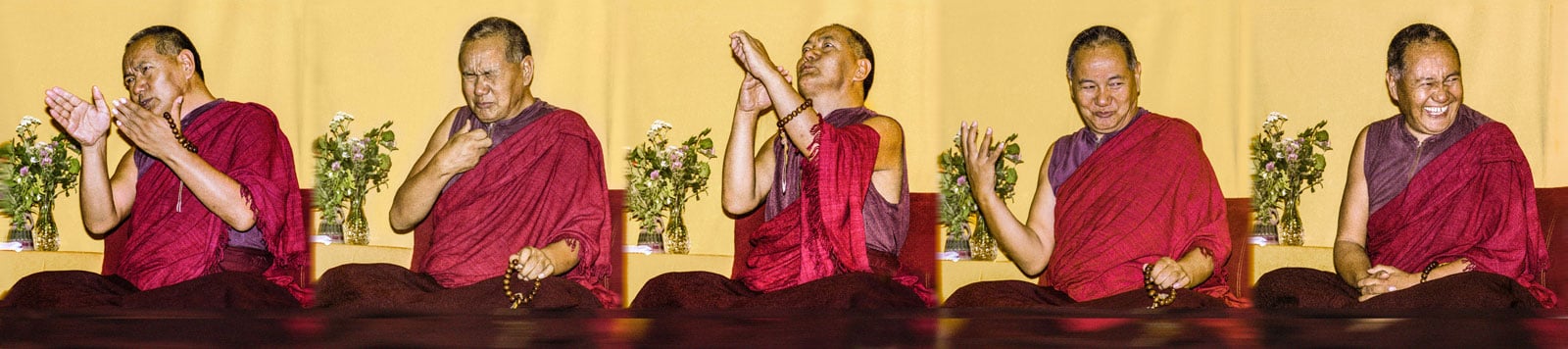
Benny Liow of the Young Buddhist Association of Malaysia's magazine Eastern Horizon talked to Rinpoche on March 7, 1996. This teaching appeared in the July-August, 1996 issue of Mandala, the news magazine of the FPMT.

BL: Rinpoche, in Malaysia we have Buddhists from various traditions. Can one learn and practice different traditions?
LZR: Yes, definitely. We can learn from both Theravada and Mahayana. It is really a question of our mental capacity and intelligence to absorb the Dharma. We need to know our motivations—are we seeking enlightenment for ourselves or for the sake of other sentient beings? Having a tradition to follow is important but more important is to learn from qualified teachers—and it doesn't matter whether Theravada or Mahayana.
If the practitioner is merely seeking liberation from samsara for himself, then he needs to learn and practice the meditation which will lead him onto the full path to liberation. But if his aim is to achieve enlightenment for the sake of all sentient beings, then he needs to learn the full path to enlightenment. In this case there are additional meditation practices taught in the Mahayana teachings.
To practice and have realizations on the path to enlightenment involves several levels. Firstly, there is the graduated path of middle capable beings, secondly, the graduated path of higher capable beings and finally the four levels of Mahayana Tantra. Very basic to the Mahayana practice is the development of bodhicitta, which is the door to enlightenment.
However, you can't realize bodhicitta without first realizing the renunciation of samsara. We need of course to realize the graduated path of middle-capable beings, that is, to be free from samsara. The realization is that the nature of samsara is suffering, that there is not one second of pure happiness. In order to have this realization one needs to practice renunciation. This is also found in the Theravada teachings. In order to achieve this realization to be free from samsara, there are again various stages. This comes firstly from realizing the Four Noble Truths. When one practices renunciation, one develops a detached mind to this life and also to future lives in samsara. With this realization that the nature of samsara is suffering, it also becomes the basis to develop compassion.
BL: Rinpoche, in your book The Door to Satisfaction you mention the three levels of happiness—happiness in future lives, liberation from samsara (release from karma and bondage) and enlightenment. Why is liberation from samsara different from enlightenment?
LZR: Too achieve liberation from samsara there are five paths: the path of accumulating merits, the preparatory path, the right seeing path, the path of meditation and the path of no more learning. To be liberated from samsara is to achieve arhatship.
By achieving the right seeing path we remove 112 delusions to do with the desire realm, form realm and formless realm. Then through the path of meditation one removes sixteen obscurations and delusions. With this one attains arhatship. That's nirvana in the sense of having ceased completely all the causes of suffering, karma and delusion.
However, there are still obscurations, but they are very subtle. They obstruct the arhat's mind even though he has tremendous psychic powers. Unlike the Buddha, the arhat is not able to see directly everything at the same time. An arhat does not have an omniscient mind; that's the quality of a buddha, one who has completely destroyed all subtle obscurations.
In Mahayana teachings, wisdom arises when all obscurations are removed, not only gross obscurations but even the subtle ones. The wisdom to remove the subtle obscurations comes through the development of bodhicitta. With this the wisdom realizing emptiness is able to destroy the subtle obscurations. It's like washing cloth. First you wash the black, dirty part. Then there is still some smell and stain left. Even that is washed. Eventually the cloth becomes completely cleaned. It becomes as clear as a mirror. We all have the buddha nature in our mind when the subtle obscurations are removed.
BL: Rinpoche, you mentioned that no matter what action we do, it is extremely important to have the right motivation. Can we interpret this to mean having the right intention?
LZR: Yes, yes.
BL: Rinpoche said that if gambling, for example, is done with pure motivation it will also become pure Dharma. How could an action like gambling which is rooted in delusion and greed be a pure action?
LZR: If you gamble with the intention that with the money you win you want to help refugees, hospitals or poor and starving people, the motivation is compassion to benefit others. If one truly has a pure attitude then the action becomes Dharma.
BL: But wouldn't gambling be an unskillful action, even if one gambles to help others?
LZR: The natural action of gambling is itself clean. If it is done with compassion and the intention is to use the money to benefit others, then it is wisdom. Knowing that it is done with compassion for others it becomes Dharma. There is both compassion and wisdom.
BL: Rinpoche, you mentioned that to practice Dharma we have to constantly think of impermanence and death. Wouldn't this lead one to develop a morbid attitude to life? Isn't this negative?
LZR: Actually, Buddhism is very positive. Bodhicitta makes life unbelievably beneficial. Not only can one achieve the happiness one wishes, one can also cause many others to be happy and help create the cause for enlightenment. That is the beauty of Dharma. With bodhicitta we get great fulfillment and satisfaction in whatever we do, be it our career, doing a retreat and practicing Dharma or spending leisure time with the family. So there is beauty and joy in life. The Buddha's teaching is always positive.
For instance in the lamrim teachings there is mention of the preciousness of human life. It explains how we can achieve happiness in future lives, liberation from samsara and ultimate enlightenment. Each of these happinesses is more precious than a mountain of diamonds or a whole sky filled with millions of dollars. So we look at this life as precious and wonderful. We then begin to ask how this human birth can give such unbelievable opportunity for us to realize our Buddha nature. All these opportunities create the cause for our happiness and that of numberless other sentient beings. Well, that's the beauty of life.
But we also need to face reality. For instance, if we want to buy gold we need to differentiate the real from the false. If we don't we may end up cheated and regret our actions. Similarly, we need to understand the reality of existence and recognize that impermanence, disease and old age are part of life. The nature of samsara is the reality of life. Rather than ignoring it, it is better to learn about its true nature and be aware of it. This will make us develop the strong inspiration to be free from samsara.
BL: What is the final spiritual goal for Buddhists?
LZR: The final spiritual goal for Buddhists is enlightenment. But firstly we must learn to see attachment and clinging as the main cause of suffering, like a chain which continuously ties us to samsara. Then there will arise a strong renunciation of the suffering realms of samsara. The Dharma practitioner will want to seek lasting happiness and not temporary happiness. This is seeking final liberation from the suffering of samsara. With this realization of samsara we will enter the path to full liberation or enlightenment.
It is also Important for Buddhists to note that the very purpose of our life is to benefit other sentient beings. That is our ultimate spiritual goal in life. We practice meditation so that we can develop ourselves spiritually in order that we can make ourselves useful for other sentient beings. When we develop bodhicitta we cherish this life, take care of it and keep it busy for the benefit of others. Realizing that the nature of life is impermanence and suffering will have incredible benefits; it is the basic meditation that we can use to immediately cut the emotional problems of the mind. When the mind is completely overwhelmed by desires and we don’t get what we want, anger will arise to harm oneself and others, including family, friends and other sentient beings. But by realizing that the reality of life is suffering we begin go see that there is no point to follow our emotional mind. This is the understanding that the reality of life is suffering as explained in the Four Noble Truths.