
Light of Dharma
A lightly edited transcript of Lama Yeshe's commentary on the three principal aspects of the path to enlightenment. In this weekend meditation course on the Buddhist attitude to life, Lama Yeshe deals specifically with the problems faced by Westerners who sincerely wish to practice meditation but find it difficult to generate any realizations. He shows how it is possible to eliminate the obstacles to our practice and integrate Dharma into Western society. These teachings were given in September 1983 in Vaddo, Sweden. Originally published as a transcript by Wisdom Publications.

Light of Dharma: Introduction and Chapter One
First Discourse: Sunday Morning
Good morning. And then, what can I say? (Laughter)
We are seeking freedom, liberation. What kind of liberation are we seeking? We need to somehow conquer the ego: ego problems, desire problems, grasping problems, depression problems, anxiety problems, emotional problems, hatred problems— I hope I’ve mentioned enough problems! These problems have to be eradicated, conquered. That is why, first I will give you this mantra, Shakyamuni’s mantra: MUNÉ MUNÉ MAHAMUNA-YE SVAHA. “Conquer, conquer desire and attachment, conquer all dualistic concepts.” It is useful.
From my heart, all these mantra come to your heart, and you recite, TADYATHA OM MUNÉ MUNÉ MAHAMUNAYÉ SOHA. Also, think about the problems I mentioned, “These are my problems. They have to be conquered, then I can help others.” TADYATHA OM MUNÉ MUNÉ MAHAMUNAYÉ SOHA.
Then also, think about this very simple thing: as human beings we are responsible for our body, our speech and our mind. These three things are our business besides our job. Buddhism is very simple, very earthed, it says that as human beings we are responsible for our body, our speech, and our mind. These three things are our business besides our job. Buddhism is very simple, very down to earth. It says that as human beings we are responsible for our body, speech, and mind. If you can subdue these three things then everything is easy; if you can’t make these three things easy, then everything becomes crazy.
Now, a simple meditation. I will give you this mantra, OM AH HUNG. At your brow chakra, here in the center of the brain, there is a white OM; you can visualize some kind of OM sound. At the throat, a small red light AH. And at the heart, a blue light with HUNG sound. Then at the same time, from my three centers come a white OM; red AH; and blue HUNG, to your three places. Repeat OM slowly at the same time as me: OM…. And think that blissful, white radiating light energy comes to all your body. Then, from the red AH comes blissful, red radiating light energy, increasing throughout your entire body and purifying impure speech. Repeat AH for some time. Then again, from the heart, blue energy, infinite, blissful, blue radiating light radiates throughout your entire body and the entire environment of Sweden and the entire universe. HUNG.... Again, with intensive awareness say HUNG as much as possible. You can make one long sound or take breaths in between. HUNG....
Now, Swedish people invited me to come to Sweden to bring light, light of dharma. I will tell you a story. You people mean well. When Atisha came to bring Buddhism to Tibet, one Tibetan meditator welcomed Atisha and told him that he used to do strong, one-pointed meditation. Atisha said, “That is a bad action, give it up!” If I imitate Atisha and say to you, “Stop meditating, meditation is wrong!” you would kill me. You would say, “I came here to do meditation and you say that meditation is a bad action.” That would be strange for you.
This meditator thought, “Maybe I should teach other people Dharma instead.” But Atisha told him, “That is a bad action, give it up!” Then he didn’t know what to do, he was already confused. He thought, “Maybe sometimes meditate and sometimes give teachings.” Atisha said, “That is also a bad action, you should give it up.” Then he gave up and said, “What should I do?” Atisha said, “Give up grasping after this life’s pleasures, that is what you should do.”
Does that make sense or not? It makes sense. What is our problem? Check up now, what is the Swedish people’s problem? I am sure most of you meditate already, but still you have the problem of self-pity. I am sure you already have a lot of conversation, a lot of talk about Dharma, Dharma, Dharma. Unreasonable or reasonable?
You see, in Buddha’s teaching we understand the root of human problems. We understand that we create human problems; we make our own problems. I will explain it another way. Grasping after this life’s pleasures is a problem because, as you can see, we are all looking for pleasure. We are doing everything, everything, everything we can think of—getting a boyfriend or girlfriend, getting married, and so on, a house, electricity, everything—because we need pleasure, and so we try everything. But we don’t feel comfortable here (Lama points to his heart), because we are grasping.
Besides trying to get as much worldly pleasure as possible to make us happy, we also try different religions. Your own religion does not satisfy you, so you start looking around, “Tibetan Buddhism maybe that would be good…maybe Hinduism… maybe Islam….” All this is to try and solve your problems. You mean well, but as Atisha said, “You meditate, but your problems do not change.” You recite mantras, you make prostrations, you do so many things—teaching bla bla bla bla (like me!). Bla bla bla—but the problem still remains. The problem still remains.
That is why Atisha said that all these religious actions were bad and should be given up. What he really means is that you should give up the negative thoughts and concepts that make you miserable, that make us cling to and grasp after worldly pleasure, so that we are only concerned with worldly pleasure.That has to be given up. Then there is the light of Dharma.
This is why it is important to have a simple life and cut confused situations. We should make our lives as clean-clear as possible. You have heard about how Shakyamuni Buddha and many Tibetan meditators lived a simple ascetic life. They gave up a worldly, complicated life. I think you should understand that you create your complicated life and complicated situations, so you always end up with confusion, and endless problems. So your problems are endless and repeat themselves again and again.
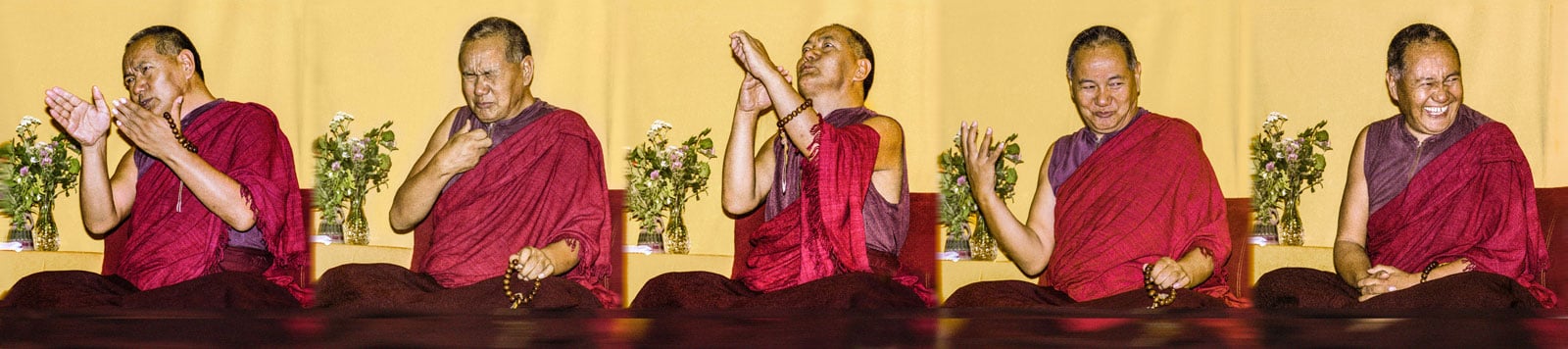
When we say that grasping, clinging, and desire have to be given up, that doesn’t mean giving up your nose, like this (pretending to pull his nose off and throw it away). It doesn’t mean you have to take off your head like this. It doesn’t mean that you should throw your arm away (pulling at his arm). Not like that. It means being less concerned, less uptight, less bound up. Things are still there, but they don’t bring tightness and complications. There are fewer expectations.
For example, if I believe that having this watch brings me pleasure, then when it is no longer there, I have no more pleasure and I start shaking. If you believe that way, then that belief is your problem; this watch is not the problem. You exaggerate the quality of this watch, okay? So the problem is here inside (Lama points to himself ), not the watch. You think all the time about this watch, this watch, this watch, this watch, this watch…! You become so concerned about the watch that you forget your own mind, which is the problem. Not having comprehensive awareness of your mind is the problem.
The quality of life, whether happy or unhappy, does not come from the outside objects that we are normally concerned with: a house, electricity, and these things—not from a Buddhist point of view anyway. Now, I have to talk about the Buddhist point of view, don’t I? Maybe I have the wrong concept according to your society’s point of view! So now, even if Buddhism does have the wrong conception I have to talk to you about it. It is my duty, so what to do?
All your experiences of a happy life or unhappy life come from your attitude, your mind. That is clean-clear in Buddhism, number one, PAM! clean-clear. If you are not clear about that one, then you become like a yo-yo.
Normally, we say that the negative impulse of the mind results in confusion and the positive impulse leads to a happy, peaceful life. You have heard about the three poisons in this house. Maybe there is no chemical poison here, but there is poison in this room: desire, hatred, and ignorance. If these three emotional poisons become strong, they always turn into mental pain. If they are not strong, we feel happy.
Our normal situation is that we have mental pain even if we meditate a little bit, even if we have love, and even if we have wisdom. All of us have some kind of intelligence, but at the same time we have mental pain because we are self-pity-sensitive, self-pity-negative-sensitive and ego-sensitive. We are involved in life, worldly life. So how?
Let me put it this way, when we gain material things, sensitively, we are so happy, like this (showing excitement). When we earn or somebody gives you chocolate, money, or things like that, then you go like this: “Oh yes, yes! I am so happy!” You become self-sensitively emotionally out of control. Then when we don’t get any gifts from work or from other people or other resources, we become self-sensitively, emotionally down, we have a grey face (showing a depressed face). Then we get sensory pleasure and again we are so happy, emotionally so happy. Then we don’t get any sensory pleasure and again we are down.
When someone tells you good things, “Oh, you are so beautiful. Oh, you are so wise. Oh, you are so kind,” then we are so happy that we are out of control. Then if someone says, “You are ugly; you are selfish,” you say, “Oh, no…!” Don’t you? It’s the same with reputation. When you have a good reputation, you feel up, and when you have a bad reputation, you feel down. When someone says something bad, you believe it and you become emotionally disturbed.
All these things that have been our habit for almost all of our life have to be changed. Remember what I said about being self-pity sensitive. When you drink, for example, there is something going on here (Lama points to his heart). Because you are so emotionally sensitive, you put an exaggerated value on the drink. Each time you do that your nervous system inside is completely shaking, disturbed. That is wrong. As long as you allow your self-pity concepts to overestimate objects, there is no way that you can solve your problem. As Atisha said, “You are meditating, you are doing something religious, but you are not solving your problem, because you are leaving your problem as it is.”
Suppose this were your problem (holding up his mala in his palm). This mala is all your problems in worldly life. You leave this (the mala) as it is, but you try to shake this one (a few of the beads) a little bit. Then you shake this, and then this a little bit (shaking individual beads at various places around the mala). But the problem is here (pointing at the whole mala). You have to shake this problem. Normally we do not shake this problem. Meditators, religious people, believers, or nonbelievers are not shaking this, so the entire ego is left. The ego is left unsolved; it is still concrete.
This sounds like your entire life is a big mistake, a big headache. Life itself seems like a big headache. Always we dismiss the problem. Let’s say this is a gun and I am supposed to shoot that target there, right? But I never hit it. I am always a little bit up or a little bit down; I always miss my point. It’s the same with your meditation or any religious action, or even when you try eating chocolate or ice cream or whatever you try to do to make yourself happy, to solve your problem. You always miss the real nucleus of the problem. You leave that untouched and try small things instead.
If meditation is not so good, not the solution to the problem, and grasping at the pleasures of this life has to be given up, this brings up the question—how do we give it up? You live in Swedish society. Since we were born up to now, we have been dedicated to pleasure; so how can you give up grasping at the pleasures of Swedish life. How?
That answer is not my business! You have to figure it out. You have wisdom. When the answer comes from your own checking process, from your wisdom, from your understanding, then it becomes a solid answer. Then true liberation comes, okay? Bla bla cannot do that for you.
That is also why it is something individual. The solution is something extremely personal, extremely individual, something that only the individual can do. You have to judge how much attachment or grasping or whatever you can eliminate and the extent to which you can sort out your ego problem, by using your own experience and wisdom.
Western people always look for the easy way, for everything to be easy-going. They try to have a life that is easy-going: “Society has to take care of me. They have to give me education; they have to give me food. My mother should take care of me; my father should take care of me; society should take care of me. They should take care of me.” There is always somebody who should be taking care of you.
Or you say, “God should take care of me.” That is true. And in the West there are many sick people who, when bad things happen in their life, always say: “God is terrible. Oh, I’m sick. God is terrible.” They put the blame completely on God. In Western hospitals there are so many people complaining about God. When bad things happen they say: “Oh, God is terrible, He doesn’t help me. Where is He now? I don’t believe in God any more because I am in trouble and He isn’t coming.” This is very common, maybe in Sweden not so much—maybe they don’t even believe in God!
What I am saying is that from the Buddhist point of view the way to liberate yourself is to take responsibility for liberating yourself. You are responsible for your thinking, your thoughts, and your body, and you are responsible for the quality of your life.
In Western history, a long time ago, maybe one hundred years ago, Western people thought that God was responsible for everything. Then religion declined and things changed. Now God is not responsible; society is the most important thing now. Society is like religion—it is so important. Politics is important for making life better and science is important for improving the quality of life, not God. I am talking about the history of Europe, the history of the human attitude, the European history of the human mind, how Europeans think.
Of course, Western psychologists talk about human problems and how to solve human problems. Still that is baby knowledge, young knowledge. The important thing from the Buddhist point of view is that to solve human problems each of us must recognize our responsibility to solve our own problems. Each of us is responsible for making our own psychology, okay? Each of us should know how to take care of our own mind. That is the way to liberate human beings.
So then, what is really fundamentally wrong in our life? We are extreme left. Do you know what I’m saying? You have left and right, they talk about the qualities of left and right—have you heard about these things? Yes? We are extreme left. That is why we have mental pain. That is why something is always wrong in our life. Why? Because we don’t understand reality.
Maybe you think this is strange, very strange. But it is a very important point to check up. We don’t understand the reality of ourselves and the reality of sensory pleasure. We don’t understand the real nature of the existence of sensory pleasure, so we overestimate. We make an overestimated projection of ourselves and we wear this like a heavy blanket twenty-four hours a day.
You can check up from your own experience whether you are wearing a heavy blanket of ego projection. This is not some intellectual thing; you can check up for yourself how you interpret your own image and then you will discover that you are wearing a heavy blanket of ego projections, a hallucinated blanket.
Check up for yourself. Be honest. Let’s say, for example, that most of us are over twenty years old. Think about how your image has changed in those twenty years, the image of what and who you are. Do you feel that you change every day when things happen? Does your image change every day? Or do you always carry the same self-pity image for many years without changing? You can analyze these things. It is a very simple thing to do, very simple.
The characteristic of the ego is that it tries to fix the image of oneself. This is the ego’s character. If the ego can’t fix the image then it becomes nervous, it feels it is losing something. The characteristic of the ego is that it always wants to fix the image of oneself so that it has something to hang onto. Then it can feel secure. But there is no such security. It is complete fantasy. From the Buddhist point of view it is total fantasy, nothing whatsoever to do with reality— the reality of oneself or the reality of the outside world.
You may have heard that in Buddhism we say the world is an illusion. Buddha said that the world is an illusion. It is an illusion, because you live life according to your superstitious deluded mind. You live in a world of fantasy created by your own mind.
Maybe, for example, you say that “Sweden is my world” but the way that you actually interpret yourself as a Swedish person and what the Swedish world is, has been put together as something solid by your ego. You say that “this is the Swedish world.” You visualize it in a certain way and project that image upon it. You say, “I am a Swedish man” or “I am a Swedish girl” so “I should do things this way, and this way, and this way.” You have a preconceived, fixed idea of who you are, in a way that has nothing whatsoever to do with the reality of yourself and the Swedish environment. That is why your projection, your experience of Sweden, is an illusion. That is all, just illusion— except this chocolate! (laughter).
You are so busy with your fantasy world that you do not have any time to contemplate your own mind. You are so preoccupied with your own fantasy illusion world that you don’t have time to investigate the reality of mind, of your own mind, your own consciousness.
This time, all of us in this meditation course are going to try as much as possible to be aware of our own consciousness and our own mind. This is our business during this seminar: to try as much as possible to be aware of the state of our consciousness.
The character of consciousness is the same in Buddhism as some Western philosophers have thought: the mind or consciousness is mere thought, thought energy, not substance, not physical.
When I tell you to meditate on the consciousness, you say: “What is consciousness? I don’t know what consciousness is, so what are you talking about, you monk!” My answer is: you shouldn’t worry about what the consciousness is in a concrete way. The consciousness is the expression of thought. It doesn’t have its own color, it doesn’t have its own substance or physical energy. It comes and goes freely and is just energy, conscious energy. It is not located in any particular place, not here or here or here or here (pointing to different parts of his body). It just embraces your entire nervous system.
Consciousness has a clear nature that takes on the reflection of other phenomena. When you look in a mirror, your reflection appears in the mirror, right? Similarly, the mind is clean-clear energy, like a mirror, which takes the reflection of all phenomena that come into the mind.
So what you should do is just know that you are thinking. Just be aware and mindful of your own state, of your feelings and of your own mind. Don’t make conversation: “Now my good mind is coming,” “now my bad mind is coming.” Bad and good minds are both clear to some extent. Our bad mind is also taking some kind of reflection so its nature must also be clear.
Thought is like the rays of the sun, so what you should do is to go straight through the sun’s rays until you reach the sun. Thought is the ray of consciousness, so contemplate your own thought, the ray of your own thought. That’s good enough. Don’t intellectualize, just let go. Don’t think that the intellect is special, we have been intellectualizing for so long and the result is restlessness. What have we gained? This time we are going to stop the intellect and just be like the sun and the moon with no expectation.
Sometimes we call this the natural state, the natural state of consciousness. We just leave the mind in a natural state without artificial intellectual concepts. That doesn’t mean being in sleepy ignorance but instead knowing, having knowledge and awareness of what is going on inside the body and mind and of what goes on in the outside vibration. Just be aware, that is good enough. Let go as much as possible and be in that natural state.
Then you experience tranquility, peace, and intensive awareness. From that state you can analyze the worldly self-pity sensitive attitude that I mentioned before: being happy when you get something and emotionally unhappy when you are not getting anything. When someone praises you you are emotionally up, when someone says you are a bad guy you are emotionally down. You discover that all these things are a complete joke; you realize that it is all nonsense. When you discover through the experience of knowing the reality of your own mind that the self-sensitive emotional clinging and grasping after the pleasure in this world is not so good, then that is true Dharma. When you yourself become knowledge, you yourself become comprehensive wisdom and you yourself become intensive awareness, then that really is true Dharma.
I advise you to close your eyes when you meditate. The reason why I advise Western people to close their eyes is that they are so habituated to using the eye. In the West the eye is the businessman. But this is just habit. When we have intensive awareness, it is not an awareness of the eye.
Okay, now I want to tell you something very important. From a Buddhist point of view, the eye, the nose, and all the rest of these five sense consciousnesses are ignorant. It is like a microscope: a microscope doesn’t have any comprehension; it just sees. In the same way the sensory consciousness is dull; it doesn’t have any wisdom, or penetrative understanding of reality. That is why a meditator’s intensive awareness has nothing to do with the eye or the nose. It is the mind. So meditation is not the eye’s business. Most of the time the eye just distracts; all sensory consciousness distracts. That is why I advise you to close your eyes and just allow your consciousness to function naturally with intensive awareness. The eye just makes you more and more busy and distracted.
Time is over. In the afternoon meditation I want you all to recite OM for two or three minutes. Everybody should say OM… and breathe in between. You don’t all have to stop at the same time, you can rotate and take new breaths while the others keep going. At the same time, in your brain a white radiating light energy comes: white blissful energy enters your entire body and purifies all impurities. It purifies all the impure energy you may feel, whether consciously or unconsciously.
After two or three minutes, you stop the OM sound completely and just contemplate the state of being of your own mind. Feel the state it is in. It doesn’t matter what is happening, whether negative or positive. Maybe garbage-bag mind will come up, but it doesn’t matter. Just be aware of your state of mind which is always clean-clear. Don’t make conversation with objects; just be mind and stay in that state, without conversation or distraction. Just stay like that and be aware of that.
If you find it difficult to do that, then you just breathe in and hold your breath. Sometimes we use this method in Buddhism. Breathing distracts the mind, so breath in and hold your breath. It will help you. Okay, as much as you can just let go. I think that is all.
Next chapter: Light of Dharma: Chapter Two »