
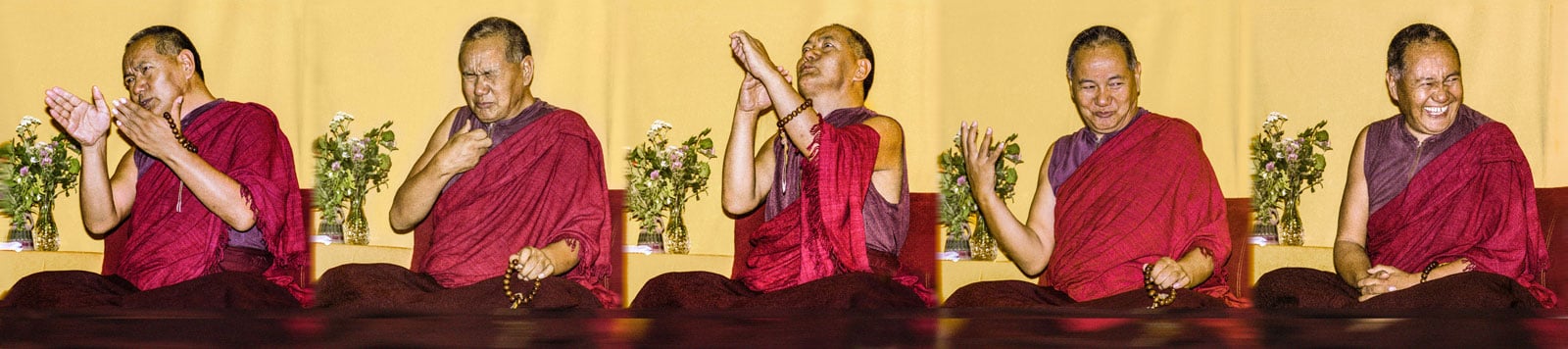
The Three Principal Aspects of the Path (LTY)
During His Holiness the Dalai Lama's 1982 teachings at Institut Vajra Yogini, France, Lama Yeshe was asked to "baby-sit" the audience for a couple of days when His Holiness manifested illness. The result is this excellent two-part introduction to the path to enlightenment, in which Lama explains renunciation, bodhicitta and the right view of emptiness.
These talks are included in Lama Yeshe's book The Essence of Tibetan Buddhism. You can also view the talks on our YouTube channel or listen to the audio recordings online.

The Three Principal Aspects of the Path: First Teaching
Today, I'm unfortunate. And today, you're unfortunate as well, because you have to put up with me, the garbage man. You have to put up with my garbage; I'm the garbage man. Due to circumstance, His Holiness is experiencing some discomfort with his health, so we should all pray for his good health...and so that it won't be necessary to be in this situation, where you have to put up with my garbage. However, due to these circumstances, His Holiness has given me permission to baby-sit you.
Now, His Holiness has chosen a particular text by Lama Je Tsongkhapa, which we call The Three Principal Paths to Liberation, or Enlightenment. So today I'm going to try to give you an introduction to this text, but going into it in detail is not my business.
In Tibetan, we call this text Lam-tso nam-sum. Historically, this book derives from Lama Je Tsongkhapa's direct, visual communication with Lord Manjushri. Manjushri gave him this teaching and then Lama Je Tsongkhapa gave it to his disciples: Lam-tso nam-sum, the Three Principal Aspects. This is a small text, but it contains the essence of the entire teaching of Lord Buddha. Also, while it is very simple and practical, it is a universal teaching that everybody can understand.
Now, the three principles are renunciation, bodhicitta and the wisdom of shunyata; these three are called the principal, essential paths to liberation.
I want you to understand why they are called the three essential, or principal, paths to liberation, because in the Western world, the word "renunciation" has a different connotation; people get scared that they will lose their pleasure. But without renunciation, there's no way out.
Renunciation
First of all, all of us consider that we would like to be free from ego mind and the bondage of samsara. But what binds us to samsara and makes us unhappy is not having renunciation. Now, what is renunciation? What makes us renounced?
The reason we are unhappy is because we have extreme craving for sense objects, samsaric objects, and we grasp at them. We are seeking to solve our problems but we are not seeking in the right place. The right place is our own ego grasping; we have to loosen that tightness, that's all.
According to the Buddhist point of view, monks and nuns are supposed to hold renunciation vows. The meaning of monks and nuns renouncing the world is that they have less craving for and grasping at sense objects. But you cannot say that they have already given up samsara, because monks and nuns still have stomachs! The thing is that the English word "renounce" is linguistically tricky. You can say that monks and nuns renounce their stomachs, but that doesn't necessarily mean they actually throw their stomachs away.
So, I want you to understand that renouncing sensory pleasure doesn't mean throwing nice things away. Even if you do, it doesn't mean you have renounced them. Renunciation is a totally inner experience. Renunciation of samsara does not mean you throw samsara away because your body and your nose are samsara. How can you throw your nose away? Your mind and body are samsara—well, at least mine are. So I cannot throw them away. Therefore, renunciation means less craving; it means being more reasonable instead of putting too much psychological pressure on yourself and acting crazy.
The important point for us to know, then, is that we should have less grasping at sense pleasures, because most of the time our grasping at and craving desire for worldly pleasure does not give us satisfaction. That is the main point. It leads to more dissatisfaction and to psychologically crazier reactions. That is the main point.
If you have the wisdom and method to handle objects of the five senses perfectly such that they do not bring negative reactions, it's all right for you to touch them. And, as human beings, we should be capable of judging for ourselves how far we can go into the experience of sense pleasure without getting mixed up and confused. We should judge for ourselves; it is completely up to individual experience. It's like French wine—some people cannot take it at all. Even though they would like to, the constitution of their nervous system doesn't allow it. But other people can take a little; others can take a bit more; some can take a lot.
So, I want you to understand why Buddhist scriptures completely forbid monks and nuns from drinking wine. It is not because wine is bad; grapes are bad. Grapes and vines are beautiful; the color of red wine is fantastic. But because we are ordinary beginners on the path to liberation, we can easily get caught up in negative energy. That's the reason. It is not that wine itself is bad. This is a good example for renunciation.
Who was the great Indian saint who drank wine? Do you remember that story? I don't recall who it was, but this saint went into a bar and drank and drank until the bartender finally asked him, "How are you going to pay?" The saint replied, "I'll pay when the sun sets." But the sun didn't set and the saint just kept on drinking. The bartender wanted his money but somehow he controlled the sunset. These kinds of higher realization—we can call them miraculous or esoteric realizations—are beyond the comprehension of ordinary people like us, but this saint was able to control the sun and drank perhaps thirty gallons of wine. And he didn't even have to make pipi!
Now, my point is that renunciation of samsara is not only the business of monks and nuns. Whoever is seeking liberation or enlightenment needs renunciation of samsara. If you check your own life, your own daily experiences, you will see that you are caught up in small pleasures—we [Buddhists] consider such grasping to be a tremendous hang-up and not of much value. However, the Western way of thinking—"I should have the best; the biggest"—is similar to our Buddhist attitude that we should have the best, most lasting, perfect pleasure rather than spending our lives fighting for the pleasure of a glass of wine.
Therefore, the grasping attitude and useless actions have to be abandoned and things that make your life meaningful and liberated have to be actualized.
But I don't want you to understand only the philosophical point of view. We are capable of examining our own minds and comprehending what kind of mind brings everyday problems and is not worthwhile, both objectively and subjectively. This is the way that meditation allows us to correct our attitudes and actions. Don't think, "My attitudes and actions come from my previous karma, therefore I can't do anything." That's a misunderstanding of karma. Don't think, "I am powerless." Human beings do have power. We have the power to change our lifestyles, change our attitudes, change our habits. We can call that capacity Buddha potential, God potential or whatever you want to call it. That's why Buddhism is simple. It is a universal teaching that can be understood by all people, religious or non-religious.
The opposite of renunciation of samsara—to put what I'm saying another way—is the extreme mind that we have most of the time: the grasping, craving mind that gives us an overestimated projection of objects, which has nothing to with the reality of those objects.
However, I want you to understand that Buddhism is not saying that objects have no beauty whatsoever. They do have beauty—a flower has a certain beauty, but that beauty is only conventional, or relative. The craving mind, however, projects onto an object something that is beyond the relative level, which has nothing to do with that object, that hypnotizes us. That mind is hallucinating, deluded and holding the wrong entity.
Without intensive observation or introspective wisdom, we cannot discover this. For that reason, Buddhist meditation includes checking. We call checking in this way analytical meditation. It involves logic; it involves philosophy. So Buddhist philosophy and psychology help us see things better. Therefore, analytical meditation is a scientific way of analyzing our own experience.
Finally, I also want you to understand that monks and nuns may not be renounced at all. It's true, isn't it? In Buddhism, we talk about superficial structure and universal structure. So when we say monks and nuns renounce, it means we're trying, that's all. Westerners sometimes think monks and nuns are holy. We're not holy; we're just trying. That's reasonable. Don't overestimate again, on that. Lay people, monks and nuns—we're all members of the Buddhist community. We should understand each other well and then let go; leave things as they are. It's unhealthy to have overestimated expectations of each other.
OK, now I'd better get back to business. I think that's enough of an introduction to renunciation. Now, bodhicitta.
Bodhicitta
Bodhicitta is like this. First, you have to understand your own ego problems—craving, desire, anger, impatience; your own situation, your inability to cope, your own disasters—within yourself and feel compassion for yourself. Because of the situation you're in, start by becoming the object of your own compassion. It begins from there: "This situation I'm in, I'm not the only one with ego conflict and problems. In all the world's societies, some people are upper class, some middle and others low; some are extremely beautiful, some are medium and others are ugly. But, just like me, everybody seeks happiness and does not desire to be miserable."
In this way, a feeling of equilibrium begins to come. Somehow, deep within you, equilibrium towards enemies, strangers and friends arises—it is not merely intellectual but something really sincere. It comes from deep down; from the bottom of your heart.
Buddhism teaches you the meditational technique for equalizing all living beings in the universe. Without a certain degree of equilibrium feeling with all universal living beings, it's impossible to say, "I want to give my life to others." Nor is it possible to develop bodhicitta. Bodhicitta is most precious, a diamond mind. In order to have space for bodhicitta, you have to feel that all universal living beings are equal.
But I want you to understand the distinction between the communist and the Buddhist idea of equality. It's possible for you to experience the Buddhist idea of equilibrium right now; you can't experience the communist idea even after a billion years—unless everybody has a gun! It's not possible.
The point is that Buddhism considers that we should have realization of equilibrium because we need a healthy mind. Equalizing others is something to be done within my mind, not by changing human beings externally. My business is not to be bothered by mental projections of disliked enemy, grasped—at friend or forgettable stranger. These three categories of object are made by my own mind; they do not exist outside.
As long as you have as an object of hatred even one human being, as long as you have an overestimated object of craving desire, as long as you have an indifferent object of ignorance—someone you ignore and don't care about—as long as you have the three poisons of hatred, desire and ignorance in relation to these three objects, you have a problem. It is not the objects' problem.
How can I be happy if Elisabeth [the French interpreter] is my biggest problem, my enemy? How can I be happy? Equilibrium is something to do with the inner experience. Forget about bodhicitta—we all have a long way to go. What I'm trying to express is that Tibetan Buddhism and Lama Tsongkhapa consider that equilibrium is most difficult to realize. So, it's worthwhile at least to try. Even though it is difficult, try.
Another way of describing equilibrium is to call it the middle way. That is why, from a practical point of view, in order for Buddhists to be healthy we should have an equalized feeling with Western religion and eastern religion. We should have an equalized feeling and respect for people who practice Christianity. That's the way to be happy, and happiness is your main business. I think it's a mistake for Western baby Buddhists to think that Buddhism is better than Christianity. It's wrong. First of all, it's not true, and secondly, it creates bad vibrations and makes your mind unhealthy.
I really feel that Buddhists can learn a lot from Christians. Recently I was in Spain and visited some Christian monasteries. The renunciation and way of life of some of those Christian monks seems much better than the renunciation I've seen in many Tibetan monasteries. Monks in Tibetan monastic communities often have individualistic attitudes, whereas the monks I saw in the Christian communities seemed to be completely unified. They had no individual possessions. For me, those monks were objects of refuge. Of course, if being individualistic is what an individual needs for his or her spiritual growth, that's all right. That's why different religions exist.
However, you should practice equilibrium in your daily life as much as you can. Try to have neither enemies nor objects of tremendous, exaggerated grasping. In this way, in the space of your equilibrium, you can grow bodhicitta—the attitude dedicated to all universal living beings.
Bodhicitta is an extremely high realization. It is the complete opposite of the self-cherishing attitude. You completely give yourself into the service of others in order to lead them to the highest liberation, which is beyond temporary happiness.
Our thoughts are extreme. Sometimes we put too much emphasis on and tremendous energy into activities from which we gain nothing. Look at certain athletes, for example; or people who put all their money and energy into motorcycle jumping and end up killing themselves. What for?
Bodhicitta is very practical, I tell you. It's like medicine. The self-cherishing thought is like a nail or a sword in your heart; it always feels uncomfortable. With bodhicitta, from the moment you begin to open, you feel incredibly peaceful and you get tremendous pleasure and inexhaustible energy. Forget about enlightenment—as soon as you begin to open yourself to others, you gain tremendous pleasure and satisfaction. Working for others is very interesting; it's an infinite activity. Your life becomes continuously rich and interesting.
You can see how easily Western people get bored; as a result, they take drugs and so forth. They are easily bored; they can't see what else to do. It's not that people who take drugs are necessarily unintelligent. They do have intelligence, but they don't know where to put their energy so that it is beneficial to society and themselves. They're blocked; they can't see. Therefore, they destroy themselves.
If you don't want to understand bodhicitta as an attitude dedicated to others—and sometimes it can be difficult to understand it in that way—you can also think of it as a selfish attitude. Why? In practice, when you begin to open yourself to others, you find that your heart is completely tied; your "I," or your ego, is tied. Lama Je Tsongkhapa [in his Three Principal Aspects of the Path] described the ego as an "iron net of self-grasping." How do you loosen these bonds? When you begin to dedicate yourself to others, you yourself experience unbelievable peace, unbelievable relaxation. Therefore, I'm saying, with the selfish attitude [of wanting to experience that peace and relaxation], you can practice dedicating yourself to others.
What really matters is your attitude. If your attitude is one of openness and dedication to all universal living beings, it is enough to relax you. In my opinion, having an attitude of bodhicitta is much more powerful—and much more practical in a Western environment—than squeezing yourself in meditation.
Anyway, our twentieth century lives don't allow us time for meditation. Even if we try, we're sluggish. "I was up too late last night; yesterday I worked so hard...." I really believe that the strong, determined, dedicated attitude of "Every day, for the rest of my life, and especially today, I will dedicate myself to others as much as I possibly can," is very powerful. Anyway, some people's attitude towards meditation is that they want some kind of concrete concentration [right now]. It's not possible to develop concrete concentration in a short time without putting your life together. And Westerners find it is very difficult to put their lives together; it's the most difficult thing. Of course, this is just the projection of a Tibetan monk! However, if you don't organize your life, how can you be a good meditator? It's not possible. How can you have good meditation if your life is in disorder?
I don't know what I'm saying! I think I'd better control myself!
Emptiness
The next topic is shunyata. But don't worry; His Holiness is going to explain shunyata. However, what I am going to say is that these three—renunciation, bodhicitta and the wisdom of universal reality—are the essence of Buddhism, the essence of Christianity; the essence of universal religion. There's no contradiction at all. Westerners easily rationalize that when a Buddhist monk talks about these three topics, he's on an Eastern trip, but these topics are neither Eastern culture nor Tibetan culture.
Historically, Shakyamuni Buddha taught the four noble truths. To whose culture do the four noble truths belong? The essence of religion has nothing to do with any one particular country's culture. Compassion, love, reality—to whose culture do they belong? The people of any country, any nation, can implement the three principal aspects of the path, the four noble truths or the eightfold path. There's no contradiction at all.
Also, you have to understand that the transmission of these three principal aspects of the path was passed from Lord Manjushri to Lama Tsongkhapa and from Lama Tsongkhapa down to the present time. It's not some exclusive Gelugpa thing; all four Tibetan traditions contain these three principles. Do not hold the misconception that the four traditions practice differently. You can't say that Kagyu, Gelug, Sakya and Nyingma renunciations are different; that Gelug refuge is different from Kagyu refuge. How can you say that? Even if Shakyamuni Buddha comes here and says, "They're different," I'm going to reject what he says. Even if Shakyamuni manifests here, radiating light, saying, "They're different," I'm going to reply, "No, they're not."
People are easily deluded; they hallucinate easily. The first and only thing you have to do in order to become a Buddhist is to take refuge in Buddha, Dharma and Sangha; that's all. How, then, can you say that Gelug refuge and Kagyu refuge are different? I want you to understand this. We have very limited concepts, limited orientation. I want you to see how limited human beings are.
Let me give you an example. Vietnamese Buddhists cannot visualize a Tibetan Buddha. Tibetans cannot visualize a Chinese Buddha. It is very difficult for Westerners to visualize a Japanese Buddha. Does that mean you ignore all these other Buddhas? Does that mean you discriminate, "I take refuge in only Tibetan Buddhas"? Or, "I take refuge in only Western Buddhas. I give up Eastern Buddhas; I give up Japanese Buddhas." Do you understand how we are limited? This is what I call human beings' limitation. They cannot understand things on the universal level and project in a culturally limited way so that their ego has something to hang on to; the Buddha that each nation's Buddhists hang on to is but an object of their ego-grasping.
Also, I've checked Western people out scientifically. Many Westerners have studied Tibetan thangka painting and the Buddhas they create are completely different. The Buddhas they paint are completely westernized, even though the dimensions are fixed precisely according to the Tibetan style and the examples they copy are also Tibetan. This is my scientific experience. This shows that human do things through only their own limited experience.
Anyway, I think it is such a pity that Gelugpas don't want to take refuge in objects that Nyingmapas also take refuge in, such as Padmasambhava. It's written in many Gelug Tibetan texts that Lama Je Tsongkhapa was a manifestation of Padmasambhava. Maybe I can also say that Lama Je Tsongkhapa was a manifestation of Jesus.
Well, I tell you, misconceptions can arise from when you first take refuge. But you have to learn that taking refuge is not simple; it's very profound. If, at the very beginning, you take refuge with a fanatical understanding of Buddha, Dharma and Sangha, you freak out; you become a Buddhist fanatic. If you are truly Buddhist, my advice is to take refuge in the buddhas and bodhisattvas of the ten directions. In the ten directions there's no division into west or east. Sometimes I think that orientation through the eye sense is not so good. Anyway, Buddha and Dharma are not objects of the eye sense.
The Christian way of explaining God as something universal and omnipresent is good. Actually, that's a good way of understanding things—better than "My Buddha; my Dharma; my Sangha." That's rubbish! That itself is the problem. If you get attached to the particular object of "my lama" or "my things," it's ridiculous. Buddha himself said that we should not be attached to him, or to enlightenment, or to the six paramitas. We should not be attached to anything.
Well, time's almost up. I still feel it's unfortunate that His Holiness could not come. I really feel that inviting His Holiness is like having a second Buddha come to this earth. Therefore, it is unfortunate that he cannot be here and you have to put up with such garbage—an ordinary person like me.
Meditation
But let's meditate for a couple of minutes. Send out our white, radiant light energy to purify all obstacles. Especially from our heart, we are sending white, blissful radiating light energy to His Holiness.
[Meditation]
And from His Holiness the Dalai Lama's heart, a white radiating light OM MANI PADME HUM mantra comes to our heart.
[Meditation]
Our entire nervous system, from our feet up to our crown, is purified by the OM MANI PADME HUM mantra coming from His Holiness's heart.
[Meditation]