
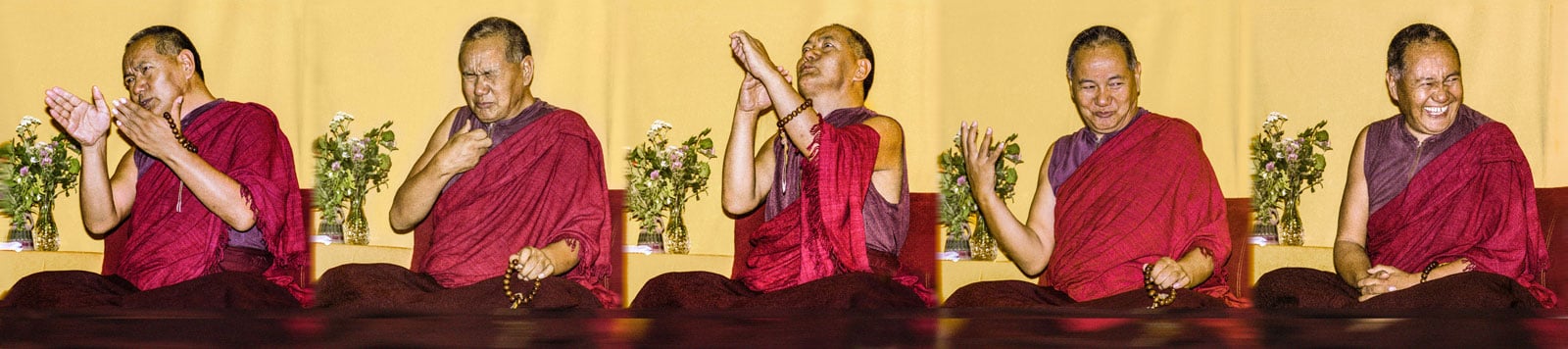
An Interview with Dr. Nick Ribush
This interview appeared in the January-April, 2003, issue of Eastern Horizon, a publication of the Young Buddhist Association of Malaysia.

Dr Nicholas, thank you for coming all the way from America to share the Dharma with us. In order to expand further your talk at the Global Conference, permit me to present a few questions to you.
No, thank you for inviting me to Malaysia to meet old and new Dharma friends. I’m happy to try to answer a few questions but I’m afraid I don’t know much.
Many teachings of the Buddha were meant for the monks. Does this make Buddhism more relevant for the monastic rather than the common laity?
First of all, I think we could say that anyone, even a layperson, who takes an interest in and practices Buddhism is far from being ordinary, or common. Such people are extremely fortunate. They also have the extra responsibility to use the Dharma for the benefit of others. However, just because certain teachings were given to an audience of monks doesn’t mean they are not relevant for others. We can say that certain Vinaya teachings were meant for monks, but there are others that are equally applicable to the laity. For example, the five precepts that lay people take in order to become serious practicing Buddhists are the first step on the path to enlightenment.
What are the preliminary practices for someone who wishes to be a Buddhist but also wants to remain a householder with a job and family?
The first preliminary practice is to take refuge. However, refuge should be taken with understanding, not simply because one’s family is Buddhist, one’s friend is a Buddhist, one’s country is Buddhist, or for some other ritualistic purpose. Taking refuge is a natural outcome of the recognition that samsara is suffering. There are two causes for taking refuge. The first is the fear of suffering, which kind of pushes us from behind. There are actually three kinds of sufferings to fear and therefore three levels of cause for taking refuge. The first suffering to fear is that of the three lower realms: the hell, hungry ghost and animal realms. The second is one’s own suffering in any realm of existence, not only lower but also upper. Here, one takes refuge in order to attain nirvana; this is the motivation for self-liberation. The third level of fear is that of not only one’s own suffering in samsara, but that of all other sentient beings’ suffering. In this case, one takes refuge to attain enlightenment in order to free all other sentient beings and lead them to enlightenment. Whichever level of suffering we fear, we see that Buddha, Dharma and Sangha are the solution to it.
The second cause for taking refuge is full confidence in the Triple Gem to save, or protect, us. This confidence, or faith, sort of pulls us along the path from in front. There’s kind of a carrot and stick approach when taking refuge. Fear is the stick; faith is the carrot. We understand how the Buddha overcame his own suffering and with compassion shared his teachings with all of us. The Buddha is like a doctor for our minds, which are full of greed, hatred and ignorance. We also understand how his teachings, the Dharma, can lead us out of samsaric suffering to complete enlightenment and are medicine for the deluded mind. Thus, Dharma is the actual refuge. Finally, we understand the qualities of Sangha, the community of monks and nuns. Actually, there are absolute and relative Sangha. The community of monks and nuns constitutes relative Sangha, while absolute Sangha is anyone who has realized the ultimate nature of his or her mind and has therefore transcended ego. Sangha is like the nurse who helps us take our medicine--those who help us along the path.
Once we have become Buddhist by taking refuge in the Triple Gem, our obligation is to follow the law of karma: to purify past negative karma and refrain from creating any more. To guide us in this, we need to know the ten non-virtuous actions: three non-virtuous actions of body--killing, stealing and sexual misconduct; four non-virtuous actions of speech--telling lies, speaking harshly, divisive speech and gossiping; and three non-virtuous actions of mind--ill will, covetousness and wrong views. Understanding and avoiding these non-virtuous actions helps prevent us from creating negative karma. This is where we take the five precepts, as I mentioned before, vowing not to kill, not to steal, not to engage in sexual misconduct, not to tell lies, and to avoid intoxicants. This keeps us firmly on the Dharma path. Preliminary practices help us purify negative karma, avoid planting more negative seeds, accumulate virtuous actions and enhance the virtuous qualities that we already have. Preliminary practice can be summarized as: “Avoid evil, do good, and purify your mind. This is the teaching of the Buddha.”
In addition to the practice of morality, which we do on the basis of refuge, as lay practitioners we also engage in meditation to calm, control and understand our mind. Most of us don’t live in a cave, monastery or retreat center, so to practice meditation effectively it’s best if we can reserve a small room or corner in our house for meditation. Set up a small shrine with a Buddha statue to represent the Buddha’s holy body, a sutra text to represent the Buddha’s Holy speech and a stupa to represent Buddha’s holy mind. For added inspiration, we can also put a picture of our personal teacher on our shrine. On or in front of the shrine we can make daily offerings of flowers, incense and so forth. In the Tibetan tradition, each morning we also offer seven bowls of water. We can also put a money box there and make daily money offerings to the Triple Gem. Then, on auspicious days, like Vesak, we can take the money out of the box and offer it to our teacher, monks or nuns, or our temple or Dharma center. Making offerings like this is an excellent way of developing the all-important practice of giving.
In the Tibetan tradition we also have the formal preliminaries that can be practiced by monks, nuns or lay people. In the Gelug tradition, which is one of the four main Tibetan schools, there are nine preliminary practices: prostration, mandala offering, Vajrasattva recitation-meditation, refuge, guru mantra recitation, Samayavajra recitation-meditation, Dorje Khadro (Vajradaka) fire puja (where we symbolically burn our negativities of greed, hatred and ignorance by offering black sesame into the mouth of the deity Dorje Khadro visualized in a bed of red-hot coals), water bowl offering, and tsa-tsas (little votive images of buddhas, bodhisattvas and so forth made of clay or plaster). We do 100,000 repetitions of each in intensive retreat or daily practice, gradually accumulating the required total. Each practice, however, entails using body, speech and mind.
These preliminary practices purify or enrich our mind so that when we do more direct meditation on the step of the path to enlightenment it is easier to gain realizations.
Would you classify these practices as ritual?
You imply that there’s something wrong with ritual, but it’s not necessarily so. What we have to do is try to make whatever ritual practice we do meaningful. The rituals I am talking about have been practiced by Dharma masters for centuries and have come down to us because they work. It is important to stress these practices have to be carried our properly with the right motivation, concentration and dedication. What I’ve been taught is that bodhicitta--the determination to reach enlightenment for the sake of all sentient beings is the best motivation. Good concentration means not letting our minds wander, while being constantly aware of what we are doing. We also meditate on emptiness, or ultimate reality, in order not to get caught up in ordinary appearances. When we finish the practice we are doing, we dedicate the merits to enlightenment of all sentient beings. Thus, motivation, concentration and dedication are all in harmony with our overall aim.
Are there many stories of householders who led spiritually enriching lives during the Buddha’s time?
I don’t know if there are many such stories or not. Many of the teachings that have come down to us from the Buddha’s time have been transmitted by monks, who might have a tendency to omit or diminish the role played by householders. In the Buddha’s time, there might not have been as many householder practitioners as there are now. In those days, people’s karma was better and more of those who were interested in Buddhism became monks. One famous householder was the bodhisattva Vimalakirti, whose wisdom may be found in The Holy Teaching of Vimalakirti, translated by Professor Robert Thurman, where he expounds both the profound and extensive aspects of the Mahayana to many hundreds of thousands of bodhisattvas, arhats, gods and others--an inspiration to the rest of us lay people that you don’t necessarily have to be a monk to realize and teach the Dharma.
In our modern society, what values can we apply in our lives as householders?
Modern society exhibits a tendency towards competitiveness, greed, materialism and aggression. As Buddhist householders, we need to counter these tendencies, at least in ourselves, thereby offering a positive example to our children and anybody else we come into contact with. We must keep our precepts and meditate daily to maintain our calm. We also need to develop a good heart, and show kindness to and have compassion for others. Furthermore, we need to uphold the Dharma and make it more available to all. We need to support our Dharma center and the Sangha. In addition, we should be less materialistic and try to live simply, using only what we need for basic shelter, food, clothing and so forth to take care of ourselves physically. We should be content with less, and whatever extra we have, should share it others.
In terms of social responsibility, we need to speak up if politicians are doing something wrong, especially on behalf of the poor, hungry, homeless, disadvantaged, disabled, sick and so forth. We should also speak up for disarmament and against war and violence, promote interracial and inter-religious harmony and say and do whatever we can to protect the environment. Overpopulation is another social problem that seriously affects the Earth. We need to slow down or even arrest population growth so that the planet can heal. Maybe all us householders should become celibate monks and nuns!
In all of this, the Dharma center is very important. Here, like-minded people can come together to discuss important social issues that affect their society and, as a group, see how they can work together with other groups to seek solutions to the problems that affect us all.
We need to have a way of transforming our daily actions into Dharma. In his book, Making Life Meaningful, Lama Zopa Rinpoche speaks about the importance of right motivation and how to generate it. He also talks about the actual practice, how to generate bodhicitta every moment, no matter what we are doing. For example, since we do a lot of walking, Lama Zopa tells us how to walk with emptiness, with dependent arising, walking with impermanence and so forth. When we understand how to walk mindfully in such ways, we can apply the same principles to our other daily activities, such as working, taking care of our child, eating, sleeping, experiencing sickness, and so forth.
The first thought that should come into our mind when we wake in the morning is how fortunate we are to still be alive. We should think, “How many people died in their sleep last night? How fortunate I am to still be alive to be able to work for the benefit of all sentient beings. This could be my last day on Earth, therefore, I am going to make every moment as meaningful as possible by never separating from the precious bodhicitta.” In this way we always remember impermanence and death and create great merit by imbuing every action with bodhicitta.
In the book, Lama Zopa Rinpoche teaches three levels of positive motivation. The lowest level of positive motivation is simply to gain a good rebirth as a human or a god. This is quite limited, because even though it allows us to avoid lower rebirths, we are still in samsara. The second level of motivation is the aspiration to attain liberation from all of samsara, nirvana. The highest level of motivation is to seek not only our own liberation, but also that of all others. In this beginningless cycle of death and rebirth, other beings have helped us in every possible way, especially with our Dharma practice and liberation, and it is selfish and cruel to ignore them and seek our own happiness alone. Therefore, we must work for the greatest happiness of others by saving them from the cycle of death and rebirth and leading them to enlightenment. In other words, we seek our own enlightenment to gain a tool by which we can lead others to enlightenment. This book is available on our Web site, www.lamayeshe.com. Here, the free book can be ordered or downloaded as a pdf file.
Whether we are monastics or laity, we all face problems in our everyday life. Is there a Buddhist approach to solving problems that arise?
Of course. The entire Buddhist teaching is the answer to this question. I believe that even when the Buddha was asked abstruse metaphysical points, he would refuse to answer and simply say, “I teach one thing and one thing only--suffering and the relief of suffering.” In this question, you mention “problems,” but problems and suffering are the same thing.
It’s true: whether we are ordained or lay, we all face problems. These tend to arise from our pursuit of ordinary happiness, pleasures of the senses. However, such happiness is merely suffering in disguise. For example, when we are hungry, we eat food, we feel happy. We identify such change as happiness, but it is not true happiness, just less suffering. Actually, our entire mind-body complex, which is created by delusion and karma, is the home of suffering. We need to see this and generate renunciation not only of the result, suffering, but its cause: delusion and suffering. We have to see that this world of cyclic existence is suffering and in it, there is no true happiness, no security.
Once we understand this, we can also appreciate the suffering that others are going through. Thus we can develop not only renunciation of our own suffering, but also develop compassion for other sentient beings, who, like us, since beginningless time, have been experiencing the dreadful sufferings that we have.
The First Noble Truth teaches us the various levels of suffering: suffering of suffering, suffering of change, and pervasive suffering. The Second Noble Truth explains the cause of suffering. If we do not want suffering, it is only logical that we understand the cause of suffering, which is created not by others but by our own mind. Because our mind is full of the three poisons of greed, hatred and ignorance, we create negative karma. Sooner or later, this ripens into suffering. Therefore, if we don’t want to suffer, we must stop creating its cause.
Furthermore, since we have been creating negative karma since beginningless time, our mind is full of unripened seeds of future suffering. In order to eradicate these, the Buddha taught the four opponent powers. These are the antidotes to future suffering. However, not only do we have to destroy the seeds of suffering planted in this and previous lives, we also have to stop planting more. As I said before, as lay people, we take the five precepts to help us avoid creating negative karma.
However, when problems arise, as they inevitably do, we can also learn to experience them with happiness. We can think, “This suffering I am experiencing is the ripening of past negative karma that I created. That particular negative karma has now finished. How lucky I am.” We can also take the suffering we experience as a teaching on karma--on how we alone create our own suffering and how, therefore, it’s up to us alone to alleviate it.
We can also use our suffering to develop bodhicitta, the cause of enlightenment, by thinking, “As I am experiencing this problem, so too are many others. May I experience it on their behalf. May my experiencing this problem free others from this and all other sufferings.” Instead of wishing with attachment to comfort and aversion to discomfort for it to stop, we should wish for all other beings’ sufferings to ripen on ourselves. This is experiencing problems with compassion, with bodhicitta.
As His Holiness the Dalai Lama often says, “We are all selfish, but let us be wise in the way we’re selfish.” If we know how to be selfish, selfishness is good. What is selfishness? Selfishness is wanting the best for ourselves. If we really want the best for ourselves, what we need to do is to forget about our own happiness and, instead, devote ourselves to the happiness of others. This is wise selfishness. Forgetting about ourselves and dedicating ourselves to the welfare of others brings us the greatest happiness. This is the nature of reality. This is what the Buddha did in his journey through samsara, and we can do the same.
The Buddhist approach to solving problems is to understand problems, know their cause, realize that there is a condition free from problems, and follow the path that leads to that freedom, not for oneself but for the sake of others; to experience the path and then share it with others.
The most difficult problem we face is accepting change. What is the Buddha’s advice on how to manage change that affects us?
I don’t know if accepting change is the most difficult problem we face, but like all problems, the difficulty in accepting change comes from ignorance, not understanding reality. We want reality to be something other than it is. The reality is that all conditioned things are impermanent; intellectually we know this. Still, when somebody dies we feel shock or regret. But death is natural and we cannot change it. On the gross level, things appear not to change because as they do, something similar arises. What the Buddha teaches is reality and we need to live in accordance with it.
In the Buddhist tradition, our human life is regarded as highly precious. What is the significance of this teaching?
Human life is precious, because it is very rare and extremely useful. There are countless beings in the six realms of cyclic existence and most of them are in the three lower realms. In the three lower realms, most of them are in the hell realm, suffering unbearable heat and cold for numberless eons. Most of the sentient beings that are not in the hell realm are hungry ghosts. Of those that are in neither the hell nor hungry ghost realms, most are animals. Thus, the vast majority of samsaric sentient beings are in the lower realms.
Of those that are not in the lower realms, most are gods. Only a small minority is found in the human realm. The reason for this is because the cause for being born human is very hard to create. Negative karma, which brings lower rebirths, is much easier to create. It is natural for us to act out of ignorance, attachment and anger.
Human life is precious because it is free from the suffering of the lower realms and has the potential to practice Dharma. What Buddhism regards as precious is not just the human life but what we call the perfect human rebirth. Most humans’ lives are wasted because they are unable to practice Dharma for various reasons. Humans have been on this Earth for millions of years but the Buddha’s teaching became known only about 2,500 years ago. All the human beings born before that time had no opportunity to practice Dharma. Such times are called dark periods because no Dharma teachings are available. The teachings of Shakyamuni Buddha will soon disappear. Humans born after that time will again not have the freedom to practice Dharma. Therefore, just being born human is not enough: you have to be born at the right time and in the right place with the right frame of mind.
Even during the Buddha’s time, some people were born in the wrong place. Even many of those born in the right place died before they could listen to the teaching of the Buddha. Even many of those born at the right time and place had impaired senses and were unable to get the full benefit of the Buddha’s teachings. Others’ minds were closed so that they could not accept the truth of the Dharma. For example, many people today suffer from scientific materialism and believe in no religion. Thus, just being born human is not enough.
There are many other conditions that constitute the precious perfect human rebirth: to be in a place where the lineage of the ordinations exists; to not have created any of the five so-called inexpiable negativities; to have faith in the Tripitaka; to follow the teachings; and to receive the kindness and compassion of Dharma friends and teachers.
In short, there are eighteen attributes, and if we have them all, we must rejoice in our ability to practice Dharma to the full. Even if we don’t, we must do the best we can and make sure to create the causes of what’s missing for future lives. In this way we can avoid being reborn in the lower realms; we can end the beginningless cycle of death and rebirth and attain the everlasting bliss of nirvana; and, best of all, we can attain enlightenment for the sake of all sentient beings. This perfect human rebirth allows us to gain all the realizations of the path to enlightenment: impermanence, karma, renunciation, emptiness, bodhicitta--so many things than no amount of money can ever buy.
Meditating on the perfect human rebirth allows us to overcome loneliness, boredom, depression, anxiety, alienation, low self-esteem, suicidal tendencies and so many other negative states of mind. It gives us the right perspective on our place in the universe and helps us generate compassion for those who do not have this great opportunity to practice Dharma and makes us want to work for their benefit more. In the traditional Tibetan presentation of the steps of the path to enlightenment (lamrim), meditation on the perfect human rebirth comes right at the beginning and is the rocket fuel that propels us to higher levels of the path and on to enlightenment itself.
We also need to appreciate the rarity of the perfect human rebirth. Why is it hard to get? Because it is hard to create its cause: practice of the six perfections and stainless prayer. Prayer isn’t asking the Buddha to give us something for nothing. Prayer is like pouring water on seeds that we ourselves have planted. Prayer links the karmic cause with its certain result. It brings the result closer and makes it ripen sooner. But of course, if we don’t first create the cause, our prayers are empty.
Is there a difference between the bliss of nirvana and the bliss of buddhahood?
Yes, there is a huge difference. The greatest bliss that we can experience in samsara is the bliss of single-pointed concentration. On the basis of morality, we can achieve single-pointed concentration, where bliss pervades our entire body and mind and is far greater than any pleasure of the physical senses. Far beyond the bliss of single-pointed concentration is that of nirvana. This is achieved by generating renunciation for the whole of samsara, developing single-pointed concentration and meditating on the ultimate nature of the mind. Thus, we cut through the veils of ignorance, transcend our ego and put a final end to the sufferings of samsara. The motivation that leads us to this state is based on limited renunciation of our own suffering. A far greater motivation is renunciation of the suffering that all beings experience. Because the object of the happiness we seek is not just one sentient being, oneself, but all sentient beings, the bliss of buddhahood is far greater than that of nirvana.
Is bodhicitta practiced in the Pali Canon?
I don’t know. The practice of bodhicitta may not be in the Pali Canon but the practice of compassion is definitely there. Bodhicitta is based on the compassion for all beings. But the teachings in the Pali Canon are not the only teachings that the Buddha gave. The Buddha taught at different times, in different places and to different kinds of people according to their need and level of mind. The Buddha gave the Mahayana teachings in Sanskrit; he gave Vajrayana teachings in the esoteric form of a deity. Some Buddhist schools do not accept the teachings of other schools, but this is very dangerous. One of the worst karmas we can create is to denigrate or belittle the teachings of other schools. At one time or another on our journey to enlightenment we will need all the teachings of the Buddha. If at this time we reject some of the Buddha’s teachings we will create an obstacle in our mind to receiving them, and when the time comes that we need them, they will not be there. So even though we may not need certain teachings right now, we should still honor and respect them. Actually, we should rejoice at the existence of all the other religions of the world, even though philosophically, some of their teachings may be contrary to ours. Religion exists to make the world a better place. Sentient beings’ minds are so complicated that there is a need for all the various religions of the world. There could not possibly be one religion that suited everybody. Even in Buddhism there are different schools, and in any particular school there are also subdivisions. Out of his great wisdom and compassion, the Buddha taught vast varieties of practices in order to reach as many people as possible. Anyway, from what I’ve been taught, the main difference between the Theravada and Mahayana traditions is the practice of bodhicitta.
What must we do to ensure we live a noble human life so that we have a good rebirth?
We need to live a life based on pure morality. If we want to make the most of our human life, we should probably become monks or nuns, taking as many of the pratimoksha precepts as we can. In addition to those, there are also the bodhisattva and tantric vows. The more precepts we take and keep purely, the better will be our chances of a good rebirth.
His Holiness the Dalai Lama often says that Buddhism can be summed up in the phrase “If you can’t help others, at least don’t harm them.” A noble human life is led on the basis of ahimsa—non-violence; not giving harm to others. On the basis of not giving harm, we should then try to help others as much as we can: materially, physically and mentally. However, the best way to help others is by giving them Dharma. Therefore, we should support our Dharma center, support the propagation of the Buddha’s teachings and, best of all, transform our minds themselves into Dharma.
But the purpose of living this life should be more than simply seeking a good rebirth. It should be to free all sentient beings from suffering. In order to do this, we need to become enlightened. It’s pretty unlikely that we’ll be able to achieve enlightenment in this lifetime, so we need to ensure that we’ll be able to continue practicing Dharma in future lives. That doesn’t mean simply gaining a good rebirth. Rebirth in the god realms is considered a good rebirth but that’s not what we want, because we can’t practice Dharma there. What we want is an unbroken series of perfect human rebirths until we realize bodhicitta or reach enlightenment. That means we have to make sure we create the right causes, which I mentioned before: practicing the six perfections and making stainless prayers to achieve enlightenment for the sole purpose of enlightening all sentient beings. This is the truly noble life. Unfortunately, not one I lead myself!
Sadhu, Sadhu, Sadhu, for allowing me to pick your mind on the Dharma.